AI Content Writing Tools Compared by Use Case (2026)
By Veldora AI · July 10, 2026 · Updated July 10, 2026
Content Writing Tools Compared: Honest Reviews, Real Pricing, and Use-Case Recommendations
Most “best AI writing tools” lists rank the publisher’s own product at #1. The rest are built around affiliate commissions, not evaluation criteria. You’ve probably noticed.
This article does something different. Every tool here is evaluated against the same rubric — output quality, real pricing, free tier limits, and honest tradeoffs. The right tool depends on what you’re writing, who you are, and what workflow you need to fit into. No single tool wins outright.
We cover eight tools across four categories. One of them is ours — and we’ll tell you exactly where it belongs and where it doesn’t.
Key Takeaways
- No single tool dominates every use case. The best choice is the one that matches your workflow, not the one with the most features.
- Most free tiers have hard limits that matter — we break down exactly what each tool allows before asking for payment.
- ChatGPT is not the same category as Jasper or Surfer SEO. Comparing them directly is a category error.
- AI tools shift the editing burden — they don’t eliminate it. Knowing what to fix after generation is as important as choosing the right tool.
- Veldora AI is the publisher’s product and is included in the SEO pipeline category. We apply the same rubric to it as every other tool.
What Kind of Content Writing Tool Do You Actually Need?
Before comparing tools, get clear on the category. Picking the wrong category wastes time and money regardless of which specific tool you choose.
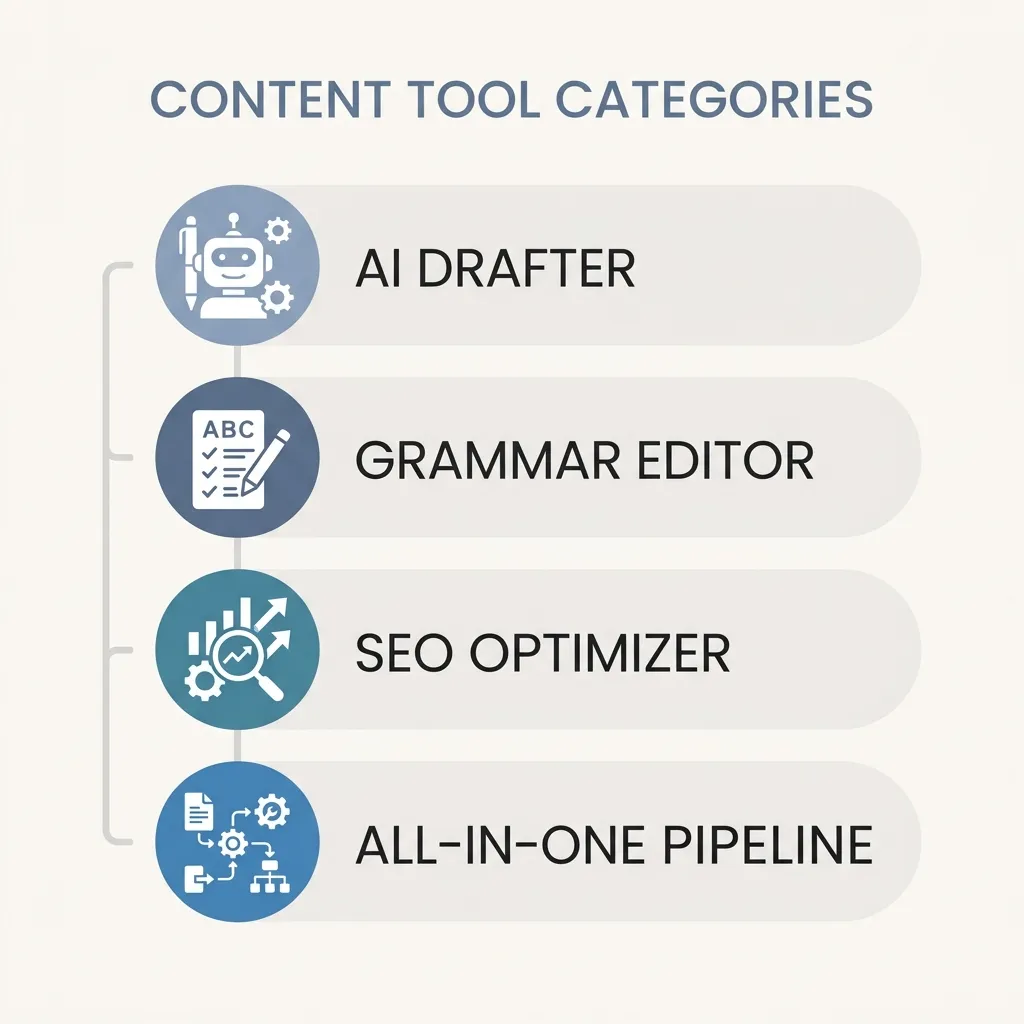
There are four distinct types:
- AI drafting tools — Generate long or short-form content from a prompt. Examples: ChatGPT, Jasper, Writesonic. These are flexible but require you to supply your own structure and strategy.
- Grammar and editing tools — Improve existing text for clarity, correctness, and style. Examples: Grammarly, QuillBot. These don’t generate content; they refine it.
- SEO content optimizers — Align content with search intent, keyword strategy, and on-page signals. Example: Surfer AI. These are purpose-built for search performance.
- All-in-one content platforms — Combine drafting, strategy, and quality assurance in one pipeline. Example: Veldora AI. These trade flexibility for workflow integration.
The critical distinction: general-purpose AI like ChatGPT and Claude gives you a powerful blank canvas. You supply the strategy, the structure, the brief, and the editorial judgment. Purpose-built tools trade some of that flexibility for workflow-specific features — SEO scoring, brand voice templates, or built-in QA steps.
A freelance writer drafting blog posts needs a different tool than an SEO professional optimizing content for search intent. Both might search for “AI writing tools,” but they’re looking for completely different categories.
AI tools assist writers — they don’t replace editorial judgment. Every category reviewed here still requires human review before publishing. If someone tells you otherwise, they’re selling something.
For a closer look at how strategy-driven content generation differs from general AI drafting, the distinction becomes clear when you examine what SEO-specific features actually change in the output.
The 2026 AI Content Writing Tools Comparison: Pricing, Features, and Best-For Ratings
Scan the table first to identify your category and shortlist. Detailed reviews follow below. Pricing verified as of early 2026 — check each tool’s pricing page for current rates.
| Tool | Category | Best For | Free Tier | Starting Price | Standout Feature |
|---|---|---|---|---|---|
| ChatGPT (OpenAI) | AI Drafter (general-purpose) | Freelancers, researchers, casual users | Yes — GPT-3.5 unlimited; GPT-4o limited daily | $20/mo (Plus) | Versatile, context-aware drafting across any format |
| Jasper AI | AI Drafter (marketing-focused) | Marketing teams, brand content at volume | No — 7-day trial only | $39/mo (Creator) | Marketing-specific templates and brand voice settings |
| Copy.ai | AI Drafter (short-form + automation) | Marketers, sales teams, workflow automation | Yes — 2,000 words/mo | $36/mo (Starter) | Workflow automations connecting content tasks |
| Grammarly | Grammar and editing | Anyone editing existing text | Yes — core grammar checks free | $12/mo (Pro) | Real-time grammar, tone, and clarity suggestions |
| QuillBot | Grammar and editing (paraphrasing) | Students, editors, non-native writers | Yes — 125 words/paraphrase, limited modes | $8.33/mo (Premium) | Paraphrasing with adjustable tone modes |
| Surfer AI | SEO content optimizer | SEO professionals, content teams | No — no free tier | $89/mo (Essential) | Real-time NLP scoring against live SERP competitors |
| Writesonic | AI Drafter (all-purpose) | Solopreneurs, content marketers | Yes — limited credits/mo | $16/mo (Individual) | Combines AI drafting with basic Surfer-like SEO mode |
| Veldora AI | All-in-one SEO pipeline | SMBs and agencies needing SEO content at scale | Free demo (one sample post, no credit card) | Credit-based (see site) | Full pipeline: strategy, keyword research, brand-matched writing, multi-step QA |
ChatGPT (OpenAI)
Best for: Freelancers, researchers, and anyone who needs a flexible drafting assistant without a dedicated workflow.
Standout feature: Contextual versatility. ChatGPT handles blog posts, emails, summaries, outlines, rewrites, and more — all from a conversation interface.
Free tier: GPT-3.5 is unlimited on the free plan. GPT-4o (the current flagship model) has daily usage limits on free accounts that most active users hit quickly.
Pricing: $20/month for ChatGPT Plus, which includes GPT-4o priority access and file uploads. The free tier is genuinely functional for light use.
Honest pro: The most flexible general-purpose AI writing assistant available at any price. If you know how to prompt well, the output quality ceiling is high.
Honest con: ChatGPT has no built-in SEO features, no brand voice memory across sessions (without custom instructions or paid tiers), and no editorial QA. You are the strategy layer. If you don’t know what good SEO content looks like, ChatGPT won’t tell you.
Jasper AI
Best for: Marketing teams that produce content at volume and need brand consistency across multiple writers.
Standout feature: Marketing-specific templates (product descriptions, ad copy, email campaigns) and a brand voice feature that applies tone settings across outputs.
Free tier: None. Jasper offers a 7-day free trial, after which payment is required. This is a trial funnel, not a free tier.
Pricing: Starts at $39/month (Creator, single seat). Team plans start at $99/month for three seats. See Jasper’s pricing page for current details — pricing has shifted multiple times.
Honest pro: The template library and brand voice configuration are genuinely useful for marketing teams producing high volumes of short and mid-length content.
Honest con: Jasper is built for marketing teams that need volume. If you’re a solo freelancer writing two posts a month, you’ll pay for capacity you’ll never use. Output quality on long-form SEO content without a strong brief is average at best.
Copy.ai
Best for: Marketers and sales teams that need short-form copy (emails, social posts, ad variations) and want to connect content tasks through workflow automations.
Standout feature: Workflow automations that chain content tasks together — useful for teams running content at scale across multiple formats.
Free tier: 2,000 words per month on the free plan. Workflow automations are limited or unavailable on the free tier.
Pricing: Starts at $36/month (Starter). The free tier is functional for occasional short-form copy but hits limits fast for any regular use.
Honest pro: The automation layer is genuinely differentiated — Copy.ai is less a writing tool and more a content operations platform for teams already running structured workflows.
Honest con: Long-form blog content is not Copy.ai’s strength. Output quality for 1,000+ word posts is inconsistent, and the SEO features are minimal compared to purpose-built optimizers.
Grammarly
Best for: Anyone editing existing text for grammar, clarity, tone, and style — regardless of whether that text was AI-generated or human-written.
Standout feature: Real-time suggestions for grammar, tone, and clarity delivered inline in your browser, Google Docs, or Word document.
Free tier: Core grammar and spelling checks are free. Tone detection, advanced suggestions, and plagiarism checking require the Pro plan.
Pricing: $12/month (Pro, billed annually). Business plans for teams start higher.
Honest pro: The free tier is genuinely useful for basic proofreading. The Pro tier’s tone detection adds value when you’re editing for a specific audience.
Honest con: Grammarly does not generate content. It is a post-drafting editing layer, not a writing tool. Users who expect it to replace a writer or drafter will be disappointed.
QuillBot
Best for: Writers who need to paraphrase, simplify, or restructure existing text — including students, non-native English writers, and editors cleaning up AI-generated drafts.
Standout feature: Paraphrasing modes (Standard, Fluency, Formal, Academic, Creative, and more) that let users adjust the degree and style of rewriting.
Free tier: Free paraphrasing is limited to 125 words per input. Most paraphrasing modes are locked behind the Premium plan.
Pricing: $8.33/month (Premium, billed annually) — among the most affordable paid tiers reviewed here.
Honest pro: Genuinely useful for restructuring AI output that sounds robotic. The paraphrasing modes are practical and fast.
Honest con: QuillBot does not generate original content from scratch, has no SEO features, and the 125-word free limit is genuinely restrictive for any serious use.
Surfer AI
Best for: SEO professionals and content teams who need on-page optimization scored against live SERP competitors.
Standout feature: Real-time NLP-based content scoring that compares your draft against the top-ranking pages for your target keyword — and tells you exactly what to add, remove, or adjust.
Free tier: None. Surfer has no free tier.
Pricing: Starts at $89/month (Essential). This is a significant investment and is priced for professionals who are accountable for search performance.
Honest pro: If SEO ranking is your primary metric, Surfer’s scoring system is the most data-driven on-page guidance available in this category.
Honest con: The price point prices out solo freelancers and low-volume users immediately. The AI drafting component (Surfer AI) produces workable but not remarkable output — the value is in the scoring, not the writing.
Writesonic
Best for: Solopreneurs and content marketers who want an affordable AI drafter with basic SEO features built in.
Standout feature: Combines AI drafting with a Surfer-lite SEO optimization mode at a lower price point than Surfer.
Free tier: Limited credits per month on the free plan — enough to test the tool but not enough for regular content production.
Pricing: Starts at $16/month (Individual). Word output is credit-based and scales with plan.
Honest pro: The price-to-features ratio is strong for solo users who want both drafting and basic SEO scoring without paying for two separate tools.
Honest con: Neither the drafting nor the SEO scoring matches the depth of dedicated tools in either category. Writesonic is a reasonable middle-ground compromise, not a best-in-class option for either job.
Veldora AI — Publisher Disclosure
Veldora AI is our product. We’ve applied the same evaluation rubric here as to every other tool. Read it with that context.
Best for: Small-to-mid-sized businesses and marketing agencies that need SEO blog content at scale without building or managing an internal content department.
Standout feature: An end-to-end automated SEO content pipeline — from live keyword research and competitor analysis through brand-matched writing and multi-step QA. Built from 12 years of SEO agency experience, not a lab experiment.
Free tier: A free demo that produces one real, strategy-backed content sample for you to read and evaluate before spending anything. No credit card required. This is not an unlimited free drafting tool — it’s proof-before-payment.
Pricing: Credit-based model with no contracts and no agency markup. See the Veldora pricing and demo page for current credit pricing.
Honest pro: The pipeline approach — strategy, keyword research, competitor analysis, brand-matched writing, and QA in one automated system — reduces the brief-to-publishable-draft lift for teams that don’t have a dedicated content strategist. The brand voice matching capability means outputs reflect your tone settings rather than generic AI phrasing. The demo produces real output you can judge before committing.
Honest con: Veldora is scoped exclusively to SEO blog content. It is not a grammar tool, a short-form copy tool, a social media assistant, or a general-purpose AI. Individual freelancers writing occasional posts will find it over-engineered for their volume. It does not have a confirmed integration with Google Docs, CMS platforms, or browser extensions.
Generate a real, strategy-backed post on the free demo and read it yourself — before you spend a dollar. No credit card. No contracts. Just proof.
Output Quality Illustration: Same Prompt, Three Tools
Prompt used: “Write an intro paragraph for a blog post about email marketing for small businesses.”
ChatGPT (GPT-4o):
Email marketing remains one of the most cost-effective channels for small businesses. It consistently outperforms social media and paid ads for customer retention — but getting started, or improving results, requires more than sending a monthly newsletter.
Observation: Clear, competent, generic. No brand voice. Serviceable as a starting draft.
Jasper AI (Creator plan):
Small business owners know the feeling: you spend hours crafting a social post that gets twelve likes, while a simple email to your list drives actual sales. Email marketing works — when it’s done right. Here’s how to make sure yours does.
Observation: More conversational and marketing-oriented. Shorter sentences, direct address. Better fit for a brand-voice-driven marketing blog, but lighter on substance. Requires a follow-up prompt to add depth.
Writesonic:
Email marketing has a problem: most small businesses treat it like a chore instead of a channel. The result is forgettable newsletters and disengaged subscribers. With the right approach, email is your highest-ROI marketing investment — and this guide shows you how to get there.
Observation: Punchy opening, problem-first structure. Closer to a content marketer’s instinct. Less generic than ChatGPT’s output, though still requires human editing to add specifics.
No single output here is objectively best. They reflect different tool orientations — ChatGPT defaults to informational, Jasper defaults to conversational marketing copy, Writesonic defaults to problem-framing. Matching the tool’s orientation to your content type is the point.
Which Tool Is Right for You? Recommendations by Role and Use Case
Scan the matrix first. Find your row. Read the prose below for the reasoning.
| I am a… | My primary need is… | Start with… |
|---|---|---|
| Freelance writer | Drafting quality blog posts, low overhead, budget-conscious | ChatGPT (Plus for volume) or Writesonic |
| Content marketer | Brand-consistent copy at volume, short-form and long-form mix | Jasper (teams) or Copy.ai (automation-heavy workflows) |
| SEO professional | Search-intent alignment, keyword optimization, SERP-competitive content | Surfer AI or Writesonic (if budget is a constraint) |
| Agency or enterprise team | SEO content at scale, brand voice consistency, no internal content team needed | Veldora AI (SEO blog pipeline) + Grammarly for editing layer |
| Beginner or casual user | Lowest friction entry point, genuinely useful without paying | ChatGPT free tier or Writesonic free credits |
Freelance Writers
For solo writers doing low-to-moderate volume, ChatGPT Plus ($20/month) delivers the best quality-to-cost ratio. The free tier is enough to test and build prompting skills. If you want built-in SEO scoring without paying Surfer’s rates, Writesonic at $16/month is a workable compromise. Jasper is overkill — the pricing assumes team capacity, not solo use.
Content Marketers and SEO Teams
Search-intent alignment is the deciding criterion here. Surfer AI is the strongest option if search performance is your primary metric — the real-time NLP scoring against live SERPs is not replicated at this depth by any other tool reviewed. For teams who also need volume and brand consistency, pairing a drafting tool (Jasper or ChatGPT) with Surfer’s optimization layer is a common and practical workflow. For AI writing that incorporates SEO strategy into the drafting stage rather than as a post-draft step, an all-in-one pipeline approach changes the workflow fundamentally.
Agencies and Enterprise Teams
Brand voice consistency at scale and content volume without internal headcount are the defining needs here. Veldora AI is built specifically for this segment — businesses and agencies producing SEO blog content at scale without a dedicated content department. The pipeline handles strategy through QA in one automated system. This is where how AI-assisted content builds compounding SEO value over time becomes operationally relevant — consistent, strategy-aligned publishing at scale is what compounds. Honest scope: Veldora is SEO blog content only. It is not a general content platform.
Beginners and Casual Users
ChatGPT’s free tier is the lowest-friction starting point in this entire category. GPT-3.5 is free and unlimited. GPT-4o has daily limits on the free plan but is available. Start here, develop prompting instincts, and upgrade or specialize once you understand what you actually need. Grammarly’s free tier is a worthwhile companion for anyone editing their own drafts.
AI Content Quality, Detection Risk, and the Editing Reality
AI writing tools don’t eliminate editing. They shift it. The question worth asking isn’t “will this be perfect?” It’s “does this get me to a publishable draft faster than starting from a blank page?”
For most use cases, the answer is yes — if you pick the right tool and know what to fix.
What Actually Affects Output Quality
Prompt specificity is the biggest variable. A vague prompt — “write a blog post about content marketing” — produces generic output regardless of which tool you use. A specific prompt with a defined audience, a stated angle, target keywords, and a required structure produces dramatically better output. The tool matters less than most comparisons suggest; the brief matters more.
Category fit is the second variable. Using a general-purpose drafter for SEO-critical content without adding an optimization step is like using a text editor to manage a database. It technically works, but it’s the wrong tool for the job.
AI Detection: What the Research Actually Shows
AI detection tools produce meaningful false positive and false negative rates. Research on AI-generated text detection methods confirms that detection accuracy varies considerably depending on the model, the writing style, and the editing level applied post-generation. Heavily edited AI output is consistently harder to detect than raw generation. The more useful question is not “will this pass a detector?” but “is this content accurate, specific, and genuinely useful to the reader?”
No tool reviewed here guarantees detection-proof output, and any tool that claims otherwise is making an unsupportable promise.
Before You Publish AI-Generated Content, Run Through This:
- Check for factual accuracy — AI confidently produces plausible-sounding errors, especially with statistics, names, and dates
- Replace generic phrasing with specific examples, data points, or brand-relevant language
- Verify every statistic, citation, or named claim in the output — hallucination is real across all tools
- Adjust tone to match your brand voice if the tool doesn’t handle it automatically
- Read the draft aloud to catch robotic sentence rhythm and repetition
- Run through your preferred detection tool if publishing for a client who requires it — understand its limitations
- Confirm the content addresses the actual search intent, not just the keyword — AI drafts frequently answer a slightly different question than the one searchers are asking
Veldora’s pipeline includes a multi-step QA pass as a built-in stage. This reduces (not eliminates) the editing burden — it’s a pipeline step, not a guarantee of zero-edit output.
Free vs. Paid: What AI Content Writing Tools Actually Give You at No Cost
“Free” in AI writing tools usually means one of two things: a genuinely usable starting tier or a feature-locked trial designed to push you toward payment fast. Knowing which is which saves you the frustration of building a workflow around a tool you’ll hit a wall with in week two.
| Tool | Free Tier Limits | First Paid Tier | What Unlocks |
|---|---|---|---|
| ChatGPT | GPT-3.5 unlimited; GPT-4o daily cap (resets every 24 hrs) | $20/mo (Plus) | GPT-4o priority, file uploads, plugins, longer context |
| Jasper AI | None — 7-day trial only | $39/mo (Creator) | Full template library, brand voice, one seat |
| Copy.ai | 2,000 words/month; limited workflow runs | $36/mo (Starter) | Unlimited words, workflow automations, priority support |
| Grammarly | Core grammar and spelling; no tone detection | $12/mo (Pro) | Tone detection, advanced suggestions, plagiarism check |
| QuillBot | 125 words/paraphrase; two paraphrasing modes | $8.33/mo (Premium) | Unlimited length, all paraphrasing modes, summarizer |
| Surfer AI | None | $89/mo (Essential) | Content editor, NLP scoring, keyword research |
| Writesonic | ~25 credits/month (varies by plan type) | $16/mo (Individual) | Expanded credits, Chatsonic, SEO mode |
| Veldora AI | Free demo — one strategy-backed sample post, no credit card | Credit-based (see site) | Full pipeline: strategy, research, brand voice, QA |
The Honest Verdict
Genuinely useful free tiers: ChatGPT (free tier is real and functional for light use), Grammarly (free grammar layer is legitimately valuable), QuillBot (useful for short edits despite the word cap).
Trial funnels, not free tiers: Jasper (7-day trial; you will hit a paywall quickly), Copy.ai (2,000 words goes fast for any active user), Writesonic (credit caps are restrictive for regular content production).
No free tier: Surfer AI — this is priced as a professional tool and does not pretend otherwise.
Proof-before-payment, not a free tier: Veldora’s free demo produces one real, strategy-backed content post you can read and evaluate. It is not a free writing tool with ongoing access — it is a no-commitment sample so you can judge output quality before spending anything. No credit card. No contracts.
User reviews and category-level ratings on G2’s AI writing assistant category provide a useful third-party check on which tools hold up over time in real workflows — particularly for enterprise and team-level tools where setup friction and customer support matter.
Frequently Asked Questions About AI Content Writing Tools
What is the best free content writing tool for beginners?
ChatGPT’s free tier is the most accessible starting point — GPT-3.5 is unlimited, and GPT-4o is available with daily limits. It handles a wide range of writing tasks without requiring a template library or onboarding. The tradeoff is that you supply the strategy, structure, and editorial judgment. Grammarly’s free tier is a useful companion once you have a draft.
Is ChatGPT better than dedicated content writing tools?
It depends entirely on the use case. ChatGPT is the most flexible general-purpose AI drafter available, but it has no SEO features, no brand voice memory by default, and no QA pipeline. Dedicated tools like Surfer AI (for SEO optimization) or Veldora (for end-to-end SEO content pipelines) are purpose-built for specific workflows ChatGPT cannot replicate without significant manual overhead. For casual or exploratory writing, ChatGPT is hard to beat. For production-level SEO content, purpose-built tools do more of the work.
Which content writing tool is best for SEO?
Surfer AI is the most data-driven SEO content optimizer reviewed here — its real-time NLP scoring against live SERP competitors is the category standard. For teams that want SEO strategy, research, and writing integrated in one automated pipeline rather than as separate steps, Veldora AI is purpose-built for that workflow. Writesonic sits between the two at a lower price point but with less depth in either category.
Can AI writing tools match my brand voice and tone?
Some can, with setup. Jasper includes brand voice configuration for marketing copy. Veldora’s pipeline includes built-in brand voice matching designed for businesses that need consistent tone across multiple posts or writers. ChatGPT can approximate a brand voice if you provide detailed instructions or examples in the prompt, but it does not persist this across sessions on the free tier. Tools that don’t offer brand voice settings will produce generic-sounding output that requires manual tone adjustment on every draft.
Do AI content tools produce content that passes AI detection?
Not reliably, and any tool claiming otherwise is overpromising. AI detection tools have meaningful false positive and false negative rates — detection accuracy varies with the model used, editing level, and content style. Heavily edited and humanized AI output is harder to detect than raw generation. The more useful editorial standard is whether the content is accurate, specific, and genuinely valuable to the reader. No tool reviewed here offers a detection guarantee.
How much do content writing tools cost?
The range is wide. Free tiers exist at ChatGPT, Grammarly, QuillBot, Copy.ai, and Writesonic — with varying real-world usefulness. First paid tiers run from $8.33/month (QuillBot Premium) to $89/month (Surfer Essential). Jasper’s team plans start at $99/month. Veldora operates on a credit-based model with no contracts. Most tools bill annually for the lowest per-month rate. Pricing across this category shifts frequently — always verify on the tool’s current pricing page before budgeting.
The Right Tool Is the One You’ll Actually Use Correctly
Every tool reviewed here does something specific well and something else poorly. The category error most buyers make is evaluating tools by feature count rather than by fit — choosing the most popular option or the most-reviewed list rather than the one that matches their actual workflow.
If you produce SEO blog content for a business or agency and need a pipeline that handles strategy through publishing-ready output, see what Veldora actually produces before making a decision.
Generate a real, strategy-backed post on the free demo and read it yourself — before you spend a dollar. No credit card. No contracts. Just proof.
← Back to all posts