What Is an AI-Powered Content Platform? How to Evaluate and Choose the Right One
By Veldora AI · June 24, 2026 · Updated June 24, 2026

What Is an AI-Powered Content Platform — And How to Choose the Right One
Most buyers searching for “AI content platforms” end up with a list of AI writing tools. They pick one, generate some blog posts, get generic output, and conclude that AI content doesn’t work. The problem isn’t AI. The problem is a category mistake.
An AI-powered content platform is not a faster text generator. It is infrastructure — a connected system that covers the full content lifecycle from strategy and keyword research through writing, quality review, and performance reporting. A writing tool is a utility. A platform is an operation.
This article does two things: it defines the platform category with concrete, testable criteria, and it delivers a structured evaluation framework you can apply to any vendor you consider — including Veldora, including everyone else.
Key Takeaways
- An AI-powered content platform covers the full content lifecycle — strategy, creation, governance, publishing, and analytics — not just text generation.
- The platform-vs-tool distinction is architectural, not semantic. It changes what you evaluate and what you buy.
- A structured criteria framework — covering workflow fit, brand governance, output quality controls, and analytics depth — is more predictive of platform value than price or feature count.
- A platform is not always the right answer. The article provides a decision threshold to help you self-qualify.
- Risks like hallucination, brand drift, and vendor lock-in are real and belong in any vendor evaluation.
Platform vs. Tool: The Category Distinction That Changes Your Decision
Here is the distinction that most vendor comparisons skip: a tool solves a single-stage problem. A platform manages a multi-stage operation.
Using ChatGPT to write a blog post is using a tool. Running a content operation where keyword research, brief generation, writing, QA, and performance reporting happen in a connected workflow — that is a platform. A hammer is a tool. A construction management system is a platform. Both involve building things. Only one manages the process.
An AI-powered content platform has five defining characteristics that a writing tool does not:
- Multi-stage lifecycle coverage — strategy through analytics, not just text output.
- Workflow orchestration — the stages connect; output from one feeds input to the next.
- Brand governance — voice, tone, and style enforcement is built into the pipeline, not dependent on how well you prompt.
- Editorial quality controls — a QA or review layer exists before content exits the system.
- Performance reporting — the platform closes the loop between what you published and what it achieved.
If a product handles only one or two of these, it is a tool with a better interface. That is fine — tools have their place — but you should not pay platform pricing for tool-level functionality, and you should not expect platform-level outcomes from a tool-level purchase.
The table below makes this concrete:
| Capability | AI Content Platform | AI Writing Tool | General AI Assistant |
|---|---|---|---|
| Function scope | Full content lifecycle | Single-stage text generation | Open-ended task assistance |
| Strategy layer | Keyword research + content brief built in | None | None |
| Brand governance | Voice enforcement built into pipeline | Manual prompt-based | Manual prompt-based |
| Workflow support | Multi-step QA, approval layers | None | None |
| Publishing | CMS integration, scheduling | Export only | Export only |
| Analytics | Performance reporting + re-strategy | None | None |
| Team features | Collaboration, role-based workflows | Solo-use or basic sharing | Solo-use |
| Best for | Content teams, agencies, SMBs with recurring needs | Solo creators, one-off tasks | Ad hoc generation, brainstorming |
If you want to see what a full-lifecycle content platform looks like in practice, explore what platform-level feature coverage actually requires — it is a useful reference point regardless of which platform you are evaluating.
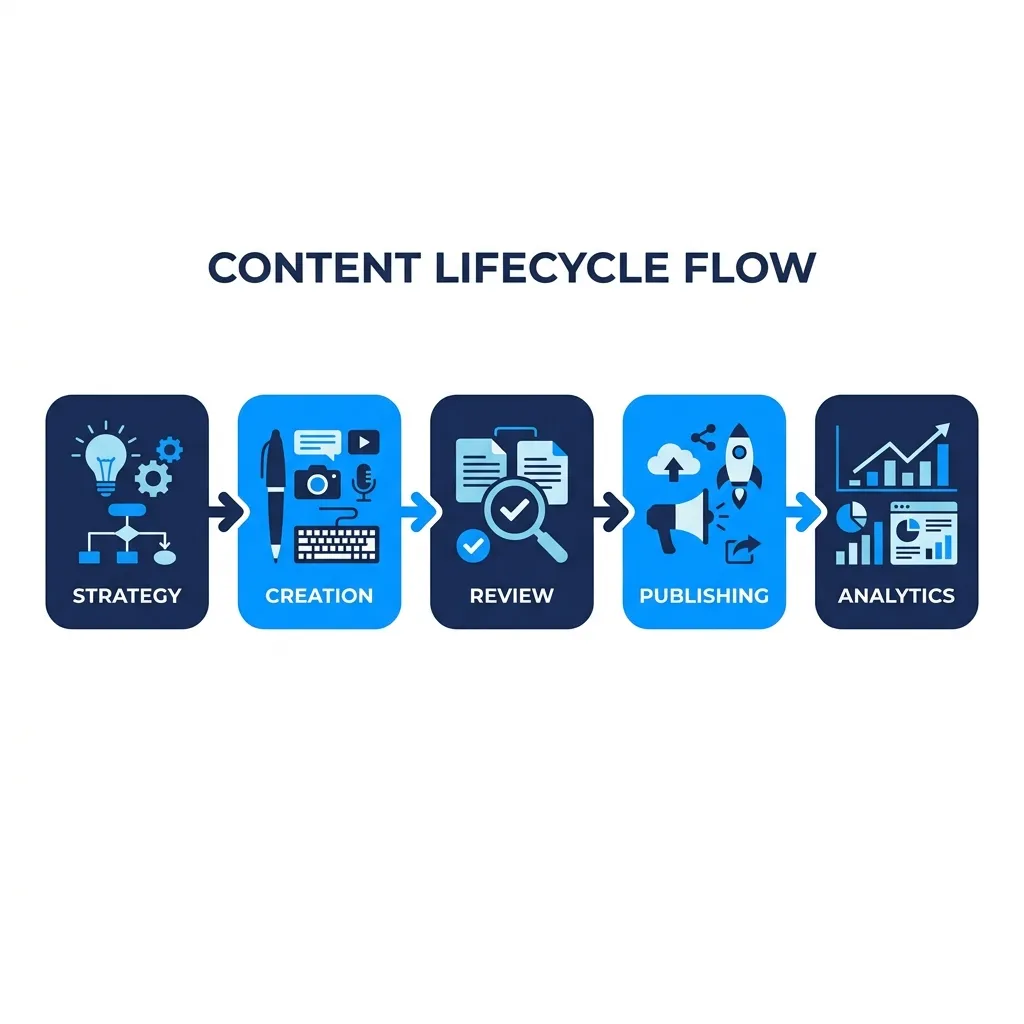
What an AI-Powered Content Platform Should Actually Do
Before you evaluate any platform, you need a map of what it should cover. Five stages make up a complete content lifecycle. A platform that handles fewer than five is handing you coordination work it should be absorbing.
- Strategy and planning — Live keyword research, competitive analysis, and content briefs generated before writing begins. The platform tells you what to write and why. A blank prompt box is not strategy.
- Content creation — Multi-format generation with brand voice enforcement built into the pipeline — not applied after the fact via manual prompting. Output should be brand-matched by default, not by luck.
- Workflow and governance — Editorial review layers and multi-step QA that catch hallucinations and brand drift before content publishes. This stage is where most tools fail and most platforms differentiate.
- Publishing and distribution — CMS integration, scheduling, and output formatting that reduces coordination overhead rather than adding a manual export step. Ask specifically which CMS connections exist and how they work.
- Analytics and optimization — Performance reporting tied to published content and a re-strategy loop that closes the gap between what you publish and what actually performs. Volume metrics are not analytics.
A platform like Veldora runs this full pipeline automatically — live keyword research, brand-matched writing, multi-step QA, and weekly performance reporting — with the strategy visible before any content is produced. That is the architecture to compare against, not just the feature checklist.
According to Content Marketing Institute’s B2B research, the shift toward AI adoption in content operations reflects infrastructure investment decisions, not just tool experimentation — which means the evaluation stakes are higher than a single software subscription.
How to Evaluate AI Content Platforms: A Decision Framework
Most buyers evaluate platforms on price and feature count. Neither predicts value. The criteria that actually matter are workflow fit, governance depth, and output quality controls. A platform with no QA layer and no strategy input will cost more in rework and brand damage than a higher-priced integrated pipeline — even if it is cheaper on paper.
Here is a structured evaluation framework. Apply it to any platform you consider.
| Evaluation Criterion | What to Look For | Red Flags |
|---|---|---|
| Workflow integration | Connects to your existing CMS, CRM, or approval process | No integration layer; export-only output |
| Brand governance | Voice and tone enforcement built into the pipeline | Style guide is a manual upload with no QA enforcement |
| Output quality controls | Multi-step review, fact-check layer, human editorial checkpoint | Single-pass generation with no QA stage |
| Strategy layer | Keyword research and content briefs generated per piece | Content generation without strategic input |
| Analytics and reporting | Performance reporting tied to published content; re-strategy loop | Vanity metrics only; no connection to ranking or traffic outcomes |
| Scalability | Volume, seat, and workflow limits clearly defined per tier | Opaque limits; seat-based pricing that punishes growth |
| Onboarding and time-to-value | Clear implementation timeline; support tier for your plan | No onboarding documentation; enterprise support locked behind highest tier |
| Total cost of ownership | License cost + coordination overhead + tool replacement savings | License cost presented in isolation without tier limitations disclosed |
A note on integrations: ask specifically about CMS compatibility, CRM connectivity, and DAM support. Not every platform covers all three, and some platforms require manual exports where integration is claimed. What matters is not whether a vendor lists “integrations” on their features page — it is whether those integrations fit your actual stack.
A note on brand governance: prompt-based style guidance degrades at scale. If a platform’s answer to brand voice is “make sure your prompts describe your tone,” that is not governance — that is manual effort rebranded as a feature. Built-in enforcement means the pipeline applies it automatically, every time, without requiring a human to configure each request.
When an Integrated Platform Is Worth It — And When It Isn’t
An integrated platform is not the right answer for everyone. An article that claims otherwise is selling, not advising.
The threshold is real and testable. If you are producing four or more pieces of SEO content per month across more than one stakeholder, the coordination overhead of a disconnected tool stack typically exceeds the cost difference of an integrated platform. The economics shift when you factor in not just license costs but the time spent context-switching between tools, reconciling inconsistent outputs, and manually applying brand corrections.
On the other side of the threshold: if you are a solo operator publishing one blog post a month with a consistent voice and no team review, a well-prompted ChatGPT workflow is probably enough. Do not buy infrastructure you do not need.
The total cost of ownership framing matters here. Three to four individual AI tools — a keyword tool, a writing tool, a grammar checker, a basic analytics tool — often add up to more than a platform license when you count the monthly subscriptions. Add the hours spent moving content between them and the cost gap narrows further.
Do You Need an AI Content Platform? Answer These Questions First
- Are you producing content across more than one channel or format consistently?
- Do multiple people touch the same piece of content before it publishes?
- Does your brand have documented voice, tone, or compliance requirements that AI output must meet?
- Are you spending more time coordinating content production than producing it?
- Do you lack visibility into which content is performing and why?
- Are you paying for two or more AI tools that don’t connect to each other?
- Have you published AI-generated content that went off-brand or contained factual errors?
- Do you need content tied to a live keyword and competitive strategy, not just generated on demand?
If you answered yes to four or more of these, you have a platform problem. A writing tool will not solve it.
Risks, Limitations, and Questions to Ask Any Vendor
A platform that does not acknowledge its own failure modes has not built guardrails against them. Transparency about risk is a platform maturity signal. Here are the risks that belong in every vendor evaluation.
Hallucination and factual accuracy. Large language models generate plausible-sounding content that can be factually wrong. A QA layer reduces this risk — it does not eliminate it. Ask any vendor specifically how their pipeline catches factual errors before content publishes. “We use GPT-4” is not an answer. A described review stage is.
Brand drift. Without governance controls enforced at the pipeline level, AI output erodes brand voice over time. Prompt-based style guidance degrades with scale. If a vendor’s brand governance story is “you can include a style guide in your prompt,” test what happens on the hundredth piece of content compared to the first.
AI detection and content authenticity. Google’s official guidance is that content quality and usefulness matter more than authorship method. Thin, undifferentiated AI output at scale can trigger quality signals regardless of authorship — the mitigation is editorial oversight and genuine information gain, not AI detection avoidance. A platform that helps you produce strategically grounded, well-reviewed content is a better answer to this risk than one that claims its output is “undetectable.”
Vendor lock-in and dependency risk. What happens to your content pipeline if the platform changes pricing, deprecates a feature, or goes offline? Ask about data portability, contract structure, and what you own if you leave. Credit-based, no-contract pricing — like Veldora’s model — reduces this risk relative to annual commitments with opaque exit terms.
Over-reliance and quality degradation. Platforms reduce the operational burden of content production. They do not replace editorial judgment. Teams that remove human oversight entirely typically see quality decline over time. The right model is human-in-the-loop at the review stage, not human-out-of-the-loop entirely.
Frequently Asked Questions
What is the difference between an AI content platform and an AI writing tool?
An AI writing tool generates text in response to a prompt. It handles one stage — creation — and stops there. An AI content platform covers the full content lifecycle: strategy and keyword research, content creation with brand voice enforcement, multi-step QA, publishing support, and performance reporting. The difference is architectural. A tool produces output; a platform manages an operation.
Can AI-generated content rank in Google?
Yes, with meaningful qualifications. Google’s guidance evaluates content on quality, usefulness, and information gain — not on whether a human or an AI produced it. Generic, thin AI output at volume does not rank well, not because it is AI-generated but because it lacks the depth and differentiation that earns rankings. Strategy-backed, editorially reviewed content — tied to live keyword research and a genuine point of view — performs. How a consistent content pipeline compounds SEO results depends less on the authorship method and more on whether the strategy layer and quality controls are built in.
How do AI content platforms handle brand voice?
The honest answer is: it depends on the platform. Some platforms ask you to describe your brand voice in a prompt and apply it manually per request. That approach degrades at scale. A platform with genuine brand governance enforces voice, tone, and style guide requirements at the pipeline level — automatically, on every piece, without requiring manual configuration. Ask vendors to show you how brand enforcement works on the hundredth piece of content, not just the demo piece.
What integrations should an AI content platform have?
At minimum, evaluate CMS compatibility (can it publish directly to your site or does it require a manual export step?), and ask specifically about which systems it connects to. Beyond CMS, relevant integrations for most content teams include CRM connectivity for audience segmentation and approval workflow routing. Not every platform covers all of these — the key is knowing which gaps you will have to bridge manually and whether that coordination cost is acceptable. Use the criteria grid in this article to score each integration gap against your actual workflow.
How much do AI content platforms cost for teams?
Pricing models vary widely: per-seat subscriptions, word-volume tiers, credit-based models, and annual contracts all exist in the market. The number on the pricing page is not the total cost of ownership. Factor in tool replacement savings (how many individual tools does this replace?), onboarding complexity and time-to-value, and what you lose access to if you downgrade or cancel. Credit-based, no-contract models like Veldora’s give teams flexibility without long-term commitment risk. Whatever the model, ask what is excluded at each tier before you sign.
How do you measure ROI from an AI content platform?
Start with what the platform replaces: if it consolidates a keyword tool, a writing tool, and a QA workflow, the direct cost comparison is straightforward. Beyond cost, measure content velocity (pieces produced per month before and after), content quality consistency (reduction in revision cycles and brand corrections), and SEO performance over time — rankings, organic traffic, and lead attribution for published content. A platform that only reports on word volume produced is not giving you ROI data; it is giving you activity data. Require performance reporting tied to published content outcomes, not just output volume.
See the Strategy Before You Spend a Dollar
You now have a framework: a category definition, a lifecycle map, a criteria grid, a self-qualification checklist, and a list of vendor questions most sales pages will not answer voluntarily.
The logical next step is to put a platform through those criteria yourself — not based on a demo video or a feature page, but on actual output you can read and evaluate.
Veldora is built on 12 years of SEO agency experience — a direct response to how the traditional agency model fails, not a technology-first claim. The platform runs the full SEO content pipeline: live keyword research, brand-matched writing, multi-step QA, and weekly reporting. No contracts, no markup, no overhead.
Generate a real, strategy-backed post on the free demo and read it yourself — before you spend a dollar. No credit card. No contracts. Just proof.
← Back to all posts