Best AI Content Writing Tools (2025): Tested by Use Case
By Veldora AI · July 5, 2026

Best AI Content Writing Tools in 2025: Tested, Compared, and Matched to Your Use Case
You have probably already read three of these articles. Each one listed 20-plus tools, gave every single one the same enthusiastic two-paragraph treatment, and left you no closer to knowing what to actually install.
That is the problem this article is designed to fix.
The best AI content writing tool does not exist in the abstract. It depends on what you are writing, whether SEO matters to your workflow, and whether you are a solo creator publishing twice a month or a team pushing 20 posts a week. A tool that handles marketing copy brilliantly may produce hollow, unoptimized blog content. A tool that excels at SEO long-form may be comically overkill for social captions.
Here is what this article does differently: we applied the same standardized brief across every reviewed tool, scored outputs on five consistent criteria, and organized recommendations by the use case they actually fit. There is a named winner for long-form SEO blog content. Every other user type gets a specific recommendation with honest tradeoffs — not a list of 25 options with no guidance on which to choose.
Key Takeaways
- Best for long-form SEO blog content: Veldora — not because it is an AI writing tool, but because it is a complete strategy-to-publication pipeline, which is a different category entirely.
- The right tool depends on three variables: content type (long-form blog, marketing copy, short-form), SEO requirement, and whether you are solo or part of a team.
- No tool eliminates the human review step. Every AI-generated piece needs editing before publication — the question is how much.
- Several free tiers are genuinely useful, but the features that matter for SEO content workflows — built-in research, brand voice, QA — live behind paid plans.
Why Most AI Writing Tool Roundups Fail You (And What This One Does Differently)
Most roundups are structured to maximize affiliate clicks, not reader clarity. The formula is predictable: pick 25 tools, write 150 words on each, insert a pros/cons list, add an affiliate link. No one who wrote the article has used most of those tools for real work. The result is a page that looks comprehensive and tells you nothing useful.
There is also a deeper problem: many tools sold as distinct AI writing platforms are thin wrappers over GPT-4 or Claude. They offer a template layer and a branded interface over the same underlying model you could access directly through ChatGPT or Claude.ai. That is not always a dealbreaker — a well-designed workflow layer adds real value — but readers deserve to know which tools are genuinely differentiated and which ones are charging a premium for a UI.
How this article was built: A standardized content brief — a 600-word SEO blog post targeting a specific informational keyword — was submitted to each reviewed tool. Outputs were scored on five criteria:
| Evaluation Criterion | What It Measures |
|---|---|
| Output Quality | Clarity, structure, specificity, and whether the draft needs light editing or a full rewrite |
| SEO Feature Set | Built-in keyword research, optimization scoring, or reliance on a separate tool |
| Tone Control | How well the tool matches a defined voice vs. defaulting to generic AI register |
| Pricing Value | What each tier actually delivers relative to its cost |
| Ease of Use | Prompt skill required to get usable output; learning curve for new users |
This framework is the basis for every recommendation in the article. When a tool earns a category win, it is because it scored highest on the criteria that matter most for that use case — not because it has the largest marketing budget.
For context on why SEO content quality matters beyond the immediate post, how strategic AI content builds lasting rankings is worth reading separately — this article will not re-explain that concept here.
How to Pick the Right AI Content Writing Tool: Evaluation Criteria That Actually Matter
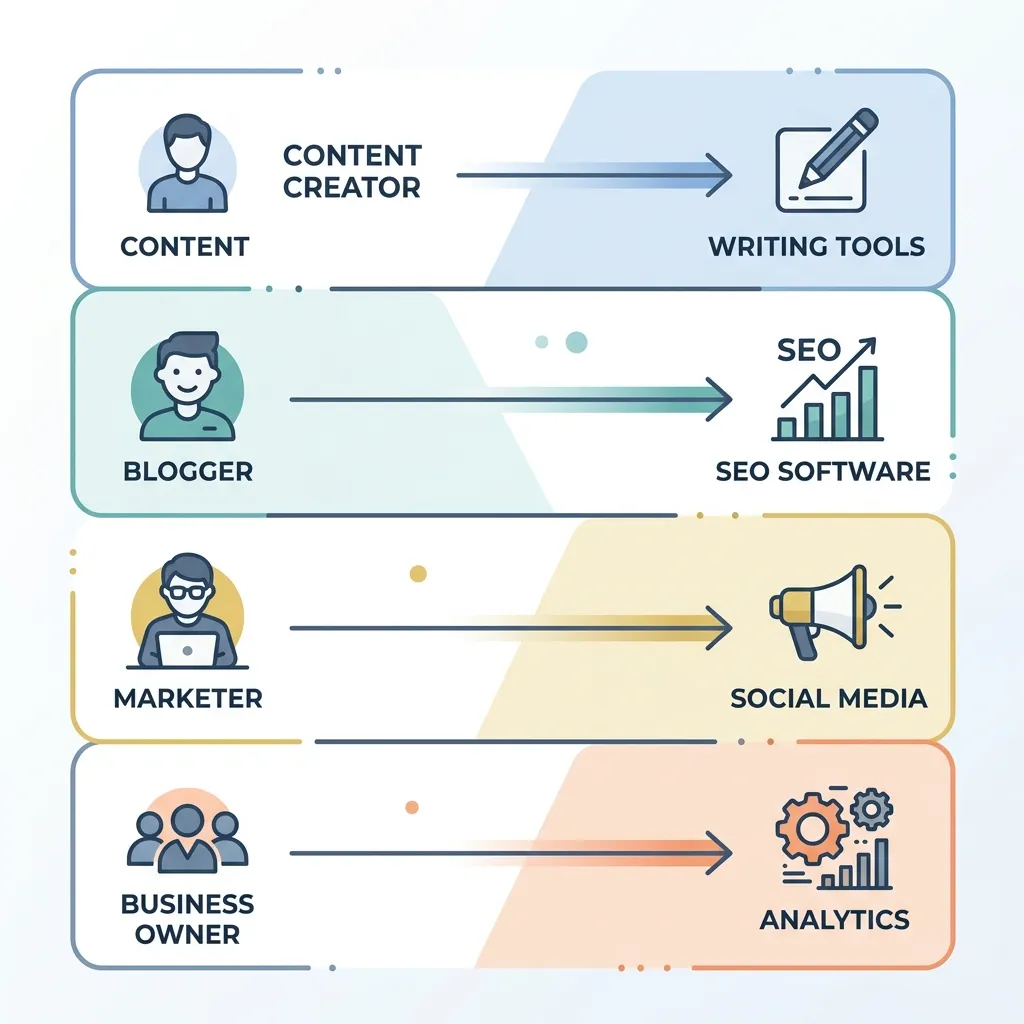
Before any tool recommendation makes sense, you need to know which category you are shopping in. There are four distinct types:
- SEO-focused platforms — Tools built to produce optimized long-form content, often with keyword research, SERP analysis, or optimization scoring built in (Surfer AI, Veldora).
- General-purpose copywriting tools — Designed for marketing copy, product descriptions, ads, and emails. Strong on brand voice and tone, weak on SEO depth (Jasper, Copy.ai, Writesonic).
- Short-form social and ad tools — Optimized for speed and variation across short-format content. Not suitable for long-form SEO work (Rytr, Copy.ai short-form templates).
- Foundation models used with prompts — ChatGPT, Claude, and similar models accessed directly. Zero marginal cost, high prompt-skill requirement, no built-in SEO workflow.
The API wrapper problem: To identify whether a tool adds genuine value, ask two questions. First, does it have built-in research capabilities (keyword data, SERP analysis, competitor review), or does it only generate text after you provide the inputs yourself? Second, does it apply a quality or optimization layer to the output, or does it pass the model’s first response directly to you? Tools that answer no to both questions are typically wrappers. That is not inherently bad, but it changes the value calculation significantly.
On AI detection risk: This is a real consideration for SEO publishing, not a footnote. Some tools produce output that AI detectors flag at high rates, which can affect editorial decisions, brand credibility, and in some workflows, publishing policy. We scored AI detection risk for each reviewed tool based on output testing. No tool produces undetectable content by default — any claim to the contrary is unsupported.
When ChatGPT with a good prompt is enough: If you publish infrequently, have strong editorial skills, and do not need built-in SEO workflow, ChatGPT or Claude with a detailed prompt template can produce usable drafts at no cost. The breakpoint is volume and workflow. When you are publishing 10+ pieces per month, managing keyword targeting, or maintaining consistent brand voice across a team, the overhead of prompting and editing becomes a bottleneck that a dedicated platform is built to solve.
Use the matrix below to find your starting point:
| I am a… | My primary content goal is… | Recommended Tool Category | Why It Fits |
|---|---|---|---|
| Solo creator, low volume | Long-form blog content (non-SEO) | ChatGPT or Claude with a prompt template | Free, flexible, sufficient for infrequent publishing without SEO requirements |
| Solo creator or marketer | SEO blog content, consistent publishing | Surfer AI or a dedicated SEO writing platform | Built-in optimization removes the manual research and scoring step |
| In-house marketer | Marketing copy, ads, emails | Jasper or Writesonic | Strong tone control, template libraries, designed for copy variation |
| Short-form content creator | Social captions, ad variations | Rytr or Copy.ai short-form | Fast, affordable, built for volume short-format output |
| SEO professional or agency | Publish-ready SEO blog content at scale | Veldora (managed pipeline) | Handles strategy, research, writing, brand voice, and QA automatically — not a self-serve tool |
Top AI Content Writing Tools by Use Case: Tested and Compared
At-a-Glance Comparison Table
| Tool | Best For | SEO Features | Free Plan | Starting Price | AI Detection Risk |
|---|---|---|---|---|---|
| Veldora | Managed SEO blog pipeline (teams, agencies, businesses) | Built-in (strategy, keyword research, QA) | Free demo (real output) | Credit-based; no contracts | Low (QA + brand voice layer) |
| Surfer AI | SEO-optimized long-form drafts | Built-in (Surfer scoring, SERP data) | No | ~$89/mo | Medium |
| Jasper | Long-form marketing copy, brand campaigns | Integration-dependent (Surfer add-on) | No (7-day trial) | ~$49/mo | Medium |
| Writesonic | Affordable marketing copy and blogs | Limited built-in | Yes (limited) | ~$16/mo | Medium-High |
| Copy.ai | Short-form copy, GTM workflows | None | Yes (limited) | ~$49/mo | Medium |
| Rytr | Budget short-form content | None | Yes (limited) | ~$9/mo | High |
| ChatGPT (OpenAI) | General drafting with custom prompts | None (prompt-dependent) | Yes | ~$20/mo (Plus) | Medium-High |
| Claude (Anthropic) | Long-form drafts, nuanced tone | None | Yes (limited) | ~$20/mo | Medium |
| Quillbot | Paraphrasing, editing assistance | None | Yes (limited) | ~$10/mo | Low (rewriting tool) |
Pricing reflects publicly available rates at time of writing and may change. Free plan quality varies significantly — see individual entries below.
Best for Long-Form SEO Blog Content: Veldora
This is the clearest category verdict in the article, and it requires a framing note: Veldora is not an AI writing tool in the same sense as Jasper or Writesonic. It is an automated SEO content pipeline. You submit a keyword or topic. The platform handles competitive research, strategy, keyword targeting, brand-matched writing, and multi-step QA — automatically, without requiring you to manage prompts or review raw model outputs.
The distinction matters because the failure mode of every self-serve AI writing tool is the same: the output quality is bounded by the quality of the inputs the user provides. If you do not know how to research a SERP, structure a brief, or evaluate whether an AI draft is actually optimized, the tool cannot compensate for that gap. Veldora’s pipeline is built to close that gap — grounded in 12 years of agency-side SEO experience, not in a bet that users will learn to prompt correctly.
Veldora’s strategy-backed writing approach covers how the pipeline integrates research and content generation — worth reviewing if you are evaluating it against Surfer AI or a Jasper-plus-Surfer setup.
Best for: Businesses, SEO professionals, and content teams that need publish-ready SEO blog content without managing the research-to-writing workflow themselves.
Pros: Full pipeline coverage (strategy through QA), low AI detection risk due to brand voice and QA layers, no contracts, free demo produces real output you can evaluate before spending anything.
Cons: Not a self-serve prompt tool — if you want to manually control every output decision, this is not the right fit. Focused on SEO blog content; not a solution for social copy, email, or ad creative.
CTA placement: See your strategy before you pay. Generate a real, strategy-backed post on the free demo and read it yourself — before you spend a dollar. No credit card. No contracts. Just proof.
Best for SEO-Optimized Long-Form Drafts (Self-Serve): Surfer AI
If you want direct control over the writing process and need built-in SEO scoring, Surfer AI is the strongest self-serve option. It combines Surfer’s established SERP analysis with AI-generated drafts, scoring content against the top-ranking pages for your target keyword as it writes.
Best for: SEO professionals who want to produce optimized drafts themselves and already understand keyword targeting.
Pros: Real SERP data integrated into draft generation, optimization score gives a tangible quality target, strong for informational content.
Cons: Requires SEO knowledge to use effectively — it surfaces data but does not interpret it for you. No free plan. AI detection risk is moderate; outputs benefit from editorial passes.
Best for Marketing Copy and Brand Campaigns: Jasper
Jasper produces clean long-form drafts and handles tone control better than most tools at its price point. It is not built for SEO research — that requires a Surfer integration — but for teams that need consistent, on-brand marketing copy at volume, it performs well.
Best for: In-house marketing teams producing brand content, email campaigns, and long-form ad copy.
Pros: Strong tone matching, solid template library, reliable output quality for copy-focused work.
Cons: No native SEO research. Paid-only (7-day trial). Positioned as a writing quality tool, not a full content workflow.
Best Affordable Option for Marketing Copy: Writesonic
Writesonic is one of the more accessible paid options for marketers who need a range of copy formats at lower cost. Output quality is competent for standard marketing content; it drops off for complex, research-heavy topics.
Best for: Budget-conscious marketers producing product descriptions, blog introductions, and short marketing content.
Pros: Low entry price, limited free plan, covers a wide range of copy templates.
Cons: Output can trend generic for technical or expert-level topics. AI detection risk rates higher than Jasper or Surfer on comparable tasks.
Best Free Option: ChatGPT (with a prompt template)
For solo creators publishing infrequently, ChatGPT’s free tier with a well-constructed prompt is genuinely useful. The ceiling is prompt skill — what you get out is a direct function of how well you brief the model. For SEO content, you will need to supply your own keyword research and structure guidance; the model will not do this for you.
Best for: Infrequent publishers with strong editorial skills who want zero-cost drafting assistance.
Pros: Free tier available, highly flexible, capable of strong output with detailed prompts.
Cons: No built-in SEO features, no brand voice memory across sessions, quality variance is high without consistent prompting practice.
Best for Short-Form Copy: Rytr
Rytr is purpose-built for fast, high-volume short-format content — social captions, product blurbs, ad variations. It is not a long-form tool and should not be evaluated as one.
Best for: Short-form content creators and social media managers who need volume output quickly.
Pros: Very low cost, fast output, free tier is usable for light use cases.
Cons: High AI detection risk on longer outputs, no SEO capability, thin on nuance for any complex topic.
Head-to-Head: The Tool Comparisons Readers Actually Search For
Jasper vs. Writesonic
Jasper:
- Pros: Superior tone control, more consistent output quality, better for nuanced brand voice
- Cons: Higher price, no native SEO research, no free plan
Writesonic:
- Pros: Lower cost, free tier available, broad template coverage
- Cons: Output quality drops on complex topics, higher AI detection profile
Verdict: For enterprise-scale marketing copy where brand consistency and output quality are non-negotiable, Jasper is worth the premium. For affordable, functional marketing copy where volume matters more than polish, Writesonic delivers at a lower cost. If SEO blog content is your actual goal, neither is the right primary tool.
ChatGPT vs. Dedicated AI Writing Tools
ChatGPT:
- Pros: Free tier, highly flexible, capable model
- Cons: No built-in SEO workflow, no brand voice persistence, quality depends entirely on prompt quality
Dedicated AI Writing Tools (Jasper, Writesonic, Surfer AI):
- Pros: Structured workflows, template libraries, some include SEO integration
- Cons: Ongoing subscription cost, still requires editorial work
Verdict: ChatGPT with a strong prompt template is sufficient for infrequent publishing with no SEO requirement. The moment you are publishing at volume, need consistent brand voice, or require built-in keyword optimization, a dedicated platform earns its cost by removing the manual workflow overhead.
Surfer AI vs. General AI Writers for SEO Content
Surfer AI:
- Pros: Real SERP data integrated into generation, optimization scoring, purpose-built for SEO
- Cons: Requires SEO fluency to use well, no free plan, ~$89/mo entry point
General AI Writers (Jasper, Writesonic) for SEO:
- Pros: Lower cost, more flexible use cases
- Cons: SEO optimization requires separate tool purchase and manual integration
Verdict: If you are an SEO professional who wants direct control and understands how to interpret SERP data, Surfer AI’s integration justifies the price. If you are buying a general writing tool and adding SEO separately, you are building a frankenstack that usually underperforms a purpose-built solution on total cost and output quality.
Honest Limitations: What AI Writing Tools Still Cannot Do
Every tool recommendation in this article includes tradeoffs. This section names the category-wide limitations that apply regardless of which tool you choose.
AI content detection risk
AI detectors — tools used by editors, platforms, and publishers to flag machine-generated content — vary significantly in accuracy, but the risk is real enough to factor into a publishing workflow. Outputs from tools with minimal post-processing tend to score higher on detection. The mitigation is not to seek tools that claim to produce undetectable output (that claim is not supportable) — it is to apply an editorial layer that adds specificity, concrete examples, and genuine perspective to the draft. Research on AI detection accuracy rates illustrates why blanket detection claims in either direction should be treated with skepticism.
Hallucination and factual accuracy
AI language models generate plausible-sounding text. They do not verify claims. For content involving statistics, named studies, product specifications, or medical and financial guidance, the hallucination risk is high enough that every factual claim needs independent verification. Research into how large language model hallucination works makes clear this is a structural property of how these models generate text — not a bug that will be patched away. YMYL content categories (health, finance, legal) carry the highest risk and require the most rigorous human review.
Brand voice consistency
AI tools default to a generic, professional-neutral register. Maintaining a consistent brand voice requires either detailed system prompting on every session or a tool that has a persistent brand voice layer built into the workflow. Veldora’s brand voice matching approach is one architecture for solving this at scale — but any solution requires that the brand voice is defined explicitly before it can be applied consistently.
When human editing is non-negotiable
Thought leadership, opinion pieces, expert analysis, and any content where the author’s credibility is the product cannot be delegated to AI in any meaningful sense. These formats require genuine perspective, original argument, and a voice that belongs to a specific person. AI tools can assist — drafting structure, suggesting examples, cleaning prose — but they cannot supply the intellectual content that makes these formats worth reading.
Pre-Publish Checklist for AI-Generated Content
Before publishing any AI-generated piece, run through this:
- Run output through an AI detection tool before publishing
- Verify all factual claims, statistics, and named sources independently
- Check that brand voice and tone match your style guide, not the tool’s default register
- Confirm all internal links and CTAs are accurate and intentional
- Edit for specificity — replace generic claims with concrete examples or evidence
- Review for hallucinated product features, pricing, or named integrations
FAQ: The Questions Readers Ask Before Choosing an AI Writing Tool
What is the best AI tool for writing long-form blog posts?
For long-form SEO blog content specifically, Veldora is the clearest recommendation — but with an important distinction: it is an automated pipeline, not a self-serve writing tool. It handles strategy, keyword research, brand-matched writing, and QA without requiring the user to manage prompts. For self-serve SEO blog writing, Surfer AI is the strongest dedicated option. For general long-form drafts without SEO requirements, Jasper or ChatGPT with a detailed prompt template are both viable.
Can Google detect and penalize AI-generated content?
Google has stated publicly that it evaluates content based on quality and helpfulness, not production method. Google’s official guidance on AI-generated content is clear: helpful, people-first content can rank regardless of whether AI was involved in writing it. The practical risk is not detection by Google — it is that AI-generated content, without sufficient editorial investment, often fails the quality bar that earns rankings in the first place. The tool is not the risk; generic, low-value output is.
What is the difference between ChatGPT and a dedicated AI writing tool?
ChatGPT is a foundation model accessed directly. Dedicated AI writing tools are applications built on top of foundation models (often GPT-4 or Claude) that add workflow structure: templates, brand voice settings, SEO integration, team collaboration, and quality layers. The value of a dedicated tool is in what it adds above the base model. Tools that add nothing meaningful beyond a branded interface are API wrappers. Tools that add genuine research integration, persistent brand voice, or output QA provide real workflow value that ChatGPT alone does not replicate without significant manual setup.
Which AI content writing tools have a genuinely useful free plan?
Three tools offer free tiers worth evaluating: ChatGPT’s free version is capable for low-volume drafting with strong prompts. Rytr’s free tier works for short-form content at limited monthly volume. Copy.ai’s free plan covers basic short-form copy tasks. Writesonic offers a limited free option. None of these free tiers are sufficient for a serious SEO content workflow — the features that matter (keyword research, optimization scoring, brand voice, QA) are paywalled across every platform. Veldora offers a free demo that produces actual output you can read and evaluate before any commitment — which is a more useful proof mechanism than a token-limited free tier.
How do I maintain brand voice when using an AI writing tool?
AI tools default to a generic register unless explicitly instructed otherwise. The practical answer has two parts. First, define your brand voice in explicit, concrete terms — not adjectives like “professional” or “friendly,” but sentence-level examples of how your brand actually sounds. Second, use a tool that supports persistent voice settings or a built-in brand matching layer so you are not re-specifying voice instructions every session. Platforms with structured brand voice features reduce the per-session overhead significantly. Without that layer, maintaining consistent voice at any real volume requires heavy editorial investment on every draft.
Are AI writing tools worth it for solo creators or just for teams?
Solo creators publishing one to four times per month can realistically get sufficient value from a free or low-cost tool with strong prompting. The breakpoint is volume and SEO complexity. Once you are publishing weekly, managing a content calendar, or targeting competitive keywords with built-in research, the workflow overhead of self-serve prompting erodes the time savings that made AI tools appealing in the first place. For solo SEO-focused publishers at that volume threshold, a dedicated platform pays for itself in hours recovered. For teams, the ROI case is clearer — consistent voice, shared workflows, and QA become team-level infrastructure problems that dedicated platforms are built to solve.
Final Recommendation: Match the Tool to the Job
There is no universal best AI content writing tool. There is a best tool for your specific use case — and now you have a framework to identify it.
If you publish long-form SEO blog content and want a complete pipeline that handles strategy through publication without managing prompts yourself, Veldora is the category that matches that need. It is not a writing tool you operate — it is a system that runs the work.
If you are a self-serve SEO writer who wants direct control with built-in optimization, Surfer AI is the strongest dedicated option.
If you need marketing copy and brand campaign content at volume, Jasper handles tone control and long-form copy quality better than most tools at its price.
If you are testing AI tools before committing to any spend, ChatGPT with a well-built prompt template is a legitimate starting point — honest about its ceiling, but capable within it.
For SEO blog content specifically: generate a real, strategy-backed post on the Veldora free demo and read it yourself — before you spend a dollar. No credit card. No contracts. Just proof.
← Back to all posts