AI-Powered Content Writing: Tools, Tradeoffs, and a Decision Framework That Actually Works
By Veldora AI · July 8, 2026

AI-Powered Content Writing: How It Works, Which Tools Win, and What the Listicles Leave Out
Every article about AI-powered content writing looks the same: a grid of tool logos, star ratings, and a comparison table where every tool is somehow “best for” a slightly different thing. Nobody loses. Nobody wins. You close the tab no closer to a decision than when you opened it.
This article does something different. It makes calls. It names the tools worth paying for and the ones that don’t justify the upgrade from free. It covers the real risks — hallucination, brand voice drift, AI detection false positives — without softening them. And it gives you a workflow that turns AI output into publishable content, not just a first draft that creates more editing work than it saves.
If you want a feature inventory, there are dozens of those already. If you want a decision framework, keep reading.
Key Takeaways
- AI writing assistants and AI content generators are not the same thing — and using the wrong category for your use case is the most common mistake. Know which one you actually need before evaluating any tool.
- There is no universally best AI writing tool. The right answer depends on your content type, production volume, and budget tier. Any article implying otherwise is avoiding the hard judgment calls.
- AI writing tools are productivity tools, not publishing solutions. The output quality gap between great AI-assisted content and generic AI slop is almost entirely a prompting and workflow problem — not a tool problem.
- Google does not penalize AI content. It penalizes low-quality, unhelpful content — regardless of how it was produced. The risk is editorial, not technical.
- The pre-publish review step is where most AI content workflows fail. Hallucination, factual errors, and brand voice drift are editing problems, and skipping that step is what turns a time-saving tool into a liability.
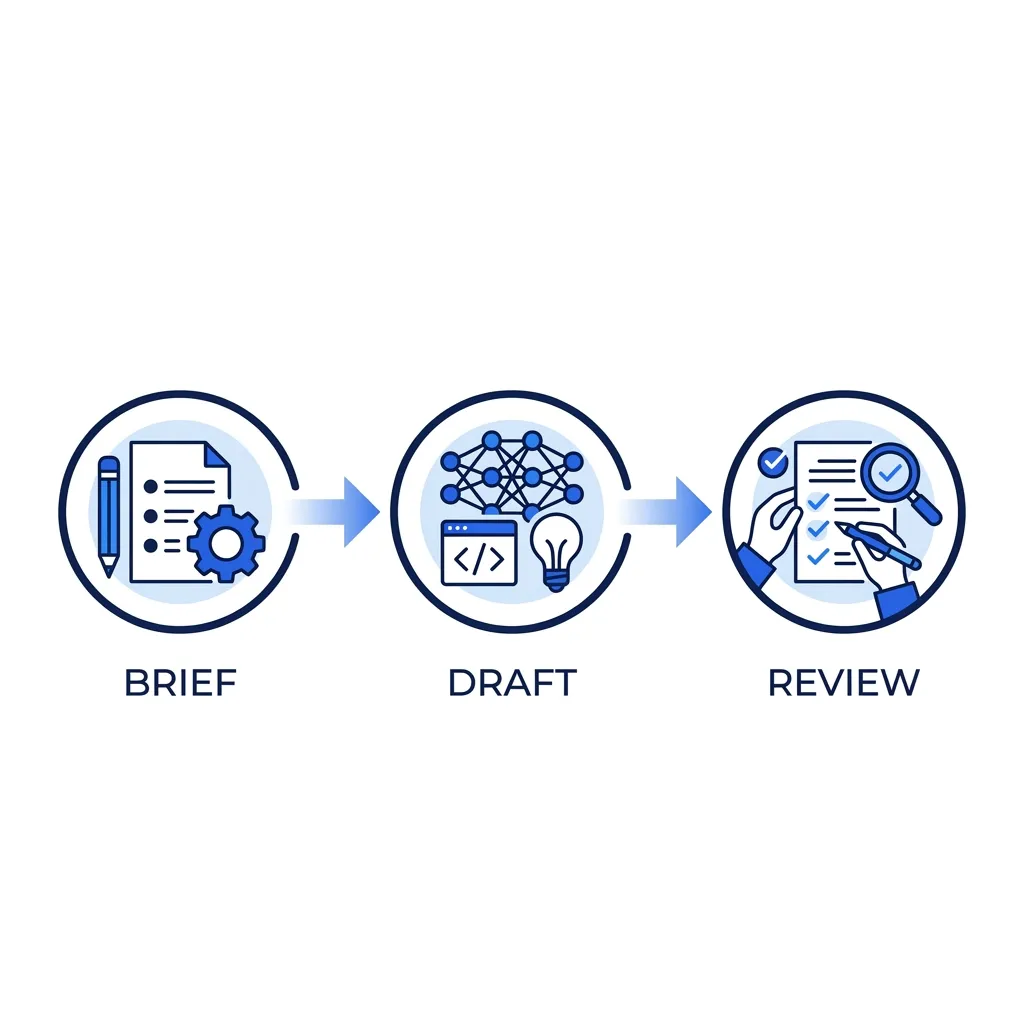
AI Writing Assistant vs. AI Content Generator: The Distinction That Changes Everything
Before you evaluate any tool, you need to answer one question: are you looking for something to improve writing you already have, or something to generate writing from scratch?
Those are different problems. They have different tools. And most comparison articles skip this entirely because acknowledging it would cut their reviewable tool list in half.
AI writing assistants work on text you provide. They improve clarity, catch grammatical errors, suggest structural changes, and adjust tone. You do the writing. The tool refines it. Grammarly and Hemingway are the clearest examples — they make your sentences better, they do not replace the sentences.
AI content generators start from a prompt and produce a full draft. You describe what you want; the tool produces the text. ChatGPT, Claude, Jasper, and Copy.ai all fall here. The quality of that draft depends heavily on the quality of your prompt and the specificity of the context you give the tool — not on the tool’s marketing copy.
Functionally, generators work by predicting the most statistically likely sequence of text given your input, drawing on training data that captures patterns in human writing across the internet. They do not know your brand, your audience, or what your competitors rank for. They know what text tends to follow text like yours. That distinction matters when you are evaluating output quality.
The verdict: A solo blogger editing their own drafts needs an assistant. A content manager producing 20 SEO articles a month needs a generator. Most readers of this article need a generator — and that narrows the field considerably.
| Category | Examples | Best For | Key Limitation | When to Choose |
|---|---|---|---|---|
| AI Writing Assistant | Grammarly, Hemingway | Refining drafts you already wrote | Cannot generate content from scratch | You write your own content and need quality and clarity checks |
| AI Content Generator | ChatGPT, Claude, Jasper, Copy.ai | Producing first drafts at scale | Output quality depends entirely on prompt quality and post-generation editing | You need volume, speed, or first-draft production across multiple pieces |
Which AI Writing Tool Is Right for You: A Decision Framework, Not Another Feature List
Three variables determine which tool category makes sense for your situation. Content type, production volume, and budget. Work through these before you read a single tool review.
Content type: Long-form SEO blog content, short-form marketing copy, email sequences, and social posts have meaningfully different quality requirements. Long-form SEO content demands structural coherence, factual accuracy, and keyword alignment — generators handle this, but they require more prompting specificity and more editing. Short-form copy (subject lines, ad variants, product descriptions) is where generators genuinely shine with minimal editing overhead.
Production volume: If you are producing two to four blog posts per month, the sophistication of your tool matters far less than your editing process. Start with ChatGPT or Claude on a free or low-cost plan before spending money on specialized tools. If you are producing 20 or more pieces per month, you need workflow integration, consistent brand voice handling, and a structured QA process — not just a better prompt interface.
Budget tier: Free plans exist across most major tools but come with real limits — typically word count caps, rate limits, or restricted access to the best underlying model. Prosumer plans ($20–50/month) unlock model quality and usage volume. Team plans ($100+/month) add collaboration, brand customization, and integrations that only justify the cost at agency or mid-market scale.
A marketing agency managing SEO content for ten clients needs a managed pipeline with built-in QA, not a prompt-and-publish tool that requires a skilled operator for every post. Strategy-backed content production — where keyword research, competitive context, and structured writing happen together — is a different category from standalone AI writing tools entirely.
| Your Situation | Content Type | Volume | Budget | Recommended Approach |
|---|---|---|---|---|
| Solo blogger or freelancer | Long-form SEO or editorial | 2–4 posts/month | Free to $20/month | ChatGPT or Claude free tier; upgrade to Plus when volume demands it |
| In-house content marketer | Mixed: blog, email, social | 5–15 pieces/month | $20–50/month | ChatGPT Plus or Claude Pro; supplement with Grammarly for editing |
| Content team or agency | SEO blog at scale | 20+ posts/month | $100+/month | Managed pipeline with built-in research, QA, and brand voice handling |
| Marketing copywriter | Short-form: ads, email, social | High volume, short format | $20–50/month | Copy.ai or Jasper with templates; ChatGPT Plus competes at this tier |
| Technical or regulated content | Long-form, high accuracy required | Any volume | Any budget | Human-led writing with AI assist only — generators carry too much hallucination risk here |
The Major AI Writing Tools, Evaluated Honestly
How these were evaluated: Each tool was assessed on four criteria: output quality for the stated best-use case, editing workload required post-generation, pricing transparency across free and paid tiers, and whether the underlying AI model is current enough to produce competitive output. Tools were not evaluated on feature count or interface design — only on whether they produce usable content for real use cases.
| Tool | Best For | Starting Price | Free Plan | AI Model | Editing Required | Skip If |
|---|---|---|---|---|---|---|
| ChatGPT (OpenAI) | Long-form SEO first drafts | $20/month (Plus) | Yes — GPT-3.5, limited GPT-4o | GPT-4o (Plus) | Medium — strong structure, needs fact-checking and brand alignment | You need SEO keyword context built in; ChatGPT has none natively |
| Claude (Anthropic) | Long-form content with natural tone | $20/month (Pro) | Yes — Claude 3 Haiku, usage-limited | Claude 3.5 Sonnet/Opus | Medium — cleaner prose than GPT-4o out of the box, still needs fact-checking | You need fast short-form output at volume; Claude is slower and better suited to longer work |
| Jasper AI | Marketing copy with brand templates | $49/month (Creator) | No — 7-day trial only | GPT-4 + proprietary layer | Medium — templates reduce structure editing, tone still needs review | You are a solo creator; the price does not justify what ChatGPT Plus covers at $20/month |
| Copy.ai | Short-form marketing and sales copy | $49/month (Starter) | Yes — 2,000 words/month | GPT-4 | Low for short-form, high for long-form | You primarily need long-form blog content; Copy.ai is built for copy, not SEO articles |
| Surfer AI | SEO-optimized blog drafts with keyword integration | $99/month (Essential, includes Surfer SEO) | No | GPT-4 | Low-to-medium — keyword coverage is handled, tone and accuracy still need review | You do not use Surfer SEO for optimization; the AI feature does not justify the platform cost alone |
| Rytr | Budget short-form copy | $9/month (Saver) | Yes — 10,000 characters/month | GPT-3.5 class | Heavy — output quality is noticeably below GPT-4-class tools | You need long-form content or high accuracy; Rytr is a budget tier with budget-tier output |
| Grammarly | Editing and refinement of human-written content | $12/month (Pro) | Yes — basic grammar and tone | Proprietary + GPT integration | N/A — it is an assistant, not a generator | You need first-draft generation; Grammarly does not produce content from scratch |
ChatGPT vs. Claude for long-form SEO: Both handle long-form drafts well. Claude tends to produce cleaner, more natural prose out of the box. ChatGPT is more configurable with custom instructions and integrates better with tools like Zapier. For SEO specifically, neither has keyword awareness — you need to supply that context in your prompt. Neither is a substitute for a content brief grounded in actual keyword research.
Jasper vs. Copy.ai for marketing copy: Jasper’s templates and brand voice profiles make it easier to maintain consistency at team scale. Copy.ai’s free tier and workflow automation features give it an edge for individual marketers. At the $49/month price point, both overlap heavily with what ChatGPT Plus handles — the question is whether the templates and workflow saves justify the premium.
What AI Gets Wrong: Hallucinations, Quality Floors, and the Editing Work No One Talks About
Hallucination is not a bug that will be patched. It is a structural feature of how large language models work. A language model does not retrieve facts — it predicts text. When asked about something outside its training data or at the edge of its knowledge, it generates plausible-sounding text regardless of accuracy. Research on LLM factual accuracy continues to document meaningful error rates even in well-performing models.
The risk profile is not uniform. AI writing a fabricated statistic into a product description is annoying. AI writing a fabricated citation into a legal explainer, medical article, or financial guide is a liability. The higher the stakes of factual accuracy in your content, the more dangerous the unreviewed AI output becomes.
The editing workload problem is real. For high-specificity content — technical documentation, data-heavy analysis, anything requiring proprietary knowledge or current events — AI often creates more editing work than time saved. You are now fact-checking and restructuring someone else’s draft instead of building your own from a brief. A 1,500-word SEO article generated from a vague prompt will consume more time to fix than to write from scratch.
For lower-specificity, higher-volume content — product descriptions, email subject line variations, SEO outline drafts, social post variations — AI genuinely saves time. The output quality floor is good enough, the editing overhead is manageable, and the volume payoff is real.
The pre-publish review step is where most AI content workflows fail. Here is the minimum viable process before any AI-generated content goes live:
Pre-Publish AI Content Review Checklist
- Verify every factual claim independently — AI does not have access to current or proprietary data and will fabricate plausible-sounding figures
- Check specifically for hallucinated citations, statistics, product names, or attributed quotes — these are the highest-risk hallucination outputs
- Read the output aloud to catch awkward phrasing, tonal inconsistency, and off-brand language that reads as generic
- Confirm the content answers the actual search intent behind the target keyword — not just the prompt you typed
- Run a plagiarism check if the content covers heavily documented topics where training data overlap is likely
- Review for brand voice consistency against your style guide, reference content, or approved sample posts
- Confirm headers, subheads, meta structure, and internal link placement meet your CMS and SEO requirements before importing
This is not optional polish. This is the step that separates publishable AI-assisted content from raw AI output. Skipping it is how you end up with fabricated statistics and generic tone living on your domain.
A built-in review process — the kind that comes with strategy-backed writing workflows rather than standalone prompt-and-publish tools — is the productized version of this checklist. The manual process works. It also takes time, and time is the honest cost that most AI tool marketing omits.
AI Content and SEO: What Google Actually Says, and What AI Detection Tools Can and Can’t Do
Here is Google’s actual position, sourced directly: Google’s guidance on AI-generated content states clearly that the helpful content system rewards content that demonstrates experience, expertise, authoritativeness, and trustworthiness — regardless of how it was produced. The question is not whether AI wrote it. The question is whether it is helpful, accurate, and written for a real audience.
Low-quality AI content — generic, thin, inaccurate, or clearly not written for a human reader — can trigger the helpful content signals that suppress rankings. High-quality AI-assisted content that is factually sound, editorially reviewed, and genuinely useful to the reader is not at elevated risk. The bar is quality, not authorship.
On AI detection tools: Tools like Originality.ai attempt to identify AI-generated text by analyzing writing patterns. The core problem is documented accuracy limitations — they produce false positives on human-written content that happens to use clear, direct language, and false negatives on heavily edited AI content. Using AI detection scores as a publishing gate is not a sound strategy. The better gate is your own editorial judgment against the quality checklist above.
AI-Generated Content (published as-is)
- Pro: Fast to produce, low upfront labor cost
- Pro: Handles high-volume, low-specificity formats efficiently
- Con: High hallucination and factual error risk without editorial review
- Con: Rarely reflects actual search intent — it reflects prompt intent, which is different
- Con: More likely to exhibit the generic, low-depth patterns that helpful content signals are designed to surface
- Con: Brand voice is absent by default unless explicitly engineered into the prompt
AI-Assisted Content (human-edited and strategy-backed)
- Pro: Quality bar significantly higher when editing addresses factual accuracy and brand alignment
- Pro: Aligns with Google’s helpful content framework — the human editorial layer is what makes it genuinely useful
- Pro: Scales content production without sacrificing the judgment that makes content trustworthy
- Con: Requires real editing time — the faster the AI, the slower the careful reviewer needs to be
- Con: Output quality ceiling depends on the quality of the underlying generation and prompt specificity
AI content only builds lasting SEO value when it clears quality and relevance thresholds — the same thresholds that have always determined whether content compounds returns over time or sits inert.
How to Get Better Output: Prompting Principles and Workflow Integration
The quality gap between good AI-assisted content and generic AI output is almost entirely a prompting and workflow problem. Most users get mediocre results because they treat AI as a one-step solution for a four-step process.
Five prompting principles that apply across all tools:
-
Specify the audience and intent explicitly. “Write a blog post about email marketing” produces generic output. “Write a 1,200-word post for B2B SaaS marketers who already use email automation and want to improve list segmentation” produces something useful. The tool cannot infer context you do not provide.
-
Give the tool your brand and voice context. A brief description of your tone (direct, conversational, technical), phrases you use and avoid, and a sample paragraph of reference content will meaningfully shift output quality. Most users skip this and wonder why everything sounds generic.
-
Define output format and length in the prompt. If you need H2s, bullets, a specific word count, and a CTA at the end — say that. The tool will follow explicit structure instructions. If you do not specify, it will default to what statistically follows content like yours.
-
Include a negative constraint. Tell the tool what to avoid: “Do not use passive voice,” “avoid bullet lists for this piece,” “do not use the phrase ‘in today’s fast-paced world.’” Negative constraints reduce the generic patterns that make AI content identifiable.
-
Provide the keyword and search context. AI generators have no keyword awareness unless you supply it. Drop the target keyword, the search intent, and one or two competitor article titles into the prompt. This is table stakes for SEO content.
On brand voice: A well-constructed system prompt or custom instruction set — one that specifies your tone, audience, writing style, phrases to avoid, and a reference sample — will produce consistently better output than a blank-context prompt. That setup takes thirty minutes once and applies to every piece after. Most users never do it. Maintaining consistent brand voice at scale with AI requires either that upfront investment in every prompt or a platform where voice matching is built into the pipeline.
The full workflow AI fits into:
- Keyword research and content brief — identify search intent, target keyword, competitive gaps, and required topics. AI does not do this reliably. This step is human or tool-driven before AI enters the process.
- AI draft generation — prompt the generator with the brief, audience context, format requirements, and brand voice reference. This is the AI’s step.
- Human editing and fact-checking — run the pre-publish checklist. Verify claims, fix hallucinations, align tone, adjust structure.
- SEO review and CMS formatting — confirm keyword placement, meta fields, internal links, header structure. Import to your CMS only after this step.
AI handles step two. It does not handle steps one, three, or four. Treating it as a complete content solution collapses those four steps into one and produces the generic, inaccurate, off-brand output that gives AI writing a bad reputation.
Try It Before You Spend Anything
If you are evaluating whether a managed AI content pipeline produces better output than a prompt-and-publish tool, the honest test is reading the actual content before making any decisions.
Veldora runs the full SEO content pipeline — keyword research, competitive analysis, strategy-backed writing, and multi-step QA — as a unified automated system built on 12 years of SEO agency experience. It is not a writing tool. It is not a ChatGPT wrapper. It is a complete content operation for small-to-mid-sized businesses and agencies who need publish-ready SEO blog content without building or managing a content department.
Generate a real, strategy-backed post on the free demo and read it yourself — before you spend a dollar.
No credit card. No contracts. Just proof.
Frequently Asked Questions
Is AI-generated content penalized by Google?
No — not for being AI-generated. Google’s helpful content guidance evaluates content on quality, usefulness, and relevance to the searcher. Low-quality AI content that is thin, inaccurate, or clearly not written for a real audience carries ranking risk. High-quality, editorially reviewed AI-assisted content does not face elevated penalty risk based on authorship alone.
What is the difference between an AI writing assistant and an AI content generator?
AI writing assistants (Grammarly, Hemingway) improve text you have already written — they correct, refine, and adjust. AI content generators (ChatGPT, Claude, Jasper) produce a full draft from a prompt. If you need help editing your own writing, you need an assistant. If you need first-draft production at volume, you need a generator. Most content teams need the latter.
Which AI writing tool produces the most accurate content with the least editing?
No AI writing tool produces consistently accurate content without editorial review — hallucination is a structural feature of language models, not a fixable bug. For accuracy-sensitive content, human editing is required regardless of tool. For lower-stakes, higher-volume content, Claude and ChatGPT Plus currently produce the cleanest output with the least structural editing required.
How do I make AI-written content sound like my brand?
Build your brand voice into the prompt itself: specify tone, target audience, writing style, phrases to avoid, and include a short reference sample of approved content. A well-constructed custom instruction or system prompt applied consistently will produce noticeably better brand alignment than a blank-context prompt. Expect to invest thirty minutes building this once before it pays off across every subsequent piece.
Are free AI writing tools good enough for professional content?
For low-volume, lower-stakes content, yes — ChatGPT and Claude free tiers produce workable first drafts. The real limits are model quality (free tiers often use older or slower models), usage caps, and the absence of brand customization features. For consistent professional SEO content at volume, the $20/month upgrade to GPT-4o or Claude Pro pays for itself in output quality and usage capacity.
Can AI writing tools handle long-form SEO articles or only short-form copy?
Generators like ChatGPT and Claude handle long-form drafts reasonably well with specific prompting. The gaps are SEO keyword context (which you must supply manually), factual accuracy (which requires post-generation review), and structural coherence across long pieces (which requires editing). Tools like Surfer AI integrate keyword guidance into generation. None produce fully publish-ready long-form content without human editing.
How do I know if my AI-generated content will be flagged by AI detection tools?
You cannot reliably predict or control AI detection scores — detection tools produce false positives on human-written content and false negatives on edited AI content. Detection scores are not a useful publishing gate. The better question is whether the content is accurate, genuinely useful, and brand-consistent. That editorial judgment is a more reliable quality signal than any detection tool score.
What editing steps are required before publishing AI-generated content?
At minimum: verify every factual claim independently, check for hallucinated citations or statistics, read aloud for tone and brand alignment, confirm the content answers the actual search intent (not just the prompt), and review header structure and meta fields before CMS import. For accuracy-sensitive content types, add a plagiarism check. Skipping these steps is how AI output becomes a liability instead of a time-saving asset.
← Back to all posts