AI Content Writing Services vs. Tools: How to Choose
By Veldora AI · July 7, 2026

AI Content Writing Services: Tools, Managed Services, and How to Choose the Right One
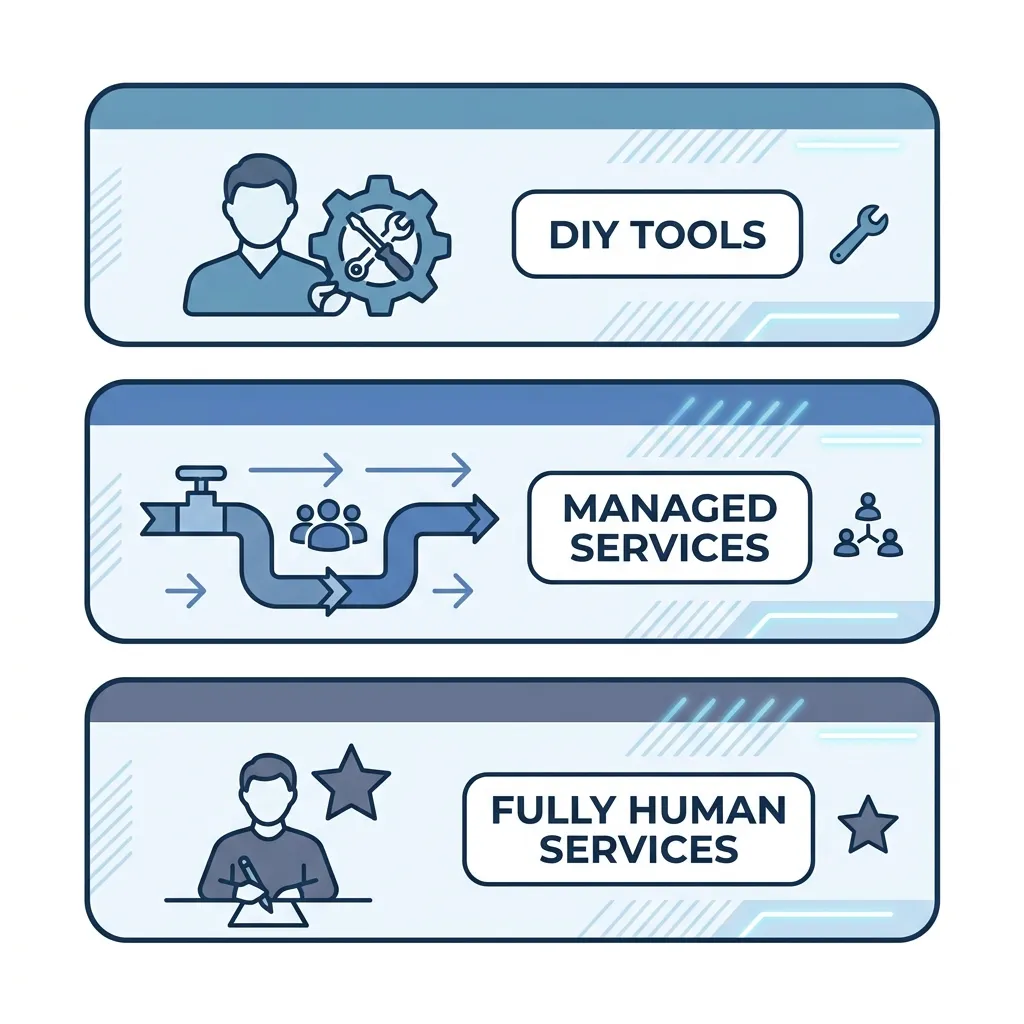
If you searched “AI content writing service” expecting a clear answer, you’ve already run into the problem. That phrase describes two completely different things — self-serve software you operate yourself, and done-for-you providers who handle the work for you. Comparing them without knowing the difference is like comparing a commercial kitchen to a catering company because both make food.
Most people realize this too late, after subscribing to a $49/month tool and spending three hours editing the output, or after hiring an “AI content service” that delivered raw draft files with no strategy attached.
This article is a decision framework, not a product roundup. By the end, you should be able to identify which model — DIY tool, managed service, or fully human service — fits your situation, and know exactly what to ask before you spend anything.
Key Takeaways
- “AI content writing service” describes at least three different things. Knowing which one you’re evaluating changes every decision about cost, quality, and workload.
- A DIY AI writing tool gives you a draft generator. You still own the strategy, editing, and quality control. That time cost is real and usually erases the savings.
- A managed AI content writing service should handle the full pipeline — research, writing, editing, and QA — so you receive publish-ready content, not a first draft.
- Not all content is equally suited to AI. Product descriptions and FAQ pages tolerate AI production well. Thought leadership, YMYL content, and competitive SEO targets generally require stronger editorial control.
- When evaluating any option, prioritize QA transparency and editorial depth over price or feature lists. A low-cost service with no editing layer is just a tool subscription with a markup.
What “AI Content Writing Service” Actually Means (Three Models, Not One)
Before anything else, it helps to know what category you’re actually shopping in — because the word “service” is doing a lot of heavy lifting in this phrase.
A DIY AI writing tool is software — Jasper, Rytr, Copy.ai, and dozens like them. You type a prompt, the tool generates a draft, and then you edit, fact-check, and finalize it. The tool does not have a strategy for your site. It does not know your brand voice unless you configure it. It does not review what it produces for accuracy. That’s your job.
A managed AI content writing service is a done-for-you provider. You submit your goals or a light brief, the service handles keyword research, draft production, editing, and QA, and delivers content that’s ready to publish. The AI accelerates production; human editorial oversight governs quality. You are not in the drafting loop.
A fully human content service — a freelancer, a writing agency, or an in-house team — uses no AI in the core writing workflow. Output quality ceiling is higher, but volume and cost constraints are real.
If you’ve typed a prompt into an AI tool, generated a draft, and then spent two hours editing it — you used a DIY AI writing tool, not a content writing service. A service handles that editing for you. That distinction determines your actual cost, your actual workload, and your actual content quality.
| Model | How It Works | You Handle | Best For |
|---|---|---|---|
| DIY AI Writing Tool | You prompt the software, it generates a draft, you edit and publish | Strategy, editing, QA, SEO integration, brand voice | Low-volume solo users with editing capacity and time to invest |
| Managed AI Content Service | Provider handles research, AI drafting, human editing, QA, and delivery | Light brief, content goals, brand guidelines review | SMBs and agencies needing consistent volume without in-house editorial capacity |
| Fully Human Content Service | Human writers research, write, and edit with no AI in the core workflow | Review and approval | Competitive SEO targets, YMYL content, brand-sensitive work requiring maximum editorial depth |
The rest of this article builds on this framework. When you hit a section on cost or quality or evaluation criteria, you’ll know exactly which model is being described.
When AI Content Writing Works — and When It Doesn’t
AI-assisted content production is genuinely useful for some things. It is a poor fit for others. Pretending otherwise leads to wasted spend and content that doesn’t perform.
Where AI production works well:
- High-volume commodity content: product descriptions, FAQ pages, location pages built from structured data, templated formats where accuracy is verifiable and originality is less critical than coverage.
- Supporting content for established topics where the goal is breadth rather than depth — category pages, glossary entries, structured how-to formats in low-competition spaces.
Where human expertise is required:
- Thought leadership and opinion content — AI doesn’t have a point of view, and readers can usually tell.
- YMYL categories (Your Money or Your Life): health, finance, legal, safety. Google holds these to a higher expertise and accuracy standard, and the cost of a factual error is real.
- Competitive SEO targets where topical authority and editorial depth are the actual ranking factors. A well-edited 1,200-word page that demonstrates genuine expertise will consistently outperform a 1,500-word AI draft that covers the surface of a topic without adding anything new.
On Google’s stance: Google’s guidance on AI-generated content is explicit that the standard is helpfulness and quality — not the production method. AI-generated content isn’t penalized because it was generated by AI. It underperforms when it’s generic, thin, or clearly not written for people. Unedited AI drafts fail that standard often — not because the technology is bad, but because raw output tends toward confident vagueness and surface-level coverage.
The editing workload reality: most unedited AI drafts require meaningful revision before they’re publishable. If you’re calculating the cost of a DIY tool subscription, that editing time belongs in the math. For competitive content strategy that builds long-term value, this point matters more than most tool comparisons acknowledge — the compounding effect of quality content over time is a separate argument covered in depth in this piece on SEO content strategy.
Honest summary:
AI content writing works well when:
- The content type is templated or structured
- Accuracy is easy to verify
- Volume is the primary challenge
- Editorial oversight is applied before publishing
AI content writing falls short when:
- The topic requires demonstrated expertise or lived experience
- Factual errors carry real consequences (YMYL)
- Brand voice consistency is critical and poorly documented
- The SERP demands depth and original analysis to compete
How a Managed AI Content Writing Service Actually Works
If you’ve only used DIY tools, the managed service model is worth understanding in concrete terms — because “done for you” can mean very different things depending on the provider.
A legitimate managed AI content writing service handles the full editorial pipeline. Here’s what that workflow looks like when it’s working properly:
- Keyword research and strategy — The service identifies target keywords based on your site, your competition, and search intent. You don’t write the brief from scratch; the strategy is the brief.
- Competitor analysis — The service reviews what’s already ranking and identifies content gaps or structural requirements the piece needs to address.
- AI-assisted draft generation — The AI produces an initial draft informed by the research. This is an internal step — not the deliverable.
- Human editing and brand voice matching — An editor reviews the draft for accuracy, tone, brand alignment, and structural quality. This is the step that separates a managed service from a raw tool subscription.
- Multi-step QA — Before delivery, the content goes through quality control: factual review, SEO integration check, originality verification, and brand voice confirmation.
- Delivery of publish-ready content — You receive something you can review and publish, not a draft that requires two hours of your time to finish.
What you provide: your content goals, brand guidelines, and target audience context. A well-built managed service should be able to work from a light brief — you shouldn’t need to write detailed prompts or act as your own content strategist.
What separates good managed services from bad ones is almost entirely the QA layer. When a provider skips genuine editorial review, the client receives AI draft output with a service price tag. It looks like finished content, but requires the same editing workload as a tool subscription — sometimes more, because the errors are harder to spot in a polished-looking document.
Veldora’s automated pipeline — keyword research, competitor analysis, brand-matched writing, and multi-step QA — is an example of what this workflow looks like when it’s built systematically rather than improvised. The strategy-backed writing process means content arrives with a readable strategy, not just a draft, so you can verify the work before you publish anything.
How to Evaluate Any AI Content Writing Option (The Criteria That Actually Matter)
Most tool comparisons on this topic sort options by price tier or feature list. Neither tells you what you actually need to know before choosing.
Here are the criteria that separate a good decision from an expensive mistake:
Editorial depth and QA transparency — Does the provider describe its editing and review process in specific terms? Vague claims like “high-quality AI content” with no process detail are a red flag. Ask: who edits the output, what do they check, and can you see evidence of that process?
Cost per piece, not per month — A $49/month tool subscription looks cheap until you add editing time at your hourly rate. A managed service with a higher per-piece price may cost less in total when you account for the time you’re not spending.
Brand voice handling — Does the service have a documented process for matching your tone, or does it promise brand voice consistency without explaining how? Good services ask for writing samples and use them systematically.
SEO methodology — Does the service conduct keyword research and competitor analysis before writing? Or does it generate content from a prompt you supply? The difference matters significantly for competitive content.
Revision policy — A legitimate managed service has a clear revision process. No revision policy is a signal that the service considers its output finished regardless of your feedback.
Google helpful content compliance — What human oversight does the workflow actually include? This question should have a specific answer, not a marketing claim.
Red flag scenario: A provider that promises publish-ready AI content with no mention of editing, QA, or revision policy is describing tool output with a service price tag. That’s not a managed service.
| Evaluation Criterion | DIY AI Tool | Managed AI Service | Fully Human Service |
|---|---|---|---|
| Editorial depth | None — editing is your responsibility | Varies significantly; QA transparency is the key differentiator | High — writer expertise and editing are the core offering |
| Cost per piece | Low cash cost; high time cost when editing is included | Mid-range; lower than human services when QA is genuine | Highest per piece; no editing overhead on your end |
| Brand voice handling | Manual configuration required; consistency is your responsibility | Good services document and match voice systematically | Dependent on writer familiarity; improves over time with the same writer |
| SEO methodology | None built in — you supply the keyword and direction | Good services include keyword research and competitor analysis | Varies; depends on whether the writer or agency has SEO expertise |
| Revision policy | N/A — you edit the output yourself | Should be explicit; absence is a red flag | Typically included; terms vary by contract |
| Scalability | High — volume limited only by your editing capacity | High — designed for consistent volume without client editing load | Low to moderate — constrained by writer availability and cost |
| Google helpful content compliance | Depends entirely on your editing depth | Depends on QA rigor — ask for specifics | Generally strong when writer expertise matches the topic |
AI Content Quality Risks: What to Watch For Before You Publish
AI-generated content has specific failure modes. They’re manageable, but only if you know what to look for.
Hallucinations and factual errors — AI writing tools produce confident-sounding text that is sometimes simply wrong. Statistics cited without sources, expert quotes that don’t exist, product features that are slightly off. Research on AI-generated content has documented the frequency and nature of these errors. This is the highest-stakes failure mode, especially in YMYL categories.
Generic phrasing and thin structure — AI drafts often cover topics in the order a topic outline would suggest, without adding anything a reader couldn’t find in the first three results. The content reads as complete while contributing nothing new. This is the most common reason AI content underperforms in competitive SERPs.
Brand voice mismatch — Without systematic voice configuration, AI output defaults to a neutral, slightly formal register that matches no one’s actual brand voice. The more distinctive your tone, the more obvious the mismatch.
Unnatural SEO patterns — Keyword insertion without editorial judgment produces the kind of phrasing that signals low-quality production — to readers and, increasingly, to Google’s quality systems.
A managed service with genuine multi-step QA should catch these failure modes before delivery. If output from your current provider consistently fails these checks, you’re not receiving a managed service — you’re receiving tool output with a markup.
Before publishing any AI-assisted content, confirm:
- Factual claims verified against authoritative sources
- Brand voice and tone matched to existing published content
- Generic filler phrases and repetitive sentence structures removed
- SEO target integrated naturally — not forced or repeated awkwardly
- Internal links and CTAs added by a human editor
- Originality check completed
- Content answers the reader’s actual question — not just the keyword
This checklist applies regardless of whether a tool or a managed service produced the draft. The difference is who runs through it: with a DIY tool, that’s you; with a legitimate managed service, it’s the provider.
Which Content Writing Model Is Right for Your Situation
Here’s a direct answer for the most common scenarios.
If you’re a solo consultant or freelancer producing 2–4 posts per month and you have available time to edit and a basic grasp of SEO: a DIY AI writing tool is a reasonable starting point. Budget the editing time honestly — expect 60–90 minutes of revision per post — and develop the editorial eye to catch the failure modes described above. The economics work if your time is genuinely available.
If you’re a growing SMB or agency managing content for multiple clients or brands and consistent volume without in-house editorial capacity is the constraint: a managed AI content writing service is the right model. The economics improve sharply when you stop paying for editing time. Vet the QA layer rigorously before committing — ask specifically how editing and quality review work, who does it, and what the revision policy is.
If you’re competing in a high-stakes SERP, producing YMYL content, or maintaining a brand voice that’s central to your positioning: human-led content or a managed service with deep editorial oversight is the minimum viable standard. Raw AI output is not appropriate here, and neither is a managed service that can’t describe its editorial process in specific terms.
Cost-quality-speed reality check:
- DIY tool: lowest cash cost, highest time cost, quality ceiling depends on your editing skill
- Managed AI service: middle ground on cost; quality depends almost entirely on the QA layer — verify before you buy
- Fully human service: highest cost per piece, lowest editing burden, highest quality ceiling — hardest to scale
| Your Situation | Volume | In-House Editing? | Content Type | Recommended Model |
|---|---|---|---|---|
| Solo user, tight budget, available time | Low (2–4/month) | Yes | General, non-YMYL | DIY AI Writing Tool |
| SMB or agency, consistent content needs | Medium to high | No | SEO content, blog, supporting pages | Managed AI Content Service |
| Competitive SEO targets, brand-sensitive content | Any | Preferred | Competitive SERPs, thought leadership | Managed service with strong QA or fully human |
| YMYL content (health, finance, legal) | Any | Required | YMYL | Fully Human Service |
| Agency managing 10+ client accounts | High | No | Mixed | Managed AI Content Service — vet QA first |
If you’re in the managed service category and want to verify quality before spending anything:
Veldora handles the full pipeline — keyword research, competitor analysis, brand-matched writing, and multi-step QA — automatically. It’s built on 12 years of SEO agency work, not a generic AI experiment. No contracts, no agency markup, credit-based and transparent.
Generate a real, strategy-backed post on the free demo and read it yourself — before you spend a dollar. No credit card. No contracts. Just proof.
Frequently Asked Questions
What is the difference between an AI writing tool and an AI content writing service?
An AI writing tool is software you operate yourself — you prompt it, it generates a draft, and you edit and publish the output. An AI content writing service is a done-for-you provider that handles the full pipeline: research, drafting, editing, QA, and delivery. The tool gives you a starting point. The service gives you a finished product. The confusion between these two categories is the source of most buyer disappointment in this space.
Will AI-generated content rank on Google or get penalized?
Google does not penalize content for being AI-generated. According to Google’s own guidance on AI content, the standard is whether the content is helpful, accurate, and written for people — not how it was produced. AI content that hasn’t been substantively edited often fails that standard because it tends to be generic and thin, not because of its origin. Well-edited, well-researched AI-assisted content can rank competitively.
How much does an AI content writing service cost compared to a DIY tool or hiring a writer?
DIY tool subscriptions are typically in the $30–$100/month range, but that cost doesn’t include your editing time — which can add 60–90 minutes per post. Managed AI content services price per piece or per volume tier. Fully human services are typically the most expensive per piece. The honest comparison includes time cost, not just subscription price. A managed service that eliminates your editing workload can be cheaper in total than a tool you’re spending hours maintaining.
What content types should not be written by AI?
Content in YMYL categories — health, finance, legal, safety — should not rely primarily on AI output because the cost of a factual error is high and Google holds these categories to a higher expertise standard. Thought leadership and opinion content require a genuine perspective AI cannot provide. Content competing in high-authority SERPs where editorial depth is a ranking factor generally requires more human involvement than AI tools can supply.
How do I know if a managed AI content service uses real human editors?
Ask directly: who reviews the output before delivery, what do they check for, and what’s the revision policy if you find errors? A legitimate managed service can answer these questions specifically. Vague answers like “our team ensures quality” or no mention of editing at all are red flags. If the process description sounds like it could apply to any AI tool subscription, the editorial layer probably doesn’t exist.
Can AI writing services reliably match my brand voice?
Good managed services use your existing content as a reference and apply systematic brand voice configuration — they ask for writing samples, document tone guidelines, and apply them through the editing step. The result is not perfect from day one, but it improves with iteration. DIY tools require you to configure this yourself, and consistency is your responsibility. Raw AI output with no voice configuration will default to a generic register that matches no one’s brand. If voice consistency is critical, ask the service how they document and maintain it.
Is the cost savings from AI content real, or does editing time erase it?
For DIY tools, editing time frequently erases or exceeds the cash savings — especially for users without strong editorial skills or clear SEO knowledge. The savings are real only if you either have that capacity or invest in developing it. For managed AI content services with genuine QA, the savings over fully human services are typically real, because the AI-assisted production model lowers per-piece cost while editorial oversight maintains quality. The key variable is whether the managed service’s QA layer is genuine or performative.
← Back to all posts