AI Content Writer Tools Compared (2025): Find the Right One for Your Use Case
By Veldora AI · July 1, 2026
AI Content Writer Tools Compared: A Use-Case Guide to Finding the Right One
You have probably already read two or three of these articles. Twenty tools, vague pros and cons, a number one pick that happens to have an affiliate program, and no clearer sense of which one is actually right for what you are trying to do.
That is not a reader problem. It is a structure problem. Most AI content writer tool roundups are built to cover everything and decide nothing.
This one is built differently. It routes you to the right tool category first — because choosing the wrong category wastes more time than choosing the wrong tool within the right category. Then it compares specific tools with consistent criteria, is honest about what free plans actually unlock, and does not pretend AI writing tools are a publishing button.
If you leave knowing exactly which tool type fits your situation and which one to try first, this article did its job.
Key Takeaways
- Category first, tool second. Most readers pick the wrong tool because they skip the category selection step. A solo blogger needs a different tool than a marketing team producing email sequences and product copy.
- Free plans are real but limited. Most free tiers let you test quality, not run production. Upgrade when your monthly output exceeds what the free plan handles without friction.
- Six criteria separate useful tools from hype. Output quality, SEO capability, brand voice control, free tier scope, workflow integration, and AI detection exposure. Use them on any tool — including ones that launch after this article.
- AI writing tools cut the blank-page phase. They do not cut the editing phase. Skipping the edit produces content that reads like it came from a tool.
- For agencies and high-volume SEO operations, a point-solution tool eventually breaks down. The overhead of prompting, editing, and QA-ing output across dozens of posts defeats the cost savings. That is a structurally different problem.
What Type of AI Content Writer Tool Do You Actually Need?
Before you evaluate a single tool, you need to know which category of tool solves your actual problem. These are not interchangeable.
Long-form AI writers — Tools like Jasper and Writesonic generate multi-section blog posts, articles, and reports from a brief or outline. They are built for volume and structure, not necessarily for search-intent precision or editorial depth. Output requires editing.
Short-form copywriting tools — Tools like Copy.ai and Jasper’s campaign frameworks are optimized for product descriptions, ad copy, email subject lines, and landing page sections. They produce punchy, conversion-oriented output. They are not designed for 2,000-word informational articles.
SEO-integrated writers — Tools like Surfer SEO and Frase combine keyword research, SERP analysis, and content generation in one workflow. They write with search intent in mind, not just fluency. This is the category that matters most if organic search traffic is the goal.
Grammar and editing assistants — Grammarly and Quillbot solve a different problem: improving content that already exists. Conflating them with content generators produces bad purchase decisions. If you need to write content from scratch, these tools are not your starting point.
All-in-one platforms — Tools like Notion AI and ChatGPT are flexible enough to handle multiple content types but optimized for none of them specifically. They work well for teams that need a generalist tool and are willing to do the workflow configuration themselves.
Choosing the wrong category is the most common mistake. A solo blogger who buys a short-form copywriting tool because it topped a listicle will spend weeks trying to bend it into a long-form writing workflow it was not built for.
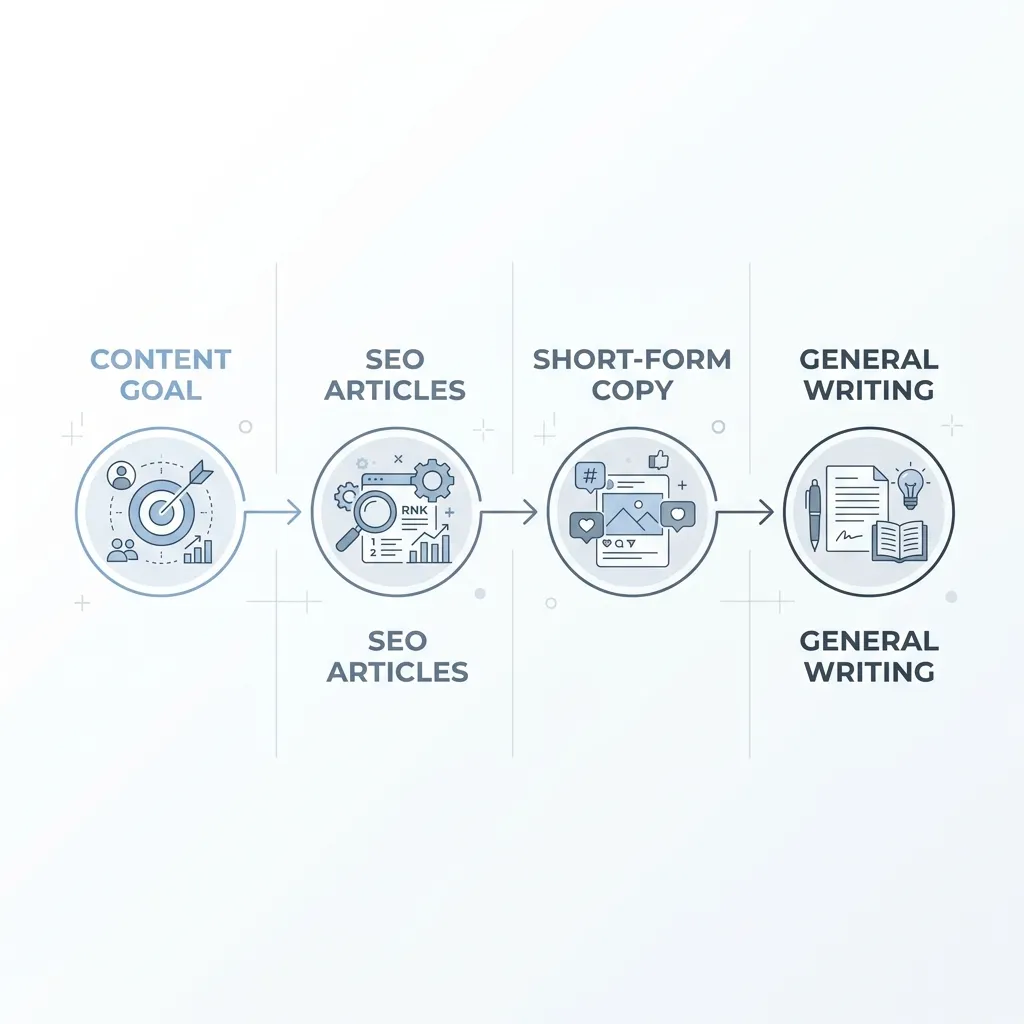
Decision Matrix: Match Your Content Goal to the Right Tool Category
| Content Goal | Tool Category to Look At | Example Use Case |
|---|---|---|
| SEO blog posts and long-form articles | SEO-integrated writer | A content marketer publishing 4–8 keyword-targeted posts per month |
| Product descriptions, ad copy, email sequences | Short-form copywriting tool | An e-commerce team writing product page variants and promotional emails |
| Editing and polishing existing drafts | Grammar and editing assistant | A writer who drafts in Google Docs and wants grammar, clarity, and tone review |
| General writing across multiple formats | All-in-one platform | A solo founder who needs a flexible tool for blog posts, emails, and internal docs |
| High-volume SEO content with consistent structure | SEO-integrated writer or full-pipeline service | An agency producing 20+ SEO articles per month across multiple clients |
| Marketing copy with brand voice controls | Short-form or all-in-one with voice features | An in-house team with established brand guidelines needing consistent output tone |
How to Evaluate AI Content Writer Tools: The Criteria That Actually Matter
Most tool reviews skip the evaluation framework and go straight to the list. That leaves you with no way to assess tools that did not make the list, or tools that launch six months from now. Here are the six criteria worth applying to any AI writing tool.
1. Output quality and naturalness Ignore vendor claims about “human-like writing.” The real question is: how much editing does the output require before you would publish it? Some tools produce drafts that need light restructuring and fact-checking. Others produce output that needs to be substantially rewritten. Test this with a real prompt from your actual workflow before committing.
2. SEO capabilities For blog content specifically, this is the dividing line between useful and not. Surface-level SEO means the tool lets you type in a keyword and it inserts it a few times. Meaningful SEO capability means the tool builds an outline informed by what is actually ranking, integrates related terms naturally, and structures content around search intent — not just a keyword count. Tools like Surfer SEO and Frase sit in this second category. For why this matters beyond a single post, see how compounding content strategy makes consistent SEO capability a structural advantage over time.
3. Brand voice and tone control The difference between a tone slider (casual vs. formal) and a tool that lets you upload sample content to train output style is significant. For individuals, a tone slider is often enough. For teams with established brand guidelines, the ability to define voice, vocabulary preferences, and writing patterns matters — and most tools handle this superficially. Look for tools that offer template libraries, style guides, or sample-based voice matching. Tone customization in AI writing is one of the harder problems to solve well, and depth of control varies dramatically across platforms.
4. Free tier scope vs. paid plan value Almost every tool has a free plan. Almost no free plan is production-ready. Free tiers typically let you generate a limited number of words or documents per month — enough to test quality, not enough to run a content operation. The useful question is not whether a free plan exists but what it actually unlocks and when the ceiling hits.
5. Workflow integration Which tools connect to Google Docs, WordPress, Webflow, or the SEO suite you already use? Workflow friction compounds fast. A tool that requires constant copy-paste between platforms adds overhead that erodes the time savings. If your content team already lives in a specific CMS or project management setup, integration matters more than feature richness.
6. AI detection exposure and content safety AI detection tools like GPTZero and Originality.ai measure statistical patterns in text — sentence structure predictability, vocabulary distribution, and syntactic regularity. AI-generated content that is not edited after generation scores higher on these detectors. This does not mean AI content is automatically penalized — Google’s guidance focuses on helpfulness, not origin — but detection risk is a real workflow consideration if your clients or publishers have policies about AI content.
Evaluation Checklist: Questions to Ask Before Buying Any AI Writing Tool
- Does the output require light editing or heavy rewriting for my use case?
- Does the tool integrate keyword and SERP data into the writing process, or just accept a keyword input?
- Can I define and train the tool on my brand voice — or just select a tone preset?
- What does the free plan actually produce, and when does it run out?
- Does it connect to the platforms my team already uses?
- How does the output perform on AI detection tools after minimal editing?
Top AI Content Writer Tools Compared
The table below covers the tools most relevant to the use cases in this article. Pricing reflects published rates as of mid-2025 — free plan details change frequently, so verify before committing.
| Tool | Best For | Free Plan | Starting Price | SEO Capability | Standout Feature | Notable Limitation |
|---|---|---|---|---|---|---|
| Jasper | Marketing copy and brand campaigns | No (5-day trial) | ~$49/mo | Medium | Brand voice templates and campaign frameworks | Long-form SEO drafts require significant editing |
| Copy.ai | Short-form copy and workflow automation | Yes (limited) | ~$49/mo | Low | Workflow automation with multi-step copy sequences | Not built for long-form or search-intent content |
| Writesonic | Long-form blog and product content | Yes (limited) | ~$16/mo | Medium | Flexible output formats across content types | Inconsistent quality on technical or niche topics |
| Surfer SEO | SEO-informed content writing and optimization | No | ~$89/mo | High | Real-time NLP optimization scored against live SERPs | Primarily an optimization layer, not a standalone writer |
| Frase | SEO research and AI-assisted drafting | Yes (limited trial) | ~$45/mo | High | SERP-informed outlines built from competitor analysis | Steeper learning curve for new users |
| ChatGPT (Plus) | Flexible, generalist writing and ideation | Yes (GPT-3.5) | ~$20/mo | Low | Highly flexible — handles almost any writing task | No native SEO integration; output quality depends heavily on prompting |
| Claude | Long-form drafts with nuanced, natural tone | Yes (limited) | ~$20/mo | Low | Strong contextual coherence across long documents | No SEO or keyword integration; limited workflow connections |
| Grammarly | Editing, grammar, and tone refinement | Yes | ~$12/mo | Low | Real-time editing with tone and clarity suggestions | Not a content generator — improves existing text only |
| Quillbot | Paraphrasing and rewriting existing content | Yes (limited) | ~$10/mo | Low | Fast paraphrase and summarization at low cost | Not designed for original content creation |
| Notion AI | Generalist writing within the Notion workspace | Requires Notion plan | ~$10/mo add-on | Low | Native to Notion — ideal for teams already in the platform | Limited output depth; no SEO or brand voice features |
SEO-Integrated Writers
Surfer SEO pairs real-time SERP analysis with a content editor that scores your draft against top-ranking pages. It is less a writer and more an optimization co-pilot — you draft, it tells you what to add or cut. If you are already producing content and want to close the gap between what you write and what ranks, Surfer is the tool. If you need the writing done for you, pair it with another tool or writer.
Frase goes further into the research phase — it builds outlines from SERP competitors before you write a word. For SEO specialists who want to start with a structured brief rather than a blank page, Frase fits that workflow better than Surfer does. The tradeoff is a steeper onboarding curve.
Long-Form AI Writers
Writesonic handles volume well and is one of the more affordable options for solo bloggers testing AI writing. Quality varies more on technical topics than on evergreen or how-to content. It is a reasonable first tool for someone exploring long-form AI writing without a large budget.
Claude produces some of the most naturally readable long-form output in the current market. It holds context well across long documents. The gap is that it has no SEO integration — you are getting fluency, not search-intent alignment. For writers who want to prompt a tool and clean up the output, Claude is a strong option. For teams who need keyword-informed drafts, it is not the right starting point.
Short-Form Copywriting Tools
Jasper built its reputation on marketing copy — brand voice templates, tone controls, and campaign frameworks are its genuine strengths. For long-form SEO blog drafts, it will produce output, but that is not what it was designed for. If your primary need is ad copy, email sequences, and product marketing content, Jasper fits. If you need editorial-quality blog posts that rank, you will be fighting the tool.
Copy.ai leans into workflow automation — multi-step sequences that chain copy tasks together. For teams running high-frequency short-form content at scale, that workflow logic is genuinely useful. The limitation is the same as Jasper: it is not built for long-form or search-intent content, and using it for that produces mediocre output.
Grammar and Editing Assistants
Grammarly solves a specific problem well: making existing content cleaner, clearer, and more consistent in tone. It is not a content generator and should not be evaluated as one. If you already have a writing workflow and want a real-time editing layer on top of it, Grammarly is the standard choice. Its free plan covers grammar and basic clarity — the paid plan adds tone suggestions and style guidance.
Quillbot specializes in paraphrasing and rewriting. It is useful for restructuring awkward passages or avoiding repetitive phrasing. Like Grammarly, it is an editing tool, not an origination tool.
Which AI Content Writer Tool Is Right for Your Situation?
The table above covers what each tool does. This section covers who each tool is for.
Solo blogger or freelance writer: Prioritize a tool with a meaningful free plan, strong long-form capability, and low friction to get started. Writesonic or Claude are the most accessible starting points. Writesonic for volume, Claude for quality-per-draft. Add Surfer SEO when your content operation is established enough to optimize rather than just produce.
In-house content marketer or small team: Brand voice control and workflow integration move up the priority list. Jasper’s brand voice templates make sense for teams with defined marketing guidelines. If the team is already in Notion, Notion AI reduces switching cost. Frase fits teams whose content strategy is SEO-driven and who want outlines built from SERP data before writing begins.
SEO specialist or content strategist: Surfer SEO and Frase are the category-specific tools. The question is whether you want optimization-focused (Surfer) or research-and-outline-focused (Frase) as your primary workflow anchor. Most SEO specialists use both at different stages. Understanding strategy-backed writing as a concept — where the content brief is built from live SERP research before a word is written — is the framework that separates SEO-informed content from keyword-stuffed content.
Agency or high-volume content operation: This is where the tool-plus-overhead model starts breaking down. An agency managing SEO content for 15 clients cannot reliably produce strategy-backed, brand-consistent, QA-reviewed content using a self-serve writing tool — the labor overhead of prompting, editing, brand-checking, and fact-checking across that volume defeats the cost savings. At that point, the problem is not which tool to use. The problem is that the point-solution model requires too many human steps to be sustainable.
This is the use case where a full automated content pipeline — one that handles keyword research, competitor analysis, brand-matched writing, and multi-step QA end to end — is structurally different from a writing tool. Veldora is not a tool with a text box. It is that pipeline, built from 12 years of agency SEO experience and designed specifically for businesses and agencies that need consistent, strategy-driven content output without managing multiple tools and contractors.
Generate a real, strategy-backed post on the free demo and read it yourself — before you spend a dollar. No credit card. No contracts. Just proof.
User-Type Recommendation Grid
| User Type | Primary Need | Recommended Starting Point | When to Reconsider |
|---|---|---|---|
| Solo blogger | Long-form volume, low cost | Writesonic or Claude | When SEO performance matters and traffic is not growing |
| Freelance writer | Editing quality, flexible formats | Claude + Grammarly | When clients require brand-specific voice you cannot replicate at scale |
| In-house content marketer | Brand voice control, team workflow | Jasper or Frase | When content volume exceeds what one tool manages without friction |
| SEO specialist | SERP-informed drafts, keyword integration | Frase or Surfer SEO | When strategy needs to be consistent across a full content calendar |
| Agency or high-volume team | End-to-end automation, QA depth | Full-pipeline service (e.g., Veldora) | When the overhead of self-serve tools costs more than it saves |
What AI Content Writer Tools Cannot Do (And How to Work Around It)
Every tool on this list has a version of the same honest limitation: AI writing is a starting point, not a finished product. The tools that produce the best results are used by writers who know exactly where AI fails and edit accordingly.
Hallucination and factual inaccuracy — AI tools generate text that sounds confident whether or not it is accurate. Statistics, quotes, named studies, and specific claims are the highest-risk output. A tool will invent a citation and format it correctly. Always fact-check before publishing, especially on technical or regulated topics.
Thin or generic output — The quality of AI output is directly proportional to the specificity of the prompt. A vague prompt produces a vague draft. “Write a blog post about content marketing” produces something you would not publish. “Write a 1,500-word post for mid-size SaaS marketing managers comparing email and SEO as acquisition channels, with a neutral tone and three concrete examples from B2B brands” produces something workable. The prompt is not an afterthought.
AI detection exposure — Research on AI detection tools (including peer-reviewed analysis of detection accuracy) shows that detection reliability varies and that edited AI content is significantly harder to classify than raw output. The practical answer is to edit every draft — add original examples, rewrite generic transitions, and insert brand-specific language before publishing. Google’s own guidance focuses on whether content is helpful and high-quality, not on how it was produced. The risk is thin, unhelpful content — not AI origin per se.
Brand voice drift — AI tools do not maintain a consistent voice across articles without explicit instruction. Output that skips the editing phase sounds like everyone else’s content. Provide voice and tone instructions in every prompt, use consistent examples, and edit for brand-specific language before any draft is published.
AI Writing Limitations and How to Mitigate Them
| Limitation | How to Mitigate It |
|---|---|
| Hallucination and factual inaccuracy | Fact-check all statistics, quotes, and specific claims before publishing — do not assume the output is accurate |
| Thin or generic output | Write specific, detailed prompts — include audience, tone, goal, format, word count, and at least one concrete example |
| AI detection exposure | Edit AI drafts to add original insight, examples, and brand-specific language — raw output scores higher on detectors |
| Brand voice drift | Provide explicit voice and tone instructions in every prompt; review every draft against your brand guidelines before publishing |
FAQ: Common Questions About AI Content Writer Tools
What is the best free AI content writer tool? For long-form content, Claude’s free tier produces the most readable drafts without a word limit that cuts you off mid-article. For short-form copy, Copy.ai’s free plan covers basic use cases. Neither free tier is production-ready at volume — treat them as quality tests before upgrading.
What is the difference between an AI writing assistant and an AI content generator? An AI writing assistant (Grammarly, Quillbot) improves content you have already written — grammar, clarity, tone, and paraphrasing. An AI content generator (Jasper, Writesonic, Claude) produces original drafts from a prompt or brief. They solve different problems. If you need to create content from scratch, you need a generator. If you need to improve existing drafts, you need an assistant. Many readers conflate these and buy the wrong tool.
Can AI-generated content be detected by Google or AI detection tools? AI detection tools can identify patterns common in unedited AI output, but accuracy varies — edited content is significantly harder to classify. Google does not penalize content for being AI-generated; it penalizes content for being unhelpful, thin, or manipulative. The practical risk is producing generic, low-value content and publishing it without editing — not the fact that a tool was involved.
Which AI content writer tool is best for SEO blog posts? Frase is the strongest starting point for SEO-specific blog writing — it builds outlines from SERP data and integrates keyword research before drafting begins. Surfer SEO is the better choice if you already have a writing workflow and want to optimize drafts against live rankings. Both require editing; neither produces publish-ready SEO content without human review.
How do I choose between AI writing tools when several seem to do the same thing? Go back to the decision matrix at the top of this article and confirm you are in the right category first. Then apply the six evaluation criteria: output quality (how much editing does the output need?), SEO capability, brand voice control depth, free plan scope, workflow integration, and AI detection exposure. Tools that look identical on a feature checklist often differ significantly on editing burden and SEO integration depth — and those are the criteria that affect your actual workflow.
Are AI content writer tools worth paying for, or are free plans sufficient? Free plans are sufficient for testing quality and producing occasional pieces. They are not sufficient for running a consistent content operation. A rough threshold: if you are publishing more than four to six pieces per month and content is a meaningful part of your marketing, a paid plan — typically $16–$49 per month depending on the tool — pays for itself in reduced time. If you are publishing less frequently or still evaluating whether AI writing fits your workflow, start with a free tier and upgrade when you hit the ceiling.
Ready to See What Strategy-Backed AI Content Actually Looks Like?
Most AI writing tools hand you a text box and wish you luck. The output quality is entirely dependent on the prompt you write and the editing you apply after.
If your content goal is SEO performance — and especially if you are running content at any real volume — the tool-by-tool approach eventually hits a ceiling. Strategy has to come before writing, and QA has to come after, and doing all of that manually defeats the point.
Veldora runs that full pipeline: keyword research, competitor analysis, brand-matched writing, and multi-step QA, automated end to end. It is not a writing tool. It is what happens when 12 years of agency SEO experience gets built into a process that does not require you to manage it.
Generate a real, strategy-backed post on the free demo and read it yourself — before you spend a dollar. No credit card. No contracts. Just proof.
See your strategy before you pay.
← Back to all posts