AI Content Writers Compared: How to Choose the Right Tool for Your Goals
By Veldora AI · July 16, 2026

AI Content Writers Compared: How to Choose the Right One for Your Use Case
You have probably read at least one roundup that listed fifteen AI writing tools, gave each of them four stars, and left you no closer to knowing which one to use. That is the standard format for this category — and it is not useful.
This guide does something different. It takes editorial positions on which tools fit which situations, segments recommendations by user type, and addresses output quality honestly — including the limitations every other comparison skips. Tools are evaluated on output quality, pricing, use-case fit, and whether they require an SEO layer on top.
If you already have a tool in mind and want confirmation or a reason to reconsider, this will give you that. If you are starting from scratch, you will leave with a specific recommendation.
Key Takeaways
- ChatGPT is the most flexible starting point for AI content writing, but it has no SEO layer, no brand memory, and no QA — you are handling all of that yourself.
- The right AI content writer depends on your role and content format, not just which tool has the most features. A freelance writer and an SMB marketing team have genuinely different needs.
- AI drafts require editorial judgment before publishing — hallucinated facts, tone drift, and boilerplate framing are real and consistent failure modes, not edge cases.
- Free tiers are useful for testing output quality. They are not reliable for production workflows.
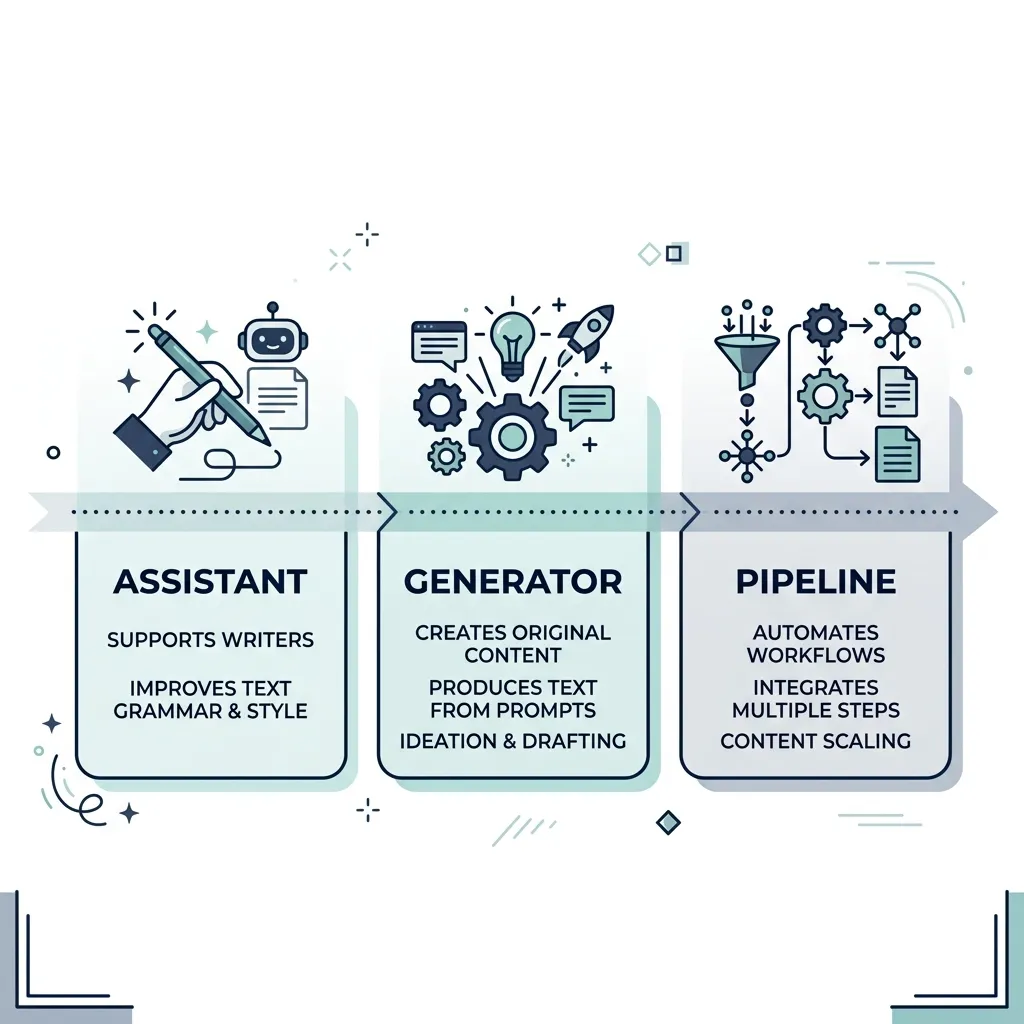
- Tools in this space fall into three different categories — writing assistant, content generator, and content pipeline — and comparing them without that distinction produces noise, not insight.
What an AI Content Writer Actually Is (And What It Is Not)
The phrase “AI content writer” gets applied to tools that do fundamentally different jobs. Treating them as interchangeable is the root cause of most bad tool comparisons.
Here is the plain-English breakdown:
AI writing assistant — a tool that works on content you have already written. Grammarly is the clearest example: it catches grammar issues, improves clarity, and flags style inconsistencies. It does not generate content from a prompt. It refines what you bring to it.
AI content generator — a tool that produces a draft from a prompt or brief. ChatGPT, Jasper, and Claude all fall here. You describe what you want; the tool writes a version of it. What you get back still needs editing, SEO work, and brand voice review — those jobs belong to you.
AI content pipeline — a system that handles strategy, keyword research, writing, and QA as a connected sequence rather than a single generation step. The distinction is not just the output; it is who handles the decisions upstream and downstream of the draft. Veldora AI falls in this category — built for SEO blog content specifically, not general-purpose generation.
All three categories accelerate content production. What separates them is how much of the surrounding work they absorb. A content generator cuts first-draft time. A content pipeline cuts first-draft time and the strategy, research, and QA steps that bracket it.
Understanding which category a tool belongs to is the prerequisite for evaluating it fairly. A grammar checker and a full content pipeline are not solving the same problem.
Top AI Content Writers Compared: Tools, Strengths, and Honest Limitations
The tools below represent the most-searched options in this category plus the strongest specialized alternatives. Coverage is intentionally limited to eight — beyond that, the distinctions get thin and the usefulness drops.
Evaluation criteria: output quality for stated use case, free tier usability, SEO capability, pricing transparency, and workflow fit. Pricing is noted as of June 2025 and will change — confirm on each tool’s pricing page before committing.
| Tool | Best For | Free Tier | Standout Feature | Notable Limitation | Starting Price |
|---|---|---|---|---|---|
| ChatGPT (OpenAI) | Flexible drafting, ideation, short-form copy | Yes (GPT-4o with limits) | Handles almost any content format with a good prompt | No SEO layer, no brand memory, no QA — all editorial work falls on the user | Free; Plus at $20/mo |
| Claude (Anthropic) | Long-form drafts, nuanced tone, research synthesis | Yes (limited usage) | Holds context and coherence across long drafts better than most tools | No built-in SEO optimization — keyword strategy and heading structure require a separate tool | Free; Pro at $20/mo |
| Jasper AI | Marketing teams producing high-volume branded content | Limited (7-day trial) | Brand voice training and templates purpose-built for marketing copy | Expensive at scale; output quality on long-form SEO content requires significant editing | Creator at $49/mo |
| Copy.ai | Workflow automation for sales and marketing content | Yes (limited credits) | Automated workflows connecting multiple content generation steps | Weaker on long-form blog content; SEO integration is surface-level, not strategic | Free; Starter at $49/mo |
| Grammarly | Editing and style refinement of existing drafts | Yes (core features) | Real-time grammar, clarity, and tone suggestions inside your existing workflow | It is an editor, not a generator — does not produce content from a brief | Free; Premium at $12/mo |
| Surfer SEO | SEO-optimized content scoring and optimization | No | Live content scoring against top-ranking pages during editing | Requires you to bring your own draft — it optimizes, it does not generate strategy or briefs | Essential at $99/mo |
| Frase | SEO research and brief generation for content teams | Limited (trial available) | Fast SERP research and AI-assisted brief creation in one interface | The writing assistant output is adequate but still needs significant editing before publish | Basic at $45/mo |
| Veldora AI | SMBs and agencies needing SEO blog content at scale | Demo (proof-of-concept, not a free tier) | Full pipeline — strategy, keyword research, brand-matched writing, and QA as a connected system | Scoped to SEO blog content — not built for ad copy, emails, social posts, or short-form formats | Credit-based; see demo |
A few annotations worth calling out:
Claude holds context well across a full 3,000-word draft in a way that ChatGPT’s default behavior does not consistently replicate. But it has no built-in SEO layer — you will need a separate tool to check keyword distribution and heading structure before that draft is ready to publish.
Jasper’s brand voice training is real and useful for marketing teams with established style guides. The limitation is cost: at production volume for a content-heavy team, the pricing adds up quickly, and the long-form SEO output still typically requires a substantive editing pass.
Veldora operates differently from every other tool on this list. It is not a draft generator you prompt and edit — it runs the AI writing built around content strategy and SEO, from keyword research through a QA review, built on 12 years of agency SEO experience. That distinction matters for the right audience and is irrelevant for others. See the user-type section below.
Which AI Content Writer Should You Use? Recommendations by User Type
The comparison table tells you what each tool does. This section tells you which one fits your situation.
There is no universal answer here. A solo blogger on a tight budget and a marketing team producing thirty posts a month have different constraints, different quality bars, and different tolerances for workflow complexity. The recommendations below reflect that.
| User Type | Recommended Tool | Key Reason |
|---|---|---|
| Freelance writer | ChatGPT (Plus) | Maximum flexibility for varied client formats; the SEO and editing work you are already doing manually fits naturally around it |
| Solo blogger | Claude or ChatGPT free | Claude handles longer drafts with better coherence; ChatGPT free is sufficient for shorter posts if you have a strong editing habit |
| Marketing team | Jasper AI | Brand voice training and marketing-specific templates reduce rework on high-volume campaigns; worth the cost at team scale |
| Agency | Veldora AI | Purpose-built for SEO content at scale without building an internal team — strategy and QA are included, not bolted on afterward |
| SMB needing SEO content | Veldora AI | Handles the full pipeline an SMB cannot staff internally — maintaining brand voice as a built-in structural feature, not a manual step |
A few clarifications:
Freelancers and solo bloggers will get the most from ChatGPT or Claude — both have usable free tiers, handle varied content formats, and fit into a workflow where the writer is already doing their own editing and SEO. Jasper is overkill for a solo operation at its price point.
Marketing teams producing branded content at volume will find Jasper’s templating and brand voice training worth the investment. Copy.ai is a reasonable alternative if workflow automation between content tasks is the priority.
Agencies and SMBs that need ongoing SEO blog content without building an internal production team are the correct audience for Veldora. The pipeline handles what an SMB cannot staff: strategy, research, writing, and QA. The demo produces real content you can read before committing.
AI Content Quality: What to Expect and Where Human Editing Still Matters
AI content quality problems are specific and consistent. They are not a reason to avoid these tools — but they are a reason to build an editing checkpoint into every AI-assisted workflow. “Proofread before publishing” is not a sufficient instruction.
Here is what you will actually encounter:
Hallucinated facts and statistics. AI tools will sometimes cite statistics that do not exist, attribute quotes to real people who never said them, or describe tool features that are outdated or invented. Every factual claim in an AI draft needs a source check before publishing. This is not a rare edge case — it is a consistent behavior across all generation-based tools.
Tone drift in long drafts. A 2,500-word article drafted in a single generation pass will often shift register somewhere in the middle — formal in the intro, suddenly casual in section three, slightly academic in the conclusion. This is difficult to catch unless you read the draft straight through with your brand voice guide in hand.
Keyword stuffing patterns. AI tools trained on SEO content will sometimes over-optimize — inserting the target keyword in phrasing that reads unnaturally, or repeating it at a density that signals manipulation rather than relevance.
Boilerplate framing. Intros that open with a rhetorical question, conclusions that summarize everything and end with “in conclusion” — AI defaults to the most statistically common structure. That structure is usually the least interesting version of your content.
On AI detection risk: Detection tools exist and are used. Google’s official guidance on AI-generated content makes clear that the quality and helpfulness of the content matters — not the method of production. The practical implication: focus on producing genuinely useful, accurate, original content rather than trying to game detection systems. Independent research on AI content detection accuracy consistently shows detection tools produce meaningful false-positive rates, which means the editorial quality bar — not the detection score — is the right north star.
Content types where AI performs reliably with moderate editing: structured how-to posts, product descriptions, comparison articles with defined criteria, FAQ content, and templated marketing copy.
Content types that require significant human input: thought leadership, technical content requiring domain expertise, highly nuanced brand voice, content making original arguments, and anything involving real-time or proprietary data.
Connecting this to brand voice specifically: the most reliable structural approach to reducing tone drift is building brand voice rules into the generation layer rather than trying to catch drift in editing. That is the design intent behind maintaining brand voice in AI-assisted content — reduce the problem upstream rather than manage it entirely in post. It also contributes to how AI content performs over the long term in search — consistent voice and editorial quality compound in ways that generic output does not.
Pre-Publish Editing Checklist for AI-Generated Content
Use this before publishing any AI-drafted content, regardless of which tool produced it:
- Fact-check every specific claim, statistic, or named source the AI generated — do not assume accuracy
- Read the full draft for tone consistency — identify any sections where the register shifts from your brand voice
- Flag and verify any tool features, pricing figures, or capability claims the AI described
- Rewrite the intro if it opens with a rhetorical question or generic scene-setting — AI defaults to the most common structure, not the most effective one
- Check the conclusion — if it summarizes everything you just said and ends on a vague call to action, it needs a rewrite
- Review for keyword stuffing or unnatural keyword placement in headings and body copy
- Verify all CTAs, links, and directional claims are accurate and current
- Run the draft through your preferred AI detection tool if your publication context requires it — but treat editorial quality as the primary standard, not the detection score
How to Build a Simple AI Content Writing Workflow
AI writing tools work best as part of a workflow, not as a one-step solution. The tools that reduce friction over time are the ones that fit a clear process — not the ones with the longest feature list.
A realistic five-step workflow for blog content production:
-
Ideation and brief — Define the topic, target keyword, audience, and intended outcome before touching a generation tool. ChatGPT or Claude can help develop a brief if you do not have one; Frase can pull SERP research quickly. If you are using Veldora, this step is handled by the pipeline — strategy and keyword research are included before a word is written.
-
AI draft generation — Generate the first draft using your tool of choice. For long-form SEO content, Claude or a pipeline tool like Veldora will produce a more coherent starting point than a quick ChatGPT prompt. Treat the output as a strong first draft, not a finished product.
-
Editing and fact-check — Apply the pre-publish checklist above. This step is not optional. Hallucinations, tone drift, and boilerplate framing require a human pass on every draft. Time estimate: 30–60 minutes for a 1,500-word post, depending on draft quality.
-
SEO optimization — If your generation tool does not include SEO scoring, run the draft through Surfer SEO or Frase to check keyword distribution, heading structure, and content depth against current ranking pages. This step is where standalone generation tools show their gap most clearly.
-
Final review and publish — Confirm the CTA is accurate, all links work, and the piece matches your brand voice end to end. If you are working with a multi-person team, this is the approval gate before scheduling.
A realistic SMB workflow might look like: Veldora for strategy and draft → human editor for tone and fact-check → Surfer SEO for keyword distribution check → final publish. Each step has a defined owner and a defined job. That clarity is what makes AI content production sustainable rather than a perpetual fire drill.
Be honest with yourself about time: AI cuts first-draft time significantly. It does not eliminate total content production time when editing and optimization are included. A workflow that accounts for the editing step will hold up; one that assumes the draft is the output usually does not.
AI Content Writer Pricing: Free Tiers and Paid Plans Compared
Free tiers vary enormously in actual usability — not just in credit limits, but in which features are locked and whether the free output is representative of what the paid product delivers. Most roundups skip this because it complicates the easy “just try it for free” message.
Here is what you actually get on each tier, as of June 2025:
| Tool | Free Tier Details | Key Feature Locks on Free | Paid Starting Price |
|---|---|---|---|
| ChatGPT | GPT-4o access with daily usage limits | Limited messages on GPT-4o; no memory features; no custom GPT access on lowest tier | $20/mo (Plus) |
| Claude | Free tier with usage caps (varies by demand) | Usage throttled heavily during peak times; no Projects or extended context on free | $20/mo (Pro) |
| Jasper AI | 7-day free trial only — no ongoing free tier | Full feature lock after trial; brand voice training requires paid plan | $49/mo (Creator) |
| Copy.ai | Free plan with limited credits | Workflow automation locked to paid plans; limited monthly word generation | $49/mo (Starter) |
| Grammarly | Core grammar and spelling features | Advanced style suggestions, tone detection, and plagiarism checker require paid | $12/mo (Premium) |
| Surfer SEO | No free tier | All features require subscription | $99/mo (Essential) |
| Frase | Limited trial available | Full SERP research and AI writing assistant require paid plan | $45/mo (Basic) |
| Veldora AI | Free demo (proof-of-concept output, not an ongoing free tier) | Demo produces real strategy-backed content for review — not comparable to ChatGPT free access | Credit-based; see demo |
For freelancers and solo bloggers: ChatGPT’s free tier is genuinely useful for testing output quality and handling shorter content. Claude’s free tier works for occasional long-form drafts when usage limits are not throttled. These are the strongest free options in the category.
For marketing teams: Jasper’s trial gives you a meaningful window to test brand voice training and template quality. The free tier on Copy.ai is functional but limited — workflow automation, which is Copyai’s core differentiator, requires a paid plan.
For agencies and SMBs: Veldora’s demo is not a free tier — it is a proof-of-concept that produces a real, strategy-backed post you can read and judge before spending anything. That is a different value proposition than a credit-limited free plan. See what your actual content would look like before you commit.
Generate a real, strategy-backed post on the Veldora free demo and read it yourself — before you spend a dollar. No credit card. No contracts. Just proof.
Frequently Asked Questions
What is the best free AI content writer?
For most users, ChatGPT’s free tier is the strongest starting point — it handles a wide range of content formats and the GPT-4o model is accessible without a subscription, though with daily usage limits. Claude’s free tier is worth testing specifically for longer drafts. Neither is a production workflow on its own — free tiers are best used to evaluate output quality before committing to a paid plan.
Can AI-generated content hurt my SEO rankings?
Producing low-quality, generic, or factually inaccurate content can hurt rankings — regardless of whether a human or an AI wrote it. Google’s guidance on AI-generated content focuses on whether content is helpful, accurate, and serves the reader — not on how it was produced. AI content that has been properly edited, fact-checked, and optimized for a real audience does not carry an inherent SEO penalty.
How do I keep my brand voice when using an AI content writer?
The most reliable approach is to address brand voice at the generation stage, not just in editing. That means providing explicit style instructions in your prompt, using a tool with brand voice training capabilities (Jasper and Veldora both offer this in different ways), and building a tone review into your pre-publish checklist. Catching tone drift in editing is possible — it is just slower and more inconsistent than reducing it upstream.
Is ChatGPT good enough for content writing, or do I need a dedicated tool?
ChatGPT handles short-form content, ideation, and varied format requests well — it is the most flexible starting point in the category. The gap shows on SEO-specific blog content at scale: no built-in keyword strategy, no brand memory across sessions, and no QA layer. For a freelancer producing varied content types, ChatGPT Plus is often sufficient. For a team needing consistent, SEO-optimized blog output, the gaps add up quickly.
What types of content can AI writers produce reliably without heavy editing?
AI performs most reliably on structured formats with defined criteria: FAQ content, comparison articles, product descriptions, step-by-step how-to posts, and templated marketing copy. Content requiring original argument, genuine domain expertise, real-time data, or a highly distinctive voice requires significantly more human input — the AI draft becomes a starting point, not a near-final product.
What is the difference between an AI writing assistant, an AI content generator, and an AI content pipeline?
An AI writing assistant (like Grammarly) works on content you have already written — it edits and refines. An AI content generator (like ChatGPT or Jasper) produces a draft from a prompt or brief — the strategy, SEO, and quality review are still your responsibility. An AI content pipeline (like Veldora) handles strategy, research, writing, and QA as a connected system — it absorbs more of the surrounding work, not just the drafting step. These three categories are not interchangeable, and comparing them as if they solve the same problem is where most tool comparisons go wrong.
Ready to see what a strategy-backed AI content pipeline actually produces? Try the Veldora demo — generate a real post, read it yourself, and decide from there. No credit card. No contracts. Just proof.
← Back to all posts