AI Content Creation: How to Choose Tools, Build a Workflow, and Control Quality
By Veldora AI · July 3, 2026

How to Use AI for Content Creation: Tools, Workflows, and Quality Control
You’ve probably tried an AI writing tool at least once. Maybe you pasted in a prompt, got a 1,200-word draft in 15 seconds, and then spent an hour fixing the tone, correcting two facts that turned out to be wrong, and realizing the whole thing sounded like a press release written by no one in particular.
That experience is not a you problem. It’s a process problem.
AI content creation works — but only when the tool matches the format, the workflow has real checkpoints, and someone owns quality at every stage. This article skips the definitions and gets into the decisions: which tools to choose, how to build a workflow you can actually repeat, what to check before you publish, and what Google actually penalizes.
Key Takeaways
- AI tools vary significantly by content format — the tool that produces a usable long-form blog draft will not generate a usable product description without different prompting, different structure, and a different review process.
- A workflow with defined human checkpoints is what separates AI content that performs from AI content that wastes time. Picking the right tool is step one; knowing where human judgment is non-negotiable is the rest of it.
- The most costly AI content failure modes — hallucination, brand voice drift, structural repetition — are predictable and preventable with a pre-publication review process.
- Google does not penalize AI-generated content. It penalizes thin, unhelpful, inaccurate content — which AI can produce efficiently if you let it go unchecked.
- There is no fully automated path to quality AI content at scale. The human layer — fact-checking, brand voice editing, originality review — cannot be skipped, only systematized.
What AI Content Creation Actually Covers (and Where It Struggles)
AI-assisted content and fully AI-generated content are not the same thing — and treating them as interchangeable is where most content strategies go wrong.
AI content adoption research shows generative AI content creation is scaling rapidly across industries, but adoption rate and production quality are separate questions — and most teams conflate them.
AI-assisted content means a human leads the process: setting the brief, shaping the structure, doing the research, and making editorial calls. The AI handles parts of the execution — drafting, restructuring, rewriting — but the judgment stays with the person. Most quality AI content workflows operate this way.
Fully AI-generated content means the output goes from prompt to publication with minimal or no human intervention. This is possible. It’s also where the failure modes compound fastest.
The capability gap across formats is significant:
- Written long-form content (blogs, guides, articles): High AI capability. The structural output from tools like ChatGPT or Claude is genuinely useful as a starting draft. The factual layer is consistently soft — expect hallucinations, especially in anything that requires specific citations, recent data, or technical claims.
- Social copy: High capability for volume and variation. The editing bar is lower, and the risk of catastrophic factual error is reduced. Works well for generating options and testing angles.
- SEO content: Strong capability when the AI has keyword context and content structure guidance. Weak when left to determine search intent or competitive positioning on its own.
- Image generation (DALL-E, Midjourney): Capable for concept visuals and creative assets. Copyright ownership for AI-generated images is legally unsettled in the US — organizational policy should precede commercial deployment at scale.
- Video: Emerging, primarily script-focused. Tools like Synthesia handle presenter-style video from script, but content quality depends entirely on the script quality feeding it.
- Audio: Limited outside transcription (Descript-style) and script preparation. AI-native audio generation for brand content is not production-ready for most teams.
The consistent failure modes across all formats: hallucination (invented facts, statistics, and citations presented as real), generic register (output that sounds like it could have come from any source, because it could), brand voice drift (AI defaults to a corporate-neutral tone regardless of how specific your prompt is), and structural repetition (AI tends to repeat similar sentence constructions and section patterns across a long document).
Knowing these failure modes before you build your workflow tells you exactly where to put your human checkpoints.
Note: Veldora covers written SEO content. The format mapping above is for workflow planning purposes — visual, video, and audio tool selection falls outside the managed pipeline.
How to Choose an AI Tool for Your Content Format and Team
Tool selection is a format-fit decision, not a ranking exercise. The question is not “what’s the best AI writing tool” — it’s “what am I making, and what does this tool actually do well.”
Before looking at specific tools, four selection criteria matter:
- Output quality for the format: Does this tool produce a usable first draft for the specific content type you’re making, or does it produce something that requires full reconstruction?
- Pricing tier and threshold: Free tiers are sufficient for experimentation and single-format drafting. Volume output, brand-specific fine-tuning, and multi-format work almost always require a paid plan.
- Integration: Does the tool connect to your CMS, marketing stack, or editorial workflow — or does it add a manual export step every time?
- Prompting requirements: Some tools produce strong output with minimal prompting (lower learning curve). Others require structured, detailed prompts to get usable output. Know which you’re buying before you deploy it across a team.
| Content Format | Tool | Pricing Tier | Best For | Key Limitation |
|---|---|---|---|---|
| Long-form blog / guide | ChatGPT (GPT-4) | Freemium | Flexible drafting, outline to full draft, rewriting | Factually soft — requires human accuracy review on every draft |
| Long-form blog / guide | Claude | Freemium | Long-context drafting, nuanced tone, document analysis | Can be verbose; needs structural editing for tight articles |
| SEO-integrated writing | Surfer SEO | Paid | Keyword structure, on-page SEO scoring alongside writing | Optimizes for keyword density, not content depth or originality |
| Social copy | Jasper | Paid | Brand voice templates, short-form variation at volume | Template-dependent; output can feel formulaic without custom tuning |
| Product descriptions | Notion AI | Freemium | Embedded drafting inside existing docs and wikis | Limited standalone capability; works best inside Notion workflows |
| Image / visual | DALL-E | Freemium | Concept visuals, illustrative assets, ideation | Copyright ownership legally unsettled; not cleared for all commercial use |
| Image / visual | Midjourney | Paid | High-quality stylized imagery, creative asset generation | Same copyright uncertainty; steep learning curve for consistent output |
| Video (script-to-video) | Synthesia | Paid | Presenter-style video from script, localization | Output quality is entirely script-dependent; no AI script generation built in |
| Audio / transcription | Descript | Paid | Podcast editing, transcription, audio cleanup | Not a content generation tool — production and editing only |
One category the tool matrix above does not cover: managed SEO content pipelines. Tools like the ones above are self-serve — you prompt, you review, you publish. If you’re running SEO content at volume and want strategy, keyword research, writing, and QA handled in a structured pipeline, that’s a different product category. AI writing grounded in a structured content strategy is what separates a managed pipeline from a standalone tool — the strategy layer is built in, not improvised at the prompt level.
Building an AI Content Workflow: From Brief to Published
The tools are available to everyone. The workflow is the actual differentiator.
Every team using AI for content production eventually hits the same point: the tool works, the output is passable, but the process is inconsistent. Some drafts are close to publishable. Others need full rewrites. The variance comes from the workflow — or the lack of one.
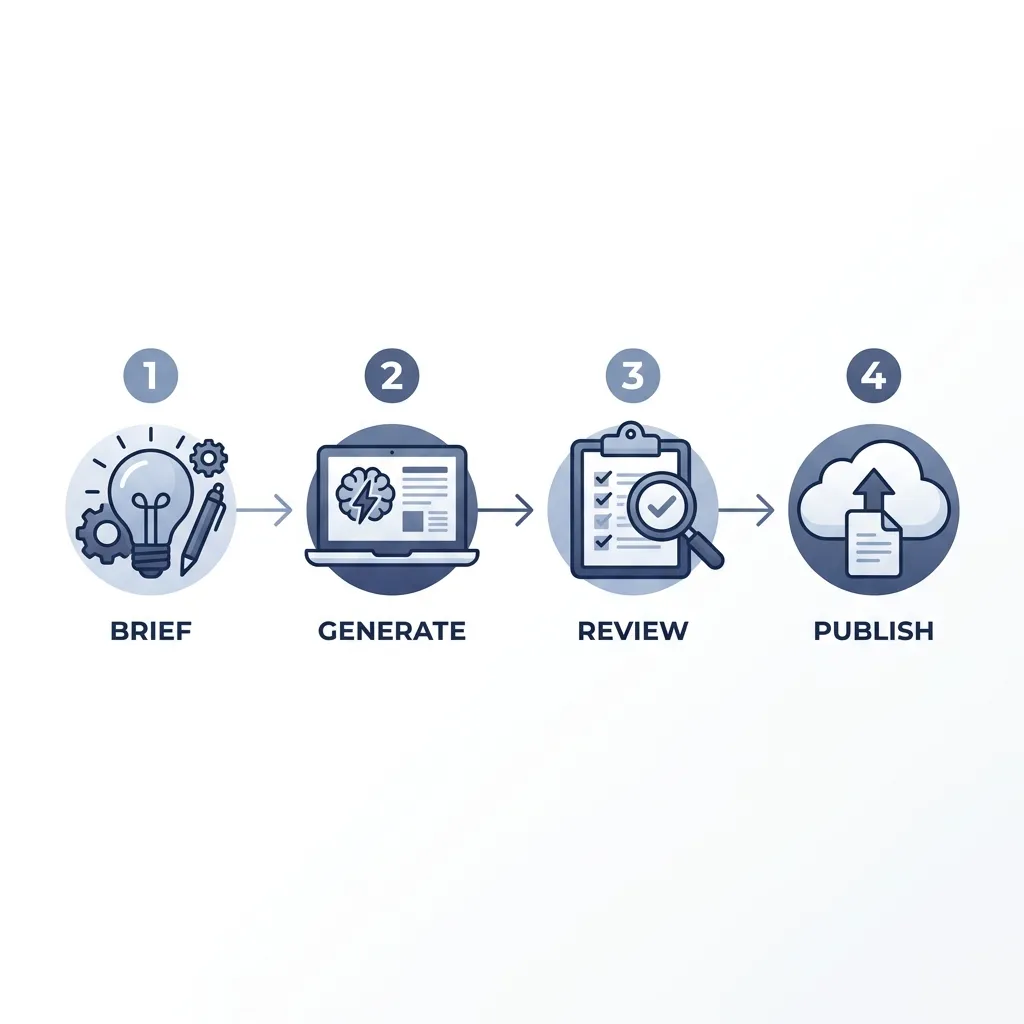
Here is a repeatable seven-step process that works for written content across formats. Some steps compress for short-form; all steps apply for long-form editorial content.
- Define the goal and audience — Before touching a tool, know what this piece is for, who is reading it, what action they should take, and what question it answers. An underdefined brief produces an underdefined draft regardless of which AI you use.
- Develop a specific prompt with context and constraints — Input quality determines output quality. A weak prompt: “Write a blog post about content marketing.” A specific prompt: “Write a 1,500-word post for content managers at B2B SaaS companies about integrating AI into an existing editorial workflow. Tone is direct and practical. Avoid generic AI enthusiasm. Structure: intro, workflow steps, quality control, SEO risk, close. Include one concrete example of a prompt that fails and one that works.” The difference in output is not small.
- Generate the draft — Run the prompt. If the output misses the structure or tone, adjust the prompt and regenerate before editing. Editing a structurally wrong draft is slower than reprompting.
- Human review for accuracy and tone (non-negotiable checkpoint) — Read the draft as an editor, not as a proofreader. Is the argument coherent? Does the structure serve the reader? Does it actually say something, or does it assemble familiar sentences around the topic?
- Fact-check all claims (non-negotiable checkpoint) — Every specific statistic, citation, named study, date, or proper noun needs verification against a primary source. AI does not self-correct on accuracy. Hallucinated citations look identical to real ones in the output.
- Brand voice edit (non-negotiable checkpoint) — AI output defaults to a generic register. If your brand has a specific tone, vocabulary, sentence length, or things it never says, this is where you enforce them. This step cannot be skipped at scale — see the brand voice section below.
- SEO compliance check and publish — Confirm the target keyword appears naturally, the structure serves the search intent, and no keyword-stuffing patterns crept in during generation. Then publish.
For social copy, steps 1–3 and a light version of step 6 are often sufficient. For product descriptions, a templated prompt (with variable inputs for SKU-specific details) can compress steps 1–3 into a near-automated pass. For long-form SEO content, all seven steps apply every time.
If that workflow sounds like significant overhead, it is — until it’s documented and assigned. Teams that invest in the workflow design upfront get consistent output. Teams that skip it spend more time on revision than they saved on drafting.
For how AI-assisted content built on this kind of process affects long-term search performance, the dynamics behind how AI-assisted content supports long-term SEO performance are worth understanding before you scale output.
Quality Control: What AI Gets Wrong and How to Catch It Before You Publish
Quality control is not optional when publishing AI content. It is the entire game.
The failure modes are predictable — which means they’re manageable, as long as you build the review process before you build the output volume.
Hallucination is the most damaging. AI models generate text that is statistically plausible, not factually verified. A model citing “a 2022 Stanford study showing that 74% of marketers…” may have invented both the study and the statistic. The citation reads as real. The source does not exist. This is a common failure mode in any content that requires specific data points, and it is why accuracy review is a non-negotiable checkpoint — not a nice-to-have.
Generic register is less catastrophic but more pervasive. AI output defaults to a tone that is competent, neutral, and completely indistinct from every other AI-generated article on the same topic. For SEO content, this is a quality problem. For brand content, it is an identity problem.
Brand voice drift happens even when you prompt carefully. The model will revert to its training distribution over the course of a long document. The opening section may match your tone; the closing section often does not.
Structural repetition is easy to miss on a first read. AI tends to use similar sentence constructions across sections — the same transitional phrases, the same “first… second… third” scaffolding, the same pattern of topic sentence followed by two supporting examples followed by a conclusion sentence. A long document can feel repetitive without any individual section being obviously wrong.
When full rewrite is more efficient than editing: If a draft has more than two or three factual errors, if the tone is fundamentally off-brand throughout, or if the structure does not fit the content goal — the cost of editing exceeds the time saved by AI drafting. In those cases, identify where the prompt failed and regenerate rather than rescue a draft that isn’t salvageable.
High-risk content types where AI errors carry elevated cost: anything touching regulatory claims, medical guidance, legal interpretation, financial advice, or product safety. The error tolerance in these areas is near-zero, and AI is not equipped to self-identify where it is speculating versus stating fact.
Veldora’s multi-step QA process is built as a systematic review layer — not a vague quality promise. It is a structured checkpoint sequence applied to every piece of SEO content before it leaves the pipeline. It does not eliminate the possibility of errors. It applies a defined process to catch the predictable ones.
Before you publish any AI-generated content, run through this checklist:
- Accuracy: Every factual claim, statistic, and named study verified against a primary source
- Accuracy: No hallucinated citations, invented proper nouns, or fabricated data points
- Accuracy: Dates, figures, and company names confirmed against the actual source
- Tone: Output matches brand voice guidelines — not a generic AI register
- Tone: No phrases or constructions your brand explicitly avoids
- Originality: No verbatim passages that read as templated or structurally repeated from section to section
- Originality: The content adds something — analysis, synthesis, a specific example — that is not already on the first page of search results
- SEO: Target keyword used naturally; no keyword-stuffing patterns visible
- SEO: Content directly and completely answers the search query it targets
- Structure: Headings reflect actual section content, not keyword-loaded filler
- Disclosure: AI assistance disclosed where required by platform policy, organizational policy, or FTC-covered sponsored content rules
AI Content and SEO: What Google Actually Penalizes
This is the most mischaracterized question in AI content marketing, and the mischaracterization goes in both directions.
Google’s official guidance on AI-generated content and search quality is direct: AI-generated content is not inherently penalized. What Google’s systems evaluate is quality — whether the content is helpful, accurate, original, and genuinely useful to the person searching. The production method is not the signal. The output quality is.
That means an AI-drafted article that goes through rigorous fact-checking, editorial review, and genuine insight addition is treated the same as a human-drafted article meeting the same quality bar. It also means a human-written article that is thin, keyword-stuffed, and provides no original value is exactly as penalizable as an AI-generated one with the same characteristics.
The specific signals that create SEO risk in AI content:
- Thin content with no original insight: AI is very good at assembling what other sources have said. Content that does only that — summarizes the SERP rather than adding to it — does not meet Google’s helpful content standard.
- Keyword-stuffed structure: AI can be prompted into keyword-stuffing patterns, especially when given optimization targets without editorial constraints. The output looks optimized; it reads as manipulative.
- Factual inaccuracies: A hallucinated statistic or fabricated citation that makes it into a published article is not just a credibility problem — it is a quality signal that undermines the piece’s usefulness to the reader.
- Structural content that doesn’t serve search intent: AI output is sometimes structurally complete but intent-wrong — a listicle when the searcher needed a comparison, or an overview when the searcher needed a how-to.
| Safe Practice | Risky Practice |
|---|---|
| AI-assisted drafting with human fact-checking and editorial review | Fully automated publishing with no human review before going live |
| Original insight, analysis, or synthesis added to AI-generated structure | Thin content that summarizes other pages without contributing new value |
| Accurate, source-verified claims with attribution visible in the content | Fabricated statistics or hallucinated citations published without verification |
| Content that directly and completely answers the target search query | Keyword-stuffed AI output with no structural or substantive editing |
| Editorial pass that enforces brand quality bar before publication | Treating AI draft as final copy because it passed a grammar check |
On AI content detection tools: they are unreliable as enforcement mechanisms. Detection models produce false positives on human writing and false negatives on AI writing regularly. Google has not indicated it uses AI detection scores as a direct ranking signal. The quality bar — not the detection question — is what actually matters for search performance.
For teams building toward search equity over time, the connection between AI content quality and compounding organic results is a separate topic worth exploring in how AI-assisted content supports long-term SEO performance.
Brand Voice, Disclosure, and the Human Layer You Cannot Automate Away
Brand voice is the hardest thing AI gets consistently wrong — and the least-discussed in most AI content guides.
The model does not know how your brand sounds. It approximates a professional tone based on its training distribution. For most organizations, that approximation is a starting point, not a deliverable.
Practical techniques for brand voice preservation:
- Embed style guide context in the prompt: Include tone description, vocabulary guidelines, sentence length targets, and what your brand explicitly avoids. “Write in a direct, practical tone. No corporate language. Avoid phrases like ‘leverage,’ ‘synergy,’ or ‘in conclusion.’ Sentences under 25 words where possible.”
- Use example-based prompting: Give the model a 2–3 sentence sample from existing brand content. “Write in the following style: [paste sample]. Match the sentence rhythm and level of directness.” This consistently outperforms abstract tone descriptions.
- Build a post-edit style pass into every workflow: No matter how good the prompt, the final draft needs a human read specifically for voice — not just for accuracy. This is not optional at scale.
Veldora’s preserving brand voice in AI-generated content handles this as a systematic step rather than a manual pass added by whichever editor has time. It does not guarantee perfect fidelity without client review — no AI pipeline does — but it removes the inconsistency that comes from leaving voice alignment to ad hoc post-editing.
On disclosure: There is no universal legal requirement in the US to disclose AI assistance in editorial content. Platform rules vary — LinkedIn, for example, has its own content policies, and FTC rules apply to AI-generated sponsored content the same way they apply to any sponsored content. Organizational policies differ. Audience trust considerations apply independently of any formal requirement.
Treat disclosure as a strategic decision, not just a compliance question. In most editorial contexts, the relevant question is not must we disclose but what does our audience expect, and does non-disclosure create a trust problem if the process becomes known.
On copyright for AI-generated visual content: Ownership of AI-generated images is an evolving, jurisdiction-dependent question in the US. The US Copyright Office has declined to register works produced without human authorship, and commercial use of AI-generated images carries risk that organizational policy should address before deployment at scale — not after.
Frequently Asked Questions
Will Google penalize my site for publishing AI-generated content?
No — not for being AI-generated. Google’s systems evaluate content quality, not production method. Content that is thin, inaccurate, keyword-stuffed, or unhelpful to the reader is what triggers quality penalties, regardless of whether a human or an AI wrote it. The fix is the same in both cases: make it accurate, make it useful, and make it say something the reader could not find just as easily on the next result.
How much human editing does AI-generated content actually need before publishing?
It depends on the content type and how good your prompt was. A well-prompted long-form draft from a capable model typically needs a fact-check pass, a brand voice edit, and a structural review before it meets a quality bar. That can be 30–60 minutes of work on a 1,500-word article. If the draft has multiple factual errors or is fundamentally off-tone, a full rewrite is usually faster than salvaging it. Social copy and short-form content have a lower editing bar. High-stakes content — anything with regulatory, legal, medical, or financial claims — needs a thorough review regardless of who drafted it.
What is the best AI tool for writing long-form blog content?
ChatGPT (GPT-4) and Claude are the tools most practitioners actually use for long-form written drafts. Both produce usable structures with strong prompts. Claude handles longer context windows and tends to maintain document coherence over longer pieces. ChatGPT is more flexible for iteration and reprompting mid-process. Neither replaces human accuracy review — both hallucinate on specific factual claims. If you need SEO structure built into the output rather than added post-generation, a tool like Surfer SEO integrates keyword guidance into the writing process directly.
How do I maintain my brand voice when using AI writing tools at scale?
Three things that actually work: embedding specific style constraints in every prompt (not just abstract tone descriptions), using example-based prompting with 2–3 sentences from your existing content, and building a dedicated voice-check pass into your review workflow. At scale, consistency requires that these steps are documented and followed on every piece — not applied when someone remembers to. A managed pipeline with brand voice built into the production process removes the inconsistency that comes from treating voice alignment as an afterthought.
What do I do if my AI content contains inaccurate information?
Catch it before publishing — that is the goal of the accuracy review step. If inaccurate content has already been published, correct it promptly and visibly. For high-traffic pages, a brief correction note or updated timestamp with a review note is appropriate. Do not leave inaccurate AI content live; the credibility cost compounds over time. Prevent recurrence by adding the specific failure mode to your prompt constraints and reviewing checkpoint process.
Is AI-generated image content safe to use commercially?
With caveats. US copyright law does not currently protect AI-generated works without meaningful human authorship, which creates uncertainty around commercial rights. Major platforms have terms of service that vary on AI-generated content. The safest approach is to check the specific tool’s commercial use terms, establish an organizational policy before deploying AI images at scale, and avoid using AI-generated visuals in contexts where rights clarity is legally material — product packaging, licensed media, regulated advertising.
Start With Proof, Not a Pitch
If you’ve read this far and you’re wondering whether AI content can actually work inside your workflow — or whether the quality bar described here is achievable — the right answer is to verify it yourself before committing to anything.
Veldora runs a complete SEO content pipeline: keyword research, competitive analysis, strategy-backed writing, multi-step QA, and brand matching — built on 12 years of agency experience and structured as a transparent, reviewable process with no contracts and no markup.
Generate a real, strategy-backed post on the free demo and read it yourself — before you spend a dollar. No credit card. No contracts. Just proof.
See your strategy before you pay.
← Back to all posts