Best AI Content Creation Tools (2026): Matched to Your Use Case
By Veldora AI · July 13, 2026 · Updated July 13, 2026

AI Content Tools Compared: How to Choose the Right One for Your Workflow
Most AI tool roundups will give you a list. What they won’t give you is a reason to pick one over another for your specific situation. That gap has a real cost: you end up with a tool that produces output you still have to fix, a subscription you’re not getting value from, or both.
This article applies a consistent evaluation framework across the tools that actually matter for content production — generalist LLMs, purpose-built writing tools, SEO-specific platforms, and full-pipeline automation systems. The goal is to help you match the right tool to your workflow, not expose you to a longer catalog.
Key Takeaways
- ChatGPT and Claude are the strongest generalist options for long-form drafting — if you write effective prompts. Purpose-built tools add value mainly through templates, workflow structure, and built-in optimization layers, not better underlying writing.
- The generalist vs. purpose-built distinction is the most important decision you’ll make. A general LLM gives you flexibility and lower cost. A dedicated tool gives you structure and faster repetitive output. The wrong choice for your use case will cost you in editing time.
- AI detection risk is real but conditional. Google’s ranking risk is tied to low-quality, unhelpful content — not AI origin. Lightly edited first drafts are a quality problem, not an AI problem. The detection question matters most in high-authority editorial contexts, not across the board.
- Free tiers are good for testing output quality, not for production workflows. Every tool on this list has a free or trial tier. Use it to evaluate output before committing to a paid plan.
- Automation-first tools solve a volume and consistency problem, not a single-piece quality problem. If your bottleneck is one article per week, a pipeline tool adds overhead. If you’re publishing 20–40+ posts per month across multiple clients, a pipeline changes the equation entirely.
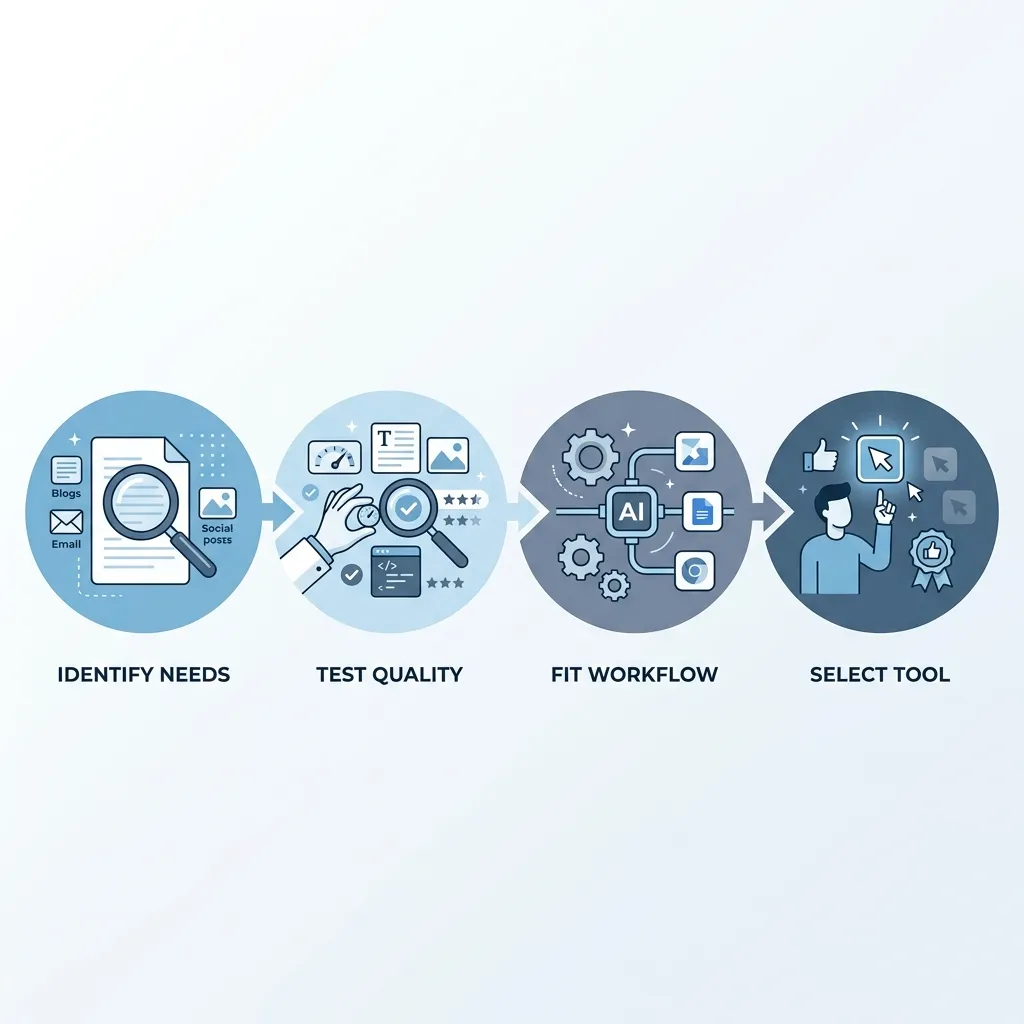
Quick-Pick: Best AI Content Tools by Use Case
If you already know your primary content type, start here. These picks reflect defensible category strengths — not universal rankings. The decision framework in the next section helps you confirm fit.
| Use Case | Recommended Tool | One-Line Rationale |
|---|---|---|
| Long-form blog writing | Claude (Anthropic) | Produces more nuanced, readable prose than most alternatives for the same prompt — best for drafting and structural outlining |
| SEO-optimized articles | Surfer AI or Frase | Optimization workflow is built in — keyword coverage, topical structure, and NLP scoring are native, not add-ons |
| Social media copy | Copy.ai | Template-driven short-form output at volume — consistent brand tone with minimal per-post prompting |
| Ad copy and variants | Jasper | Strong template library for performance copy formats — headlines, CTAs, and variant generation are where it earns its price |
| Video scripting | ChatGPT (GPT-4) | Flexible enough to handle structure, tone, and length variation for scripts — no specialized tool does this significantly better |
| High-volume / agency workflows | Veldora | Full pipeline from research to QA — strategy, writing, and optimization handled as a system, not as separate tools |
These are starting points. A solo creator writing one post per week has different constraints than an agency running content for 15 clients. The section below helps you stress-test the recommendation against your actual situation.
How to Evaluate AI Content Tools: A Decision Framework That Actually Helps
The question isn’t which tool has the best feature set. It’s which tool fits the job you’re actually trying to do. Here are the seven criteria that matter.
1. Content type fit — Different tools are optimized for different formats. Long-form blog posts, short-form social copy, ad variants, SEO articles, and video scripts have different structural and stylistic requirements. A tool that excels at one format often underperforms at another.
2. Output quality and editing overhead — The relevant question is not “does this tool write well?” It’s “how much editing does a typical output need before it’s publishable?” Some tools produce solid first drafts; others produce structural scaffolding that requires significant revision.
3. Pricing and free-tier viability — Free tiers vary significantly in what they let you actually test. Some restrict word count. Others restrict model access. Evaluate whether the free tier lets you test output quality for your specific content type before paying.
4. Workflow integration — Where does the tool fit in your existing production process? Some tools require you to manage research, briefing, writing, and QA separately. Others systematize one or more of those steps.
5. Brand voice capability — Generic AI output fails because most teams skip voice configuration. Tools vary significantly in how well they accept, retain, and apply brand voice inputs — and whether that capability requires manual prompting each time or is built into the system.
6. Generalist vs. purpose-built fit — A generalist LLM (ChatGPT, Claude) gives you maximum flexibility and low cost. A purpose-built tool (Jasper, Surfer, Copy.ai) gives you structured output faster for specific formats. The tradeoff is real in both directions.
7. AI detection risk tolerance — Whether detection risk matters depends on your publishing context. High-authority editorial publishing has different requirements than local service pages or internal documentation.
Decision Matrix: Match Your Situation to the Right Tool Category
| Your Situation | Prioritize This | Recommended Tool Category |
|---|---|---|
| Solo creator, 1–4 posts/month, tight budget | Output quality per post, low cost | Generalist LLM (ChatGPT, Claude) |
| Small marketing team, mixed content types | Flexibility, brand voice, moderate volume | Purpose-built writing tool (Jasper, Copy.ai) or generalist LLM with strong prompts |
| SEO-focused team, ranking is the primary goal | Keyword coverage, topical structure, optimization workflow | SEO-specific tool (Surfer AI, Frase) |
| Agency or team publishing 20+ posts/month | Consistency at volume, reduced per-piece overhead, QA layer | Full-pipeline system (Veldora) |
| Primarily short-form copy (ads, social, email) | Template speed, variant generation, consistency | Purpose-built copywriting tool (Copy.ai, Jasper) |
| Multilingual content needs | Model language coverage | ChatGPT or Claude — both handle major languages reasonably well; purpose-built tools vary significantly |
Tool Evaluation Checklist
Use this before committing to any paid plan — including tools not covered in this article.
- Does this tool fit my primary content type (long-form, short-form, SEO, social, ad copy)?
- What does the free tier actually let me test — and is that test representative of production use?
- How much editing does a typical output require before it’s publishable?
- Does the tool preserve or adapt to my brand voice, and does it require manual re-prompting to do so?
- What happens to output quality when I increase production volume?
- Does my use case require human-indistinguishable content, and does this tool address AI detection risk?
- What steps in my workflow does this tool replace — and which steps does it still require me to manage separately?
Writing and Long-Form Content Tools: ChatGPT, Claude, Jasper, Copy.ai, Writesonic, Notion AI
ChatGPT (GPT-4 / GPT-4o)
Best For: Flexible long-form drafting, outlining, content repurposing, video scripts, and any use case that benefits from conversational iteration.
Pricing: Free tier available (with limited access to advanced models). ChatGPT Plus runs approximately $20/month — verify current pricing at openai.com.
Key Strengths
- High output flexibility across formats and tone ranges
- Strong at structural outlining and content repurposing
- Iterative prompting lets you refine output in the same session
- Wide template community and prompting resources available
Key Limitations
- Output quality is highly prompt-dependent — weak prompts produce generic output
- No built-in SEO optimization layer; keyword targeting requires manual prompting
- Brand voice requires explicit prompting every session — no persistent memory by default in standard plans
- Editing overhead on long-form drafts is real; the output often lacks original argumentation
When NOT to use it: When you need consistent branded output across a high-volume workflow without per-post prompting. Also not ideal as a primary SEO content tool — optimization has to happen outside the tool.
Claude (Anthropic)
Best For: Long-form prose that requires nuance, tone consistency, and readability. Strong for editorial drafts, narrative content, and detailed explanations.
Pricing: Free tier available. Claude Pro runs approximately $20/month — verify at anthropic.com.
Key Strengths
- Produces more readable, less formulaic long-form prose than most alternatives for the same prompt
- Handles complex instructions and multi-part briefs better than most general LLMs
- Better at sustained tone consistency across longer documents
- Stronger at nuanced argumentation for thought leadership content
Key Limitations
- Requires stronger prompting than some purpose-built tools to get structured content outputs
- No built-in SEO workflow or content optimization features
- Less template infrastructure than Jasper or Copy.ai for structured short-form formats
- Brand voice still requires manual session-level prompting
When NOT to use it: When you need templated, high-volume short-form copy output. Or when your team needs guided structure rather than a blank-canvas drafting engine.
Jasper AI
Best For: Templated short-form marketing copy — ad headlines, email subject lines, product descriptions, and social posts — where consistency and brand tone at volume matter.
Pricing: No permanent free tier. Trial available. Paid plans start around $49/month — verify current pricing at jasper.ai. Third-party user ratings for Jasper are available on Gartner Peer Insights.
Key Strengths
- Large library of purpose-built templates for marketing formats
- Brand voice inputs are a native feature, not an afterthought
- Faster than general LLMs for repetitive short-form tasks
- Team collaboration features are more developed than most alternatives
Key Limitations
- Long-form blog output tends toward competent filler rather than substantive content — the template structure that helps with short copy constrains long-form argumentation
- At the price point, it competes poorly with Claude or GPT-4 for content requiring original thinking
- Output quality at long-form feels template-bound even with customized inputs
When NOT to use it: For long-form blog articles that require original analysis or distinctive voice. The output is functional but rarely distinctive — an editorial read will make the template scaffolding visible.
Copy.ai
Best For: Short-form copy at volume — social posts, ad variants, email sequences, and product copy — particularly for teams that need consistent branded output without extensive per-post prompting.
Pricing: Free tier available (limited runs per month). Paid plans start around $49/month — verify at copy.ai.
Key Strengths
- Fast variant generation for short-form formats
- Workflow automation features for teams managing multi-format content
- Lower prompting overhead for templated tasks than general LLMs
Key Limitations
- Long-form output is noticeably weaker than Claude or ChatGPT for the same prompt
- Free tier is restrictive enough that testing production-quality output requires a paid plan
- Less differentiation from ChatGPT than its pricing implies for teams comfortable with prompting
When NOT to use it: For SEO-focused long-form content or any content type where original argumentation matters. The tool optimizes for speed and consistency, not depth.
Writesonic
Best For: Mid-volume content teams that need a mix of blog drafts, short-form copy, and a basic SEO content layer in one tool.
Pricing: Free tier available (limited words). Paid plans vary — verify at writesonic.com.
Key Strengths
- Combines writing assistance with a basic Surfer SEO integration for on-page optimization
- Covers more format types than some single-function tools
- Article generation workflow is more guided than raw LLM prompting
Key Limitations
- Output quality sits below Claude and ChatGPT for long-form prose — the SEO scaffolding comes at a cost to writing fluency
- The breadth of features means no individual feature is best-in-class
- Brand voice customization is shallower than Jasper’s
When NOT to use it: When you need best-in-class output at either end of the spectrum. If SEO is the priority, a dedicated SEO tool does it better. If writing quality is the priority, a general LLM does it better.
Notion AI
Best For: Teams already using Notion as their primary workspace who want drafting assistance without switching context.
Pricing: Add-on to Notion plans — verify current pricing at notion.so.
Key Strengths
- Zero friction for existing Notion users — drafting happens inside the tool you’re already using
- Useful for summarizing notes, generating meeting recaps, and drafting internal documents
Key Limitations
- Produces noticeably thinner content than standalone writing tools or general LLMs
- Not a viable primary content engine for blog articles or SEO content — it is a drafting aid
- Editing overhead is higher than most alternatives because the base output is less developed
When NOT to use it: As your primary content production tool. Notion AI earns its place as a convenience layer for teams already in Notion, not as a replacement for a purpose-built writing or SEO tool.
A note on brand voice preservation: across every general-purpose LLM reviewed here, brand voice requires active per-session prompting. The output feels generic not because AI can’t match voice — it’s because most teams don’t provide the inputs required. This is a workflow gap, not an inherent AI limitation.
SEO and Optimization Tools: Surfer AI, Frase, Gemini, and Content Optimization Platforms
SEO-focused AI tools solve a different problem than general writing tools. Their value is in the optimization layer — keyword coverage, topical structure, NLP scoring, and SERP-aligned formatting — not in prose quality. That tradeoff is real and worth being clear about before you pay for one.
Surfer AI
Best For: Content teams focused on ranking — particularly those publishing regularly and needing consistent on-page optimization without manual keyword mapping.
Pricing: Part of Surfer SEO plans — verify current pricing at surferseo.com.
Key Strengths
- NLP-driven content scoring is built into the writing workflow
- Topical coverage and keyword density suggestions are native, not bolted on
- Reduces the SEO optimization step from a separate task to a parallel process
Key Limitations
- Writing style trends toward formulaic — the optimization scaffolding constrains prose fluency
- Plan for a substantive editing pass before publishing; Surfer AI drafts score well on its own NLP metrics but often read as structured templates
- Not a fit for content where distinctive voice is a priority
When NOT to use it: When content quality and brand voice matter as much as keyword coverage. Surfer AI produces optimized structure; it does not produce polished prose.
Frase
Best For: Content teams that want to combine research, briefing, and optimization in one workflow — particularly for teams that currently use separate tools for each step.
Pricing: Plans start around $15/month for basic access — verify at frase.io.
Key Strengths
- Research and brief generation are strong — Frase builds content briefs from SERP analysis automatically
- Good for identifying topical gaps and structuring articles around question-based intent
- Lower entry price than Surfer at the base tier
Key Limitations
- AI writing output quality is below ChatGPT or Claude — the tool’s real value is in research and briefing, not generation
- Article drafts require significant revision before they’re publishable
- Less robust NLP scoring than Surfer at comparable tiers
When NOT to use it: As a primary writing tool. Frase earns its keep in the research and briefing phase — use it to build the structure, then write or generate prose elsewhere.
Gemini (Google)
Best For: Teams already in the Google Workspace ecosystem who want AI drafting assistance without a separate subscription.
Pricing: Access via Google One AI Premium or Workspace plans — verify at workspace.google.com.
Key Strengths
- Native integration with Google Docs, Gmail, and Drive removes context-switching
- Real-time web access for current information and source verification
- Competitive long-form output quality at the advanced tier
Key Limitations
- Gemini Advanced is necessary for quality output comparable to GPT-4 or Claude — the standard version underdelivers
- SEO optimization is not native; keyword targeting requires manual prompting
- Brand voice and content marketing structure require the same manual prompting discipline as other general LLMs
When NOT to use it: As a standalone SEO content tool. Gemini is a capable generalist LLM with strong Google ecosystem integration — not an SEO platform.
SEO Tools Comparison: Same Brief, Different Outputs
| Tool | Primary Strength | Prose Quality | SEO Optimization | Editing Overhead | Best Fit |
|---|---|---|---|---|---|
| Surfer AI | On-page optimization | Moderate — formulaic | Native, strong | Medium-high (style editing) | SEO-first teams, ranking focus |
| Frase | Research and briefing | Below average | Good structure | High (full rewrite often needed) | Brief generation, topic research |
| Gemini | Google ecosystem integration | Good (Advanced tier) | Manual only | Medium | Workspace-native teams |
| ChatGPT (GPT-4) | Flexible drafting | Strong | Manual only | Medium (SEO added separately) | Teams with strong prompting discipline |
| Claude | Prose quality, nuance | Strongest in category | Manual only | Low-medium (prose quality is high) | Editorial, long-form, thought leadership |
For teams focused on long-term SEO content performance, tool selection matters beyond single-post output quality. A tool that produces structurally optimized but editorially weak articles creates a compounding quality problem as the content library grows.
Automation and High-Volume Workflows: When You Need More Than a Writing Tool
Automation tools solve a fundamentally different problem than writing assistants. The question isn’t which one writes better — it’s whether your bottleneck is single-piece quality or volume and consistency at scale.
For a solo creator publishing weekly, a pipeline tool adds overhead without addressing the real constraint. For an agency managing content for 20 clients, the constraint isn’t writing quality per post — it’s systematizing research, briefing, quality control, and delivery across dozens of posts per month. Those are different problems.
What workflow automation actually means in practice: It’s not that the AI writes your content. It’s that the research, brief, draft, QA, and optimization steps are systematized — handled by a defined process rather than reconstructed ad hoc for each piece. The value is in the system, not the model.
Where automation breaks down:
- Brand voice drift at volume — without a persistent voice configuration layer, output consistency degrades as volume increases
- Quality inconsistency across post types — automated systems tend to perform consistently within defined formats and inconsistently outside them
- The human oversight layer still exists — automation reduces the per-piece time investment but doesn’t eliminate editorial judgment
ContentBot
Best For: Teams needing bulk blog content generation with basic automation features.
Pricing: Credit-based plans available — verify at contentbot.ai.
Key Strengths: Bulk generation workflows, autopilot content mode for high-volume output.
Key Limitations: Output quality is below standalone LLMs like Claude or GPT-4; bulk generation often requires more editing than manual prompting of a better model.
When NOT to use it: When quality per piece matters more than volume output speed.
Veldora
Best For: Small-to-mid-sized businesses and marketing agencies that need a complete SEO content pipeline — not just a writing tool, but a system that handles research, strategy, writing, and QA as connected steps.
Veldora runs the full pipeline: keyword research, competitor analysis, brand-matched writing, and multi-step QA — without the client managing each step separately. That’s the relevant distinction from every writing tool reviewed above. The tradeoff is also real: less hands-on prompt control per piece, more systematized output. Teams that want granular creative control over every post may find this constraining. Teams that need consistent, strategy-backed output at volume will find it the opposite of that.
Veldora is built for SEO content specifically — it does not cover social media copy, ad copy, video scripting, or image generation. For agencies that need strategy-backed AI writing at scale without the overhead of managing five separate tools, that specialization is a feature, not a limitation.
When NOT to use it: If you’re a solo creator publishing one to two posts per month, the pipeline infrastructure is more than you need. If your content needs extend beyond SEO articles into social, ads, or video, Veldora doesn’t cover those use cases.
Which Approach Fits Your Team?
| Team Profile | Monthly Volume | Bottleneck | Recommended Approach |
|---|---|---|---|
| Solo creator / individual blogger | 1–4 posts | Single-piece quality and time | Generalist LLM (Claude, ChatGPT) with strong prompting and a personal editing pass |
| Small marketing team (2–5 people) | 5–15 posts | Consistency across team members, brand voice | Purpose-built writing tool (Jasper, Copy.ai) or SEO tool (Surfer, Frase) depending on content focus |
| In-house SEO team | 10–25 posts | Optimization workflow, keyword coverage | SEO-specific platform (Surfer AI, Frase) with a general LLM for prose quality |
| Agency managing multiple clients | 20–60+ posts | Volume, consistency, QA at scale, client differentiation | Full-pipeline system (Veldora) or a structured multi-tool stack with defined handoffs |
| Enterprise content team | Variable, high-complexity | Brand compliance, governance, multi-format coverage | Enterprise tiers of purpose-built tools or custom API implementations |
If you’re evaluating Veldora for an agency or SMB content workflow, the free demo produces a real, strategy-backed article based on your actual topic — no credit card, no contracts. Generate a real, strategy-backed post and read it yourself before you spend a dollar. See your strategy and your first content — free.
AI Content Quality, Detection Risk, and What Most Reviews Won’t Tell You
This section covers the questions most AI tool roundups avoid. They’re worth direct answers.
What AI Detection Tools Actually Look For
AI detection tools analyze statistical patterns in text — sentence length distribution, word choice predictability, syntactic uniformity. They do not reliably distinguish AI-generated from human-written content in all cases, and false positives are common enough that over-reliance on these tools is its own risk.
Detection risk is context-dependent. For high-authority editorial publishing — major media outlets, authoritative reference content — the reputational risk of flagged AI content is real and worth managing. For local service pages, internal documentation, or structured informational content, the practical risk is lower. Calibrate accordingly.
Google’s Actual Position on AI Content
Google’s guidance on AI-generated content is explicit: the ranking risk comes from low-quality or unhelpful content, not from AI origin. Google’s spam policies target content produced at scale to manipulate rankings — not AI-assisted writing that meets quality standards.
The practical implication: lightly edited AI first drafts published at volume are a quality problem that creates a real ranking risk. AI-assisted content with a genuine human editing layer — where factual accuracy, distinctive voice, and original perspective are added — does not carry inherent ranking risk based on Google’s stated guidance. That guidance can change; check Google Search Central for current policy.
The Human Editing Layer: Where It Matters Most
Not all editing overhead is equal. The editing that matters most:
- Distinctive voice and original perspective — AI models produce competent prose that reflects training data patterns. The original thinking, field experience, and editorial judgment that make content distinctive has to come from a human.
- Factual accuracy — Models hallucinate. Any specific claim, statistic, or source reference in AI-generated content requires verification before publishing.
- Nuanced argumentation — For thought leadership or complex analytical content, AI drafts often produce structurally correct but substantively shallow arguments. The depth has to be added.
Where editing overhead is lower: structural SEO content with consistent formatting, product descriptions at volume, templated short-form copy where originality is not the point.
The Brand Voice Problem Is a Workflow Problem
AI content feels generic because most teams skip the voice configuration step — not because AI cannot match voice. General-purpose LLMs require explicit, session-level voice inputs to produce on-brand output. Without that, the output defaults to the statistical middle of the training data.
The structural answer is persistent brand voice configuration: a system that retains and applies voice inputs without requiring manual re-prompting for each piece. Maintaining consistent brand voice across AI-generated content at scale is a solvable workflow problem — but it requires a tool or process that addresses it deliberately.
FAQ: AI Content Tools, Detection, and SEO Risk
Q: Will AI-generated content hurt my SEO rankings? A: Not inherently. Google’s stated position is that AI-generated content is not penalized based on its origin — the quality standard applies regardless of how content is produced. Low-effort AI output published without editing does carry ranking risk because it tends to be low-quality and unhelpful. The production method matters less than the result.
Q: Can AI detection tools reliably identify AI-written content? A: No. Current detection tools produce false positives at a rate that makes them unreliable as definitive arbiters. They identify statistical patterns — they do not have ground-truth knowledge of how a piece was produced. Treat detection scores as directional signals, not verdicts.
Q: Is ChatGPT good enough, or do I actually need a paid dedicated tool? A: For flexible long-form drafting and ad hoc content tasks, ChatGPT (with a strong prompting approach) performs comparably to most dedicated tools at a fraction of the cost. Dedicated tools earn their price in specific scenarios: high-volume templated output (Jasper, Copy.ai), built-in SEO optimization workflow (Surfer AI, Frase), or full-pipeline automation (Veldora). If none of those apply to your situation, ChatGPT or Claude is likely sufficient.
Q: How much editing does AI-generated content actually need before publishing? A: It depends on the content type and the tool. For SEO-structured informational content, a well-prompted LLM can produce a draft requiring 20–30 minutes of editing for factual accuracy and voice. For thought leadership or detailed analytical content, the editing investment is closer to a full rewrite of key sections. Budget editing time per tool and content type, not as a flat assumption.
Q: Are free tiers good enough for production use? A: Free tiers are good enough for evaluating output quality — which is their primary value. Most are not viable for production volume: word limits, model restrictions, or rate limits make them impractical for ongoing use. Use free tiers to test whether a tool’s output quality justifies the paid plan, not as a long-term production option.
Q: How do I know if the AI tool I’m already using is the wrong fit? A: The clearest signal is editing overhead. If you’re spending more time revising AI output than writing from scratch, the tool is not a good fit for your content type or prompting approach. A secondary signal is voice drift: if your published AI-assisted content sounds inconsistent or generic despite editing, the tool’s brand voice capability is not meeting your needs.
Recommended Tool Stacks by Team Profile
Solo creator (1–4 posts/month): Claude or ChatGPT for drafting + manual SEO keyword pass + personal editing layer. No additional paid tools required unless SEO volume justifies Frase for brief generation. Total cost: $0–$20/month.
Small marketing team (5–15 posts/month, mixed formats): ChatGPT or Claude for long-form + Copy.ai or Jasper for short-form copy + Surfer AI or Frase for SEO optimization. Expect tool overlap in the early phase; the right stack depends on which content type dominates. Total cost: varies by tier — verify current pricing on each tool’s site.
Agency or high-volume SEO team (20+ posts/month for multiple clients): A full-pipeline system replaces the multi-tool stack. Veldora’s SEO content pipeline handles research, strategy, brand-matched writing, and QA as connected steps — without the coordination overhead of managing separate tools and workflows. For agencies where content consistency, white-label delivery, and per-client brand differentiation matter, the pipeline model addresses problems that individual writing tools don’t.
The Bottom Line
Most roundups tell you what tools exist. The decision that actually matters is which one fits your specific situation — content type, team size, volume, and budget.
The honest summary: Claude and ChatGPT are the best starting points for most individual content tasks. Purpose-built tools earn their cost at specific use cases and volumes. SEO-specific tools are worth paying for if optimization workflow is your bottleneck. Full-pipeline automation is the right model for agencies and high-volume teams, not solo creators.
Pickup the right tool for the job. If that job is strategy-backed SEO content at scale, generate a real post on Veldora’s free demo and read the output yourself — before you spend a dollar. No credit card. No contracts. Just proof.
← Back to all posts