Best AI Content Writing Tools in 2026: Compared by Use Case
By Veldora AI · July 6, 2026 · Updated July 6, 2026
The Best AI Content Writing Tools in 2026, Tested and Compared by Use Case
You searched for the best AI writing tools. You found a list of 25 options, each with a glowing two-sentence description and a “Best For” label that tells you nothing. You still have no idea which one to actually use.
That is the problem this article is designed to fix.
This guide organizes AI writing tools by the content job they are actually built for — SEO blog articles, marketing copy, social media, email outreach — and commits to explicit verdicts. Every recommendation comes with a reason, a real tradeoff, and an honest answer to the question most roundups dodge: is this worth paying for, or is a well-prompted ChatGPT session enough?
To earn those verdicts, every tool on this list was tested with the same prompts — including a 600-word SEO blog introduction targeting a B2B keyword and a short-form ad copy brief — and judged against a consistent rubric. Tools that appeared only because of affiliate programs and not because of genuine use-case differentiation are not here.
Key Takeaways
- For SEO blog writing, Surfer SEO with a connected AI writer or Veldora’s full-pipeline approach outperforms generic AI text generators because they build from keyword data, not just a prompt.
- For marketing copy and ads, Jasper AI and Copy.ai are the strongest dedicated options — both handle tone variation and short-form output better than long-form tools.
- For social media and lightweight email, free or low-cost tools like ChatGPT (free tier) and Notion AI are often sufficient — a $50/month tool is not justified for caption writing.
- ChatGPT Plus ($20/month) is the right baseline: if a paid tool does not deliver noticeably better output for your specific use case, it is probably a wrapper and not worth the upgrade.
- Editing burden matters as much as output quality — a draft you rewrite from scratch is not saving you time, regardless of how fast it was generated.
How We Evaluated These AI Writing Tools
Every tool in this guide was tested against the same set of criteria and the same two test prompts. That is what “tested” means here — not a vendor demo, not marketing copy, not a five-minute signup.
Test prompts used:
- SEO long-form test: “Write an 800-word SEO blog introduction targeting the keyword ‘B2B content marketing strategy’ for a SaaS audience. Include a natural keyword mention in the first 100 words and build toward a clear article hook.”
- Short-form copy test: “Write three variations of a 50-word Facebook ad for a project management tool targeting small business owners. Each variation should use a different emotional tone: urgency, curiosity, and social proof.”
Outputs were evaluated on a consistent rubric — not impressions, not vibes.
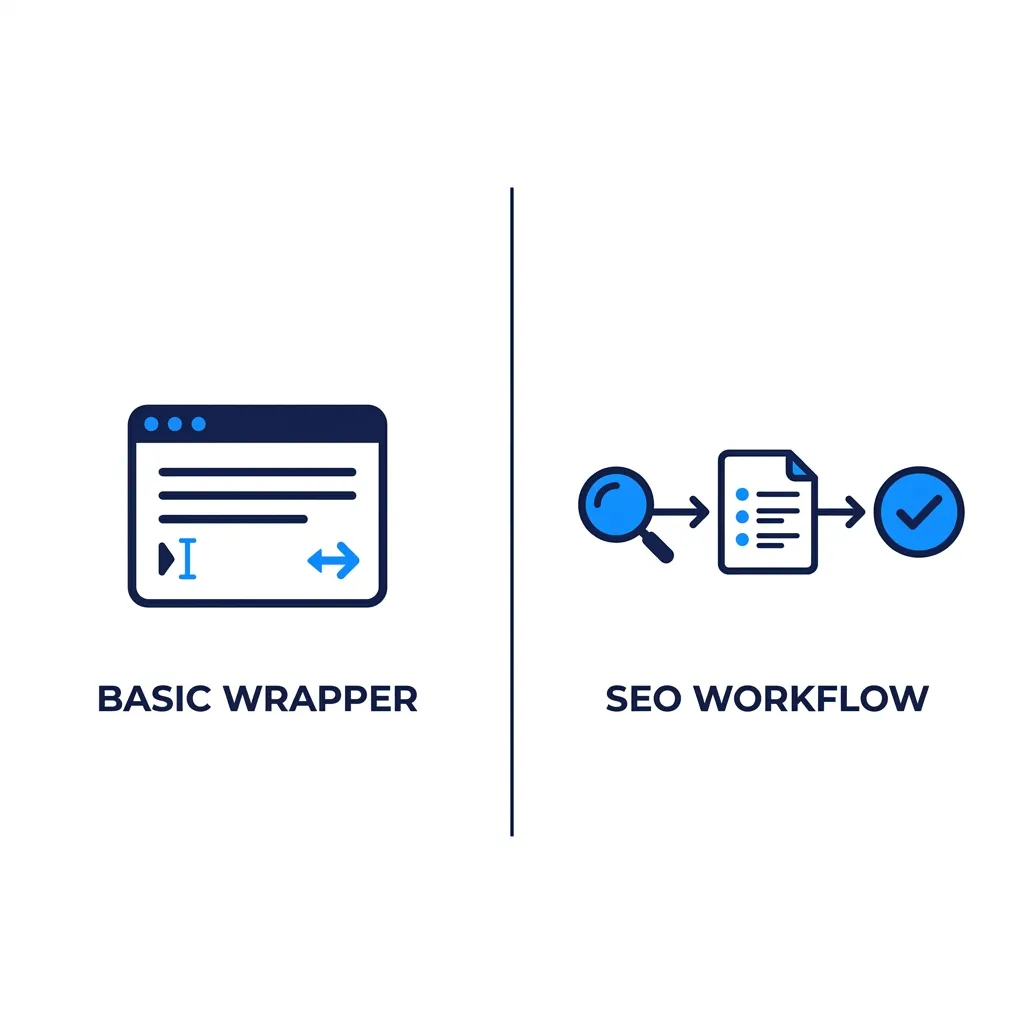
On the wrapper question: An API wrapper is a tool built on top of OpenAI’s GPT or Anthropic’s Claude via a commercial API, with a custom interface layered on top. The model underneath is identical to what you access through ChatGPT or Claude.ai directly. A proprietary or fine-tuned model has been trained or further tuned on domain-specific data, which can produce meaningfully different output for targeted tasks. This distinction matters when you are deciding whether a $49/month subscription adds real value over a $20/month ChatGPT Plus plan.
Evaluation Criteria
| Criterion | What Was Measured |
|---|---|
| Output Quality | Coherence, specificity, and how much the draft followed the brief |
| Tone Customization | Ability to adapt to a defined voice or style, not just a generic register |
| Editing Burden | How much revision the raw output required before it could be published |
| Free Plan Value | Whether the free tier produced enough output to judge quality honestly |
| Pricing | Verified at time of testing — spot-checked against official pricing pages |
| Integrations | CMS connections, SEO tool integrations, team collaboration features |
| Hallucination Risk | Whether the tool fabricated facts, statistics, or citations with confidence |
| Model Type | Proprietary or fine-tuned vs. direct API wrapper |
Tools that did not have a meaningfully differentiated use case, or that appeared primarily in affiliate-heavy roundups without independent review evidence, were excluded.
Best AI Writing Tools for SEO Blog Content and Long-Form Articles
Long-form SEO content is where the gap between a good tool and a rebranded ChatGPT window is most visible. Coherent multi-section structure, keyword integration that reads naturally, and outline generation that reflects actual SERP patterns — these are not features every tool delivers, even if they appear on the marketing page.
For this use case, three tools stood out from the field.
Surfer SEO (with AI Outline and Content Editor)
Surfer is the strongest standalone option for writers who want to stay in control of their content while getting genuine SEO guidance. The AI writing assist is connected directly to the Content Editor, which scores your content in real time against the top-ranking pages for your target keyword. The result is not just a draft — it is a draft built around what actually performs on the SERP.
Output from the SEO long-form test was well-structured, hit the keyword naturally in the intro, and required moderate editing — mostly tightening transitions and adding specificity. It did not hallucinate, but it also did not produce opinion or depth on its own. Think of it as a strong starting skeleton, not a finished draft.
Pricing starts around $89/month. No meaningful free tier — the trial is gated enough that you cannot judge output quality without a paid plan.
Surfer SEO — Pros and Cons
Pros:
- Content scores against real SERP data, not keyword density guesses
- Reduces hallucination risk because the AI pulls from SERP context, not general model weights
- Outline generation reflects actual top-ranking article structures
- Strong integration with Google Docs and WordPress
Cons:
- Expensive for solo bloggers at the entry plan
- AI writing quality requires meaningful editing — it builds the frame, not the argument
- Not a complete pipeline — you still need separate tools for keyword research and brief creation
Writesonic (for SEO Articles)
Writesonic offers a dedicated long-form article generator with SEO mode and is one of the more capable API-wrapper tools on this list. It is worth naming plainly: Writesonic runs on GPT-4 at the higher tiers, so the output quality is largely determined by the underlying model. What Writesonic adds is a structured workflow — choose a keyword, generate an outline, expand section by section — which is genuinely useful for writers who do not want to manage prompt engineering manually.
The SEO long-form test output was competent but generic in places. Tone defaulted to a neutral professional register that would need customization for any brand with a distinct voice. Editing burden was medium — the structure was usable, but approximately 30-40% of sentences needed rewording before publication.
Pricing starts at around $19/month (limited words) with a meaningful free tier that actually lets you test output before paying.
Writesonic — Pros and Cons
Pros:
- Genuinely functional free tier — enough output to evaluate quality honestly
- Structured workflow reduces the need for prompt engineering
- Good option for teams moving from ChatGPT to a more organized writing process
- Competitive pricing at entry level
Cons:
- API wrapper — output quality ceiling is GPT-4, same as ChatGPT Plus
- Tone customization is limited; brand voice adaptation requires significant prompting
- Generic output at default settings — editing burden is real
- SEO features are less data-integrated than Surfer
A Note on Veldora for SEO Content at Volume
Veldora is not a text editor or a prompt-based writing assistant — so it does not belong on the same row as Surfer or Writesonic as a comparable option. What it is: a managed SEO content pipeline that handles keyword research, competitor gap analysis, brief creation, brand-matched drafting, and multi-step QA in a single system.
For a solo blogger writing four articles a month, Surfer SEO is likely the right call. For an SMB or agency producing SEO content at volume — where the bottleneck is not just writing speed but strategy, consistency, and brand voice across dozens of posts — the pipeline model is a different category of solution. Every post is tied to live keyword research and a readable strategy document, not generated from a single prompt.
The free demo produces an actual strategy-backed content piece, not a placeholder. If you are evaluating whether a complete pipeline makes sense for your situation, see what strategy-backed AI writing actually looks like before making any commitment.
Generate a real, strategy-backed post on the free demo and read it yourself — before you spend a dollar. No credit card. No contracts. Just proof.
Also worth noting: how you approach SEO content at the tool level affects long-term organic results, not just immediate output volume. The case for treating content quality as a compounding asset — not just a publishing cadence — is worth reading separately at SEO that compounds.
Best AI Writing Tools for Marketing Copy, Email Outreach, and Ads
Short-form commercial writing is where most AI tools started, and it shows — the gap between tools in this category is narrower than in long-form SEO, but tone control separates the useful from the wasteful. Marketing copy that sounds like it came from a generic AI template is not saving anyone time. It still gets rewritten.
Jasper AI
Jasper is built for marketing copy teams. It handles ad variants, email sequences, and product descriptions well, and its Brand Voice feature is one of the stronger implementations of tone customization in this category. When you train it on sample content, the output adapts noticeably — not perfectly, but enough that copy sounds closer to your established voice on the first pass.
For the short-form ad copy test, Jasper produced three distinct tonal variants with clear differentiation between urgency, curiosity, and social proof framings. Editing burden was low for this use case — maybe 20% of lines needed adjustment. For a long-form 2,000-word SEO article, though, Jasper is not where you want to be. It loses coherence across sections and defaults to marketing register even when instructed otherwise.
Pricing starts around $49/month. No free tier — there is a trial, but it is time-limited rather than output-limited.
Jasper AI — Pros and Cons
Pros:
- Strong Brand Voice feature with real customization depth
- Short-form ad copy and email sequence templates are genuinely well-designed
- Team collaboration features are the best in this category
- Good for agencies managing multiple client voices
Cons:
- Expensive relative to its use case scope — hard to justify without a copy-heavy workflow
- Long-form output loses coherence; not an SEO blog writing tool
- No functional free tier to test quality before paying
- API wrapper at its core — the model is not the differentiator, the templates and brand voice tooling are
Copy.ai
Copy.ai is the strongest free-tier option for short-form marketing copy. The free plan is genuinely functional — not a gated preview — and the template library covers ad copy, cold email, product descriptions, and social captions with enough depth to get real output without upgrading.
Tone customization is less sophisticated than Jasper. Copy.ai defaults to a competent but somewhat generic marketing register, and while you can prompt it toward different styles, it does not retain a trained brand voice the way Jasper does. For individual marketers or small teams without a strict brand voice requirement, this is often not a problem — the output is clean and usable.
For the ad copy test, Copy.ai produced serviceable variants, though the emotional differentiation between urgency and curiosity was less distinct than Jasper’s output. Editing burden was low-to-medium.
Pricing: genuinely free at the base tier, with a Pro plan around $49/month for unlimited runs and advanced features.
Copy.ai — Pros and Cons
Pros:
- Best free tier for short-form copy — enough output to evaluate honestly
- Wide template library covering most short-form commercial writing formats
- Clean, usable output at default settings
- Good for solo marketers and small teams without heavy brand voice requirements
Cons:
- Brand voice customization is limited compared to Jasper
- Tone differentiation between variants can be subtle
- Not built for long-form content — do not try to use it for SEO articles
- API wrapper — no proprietary model differentiation
For teams with established brand standards, tone customization as a decision criterion deserves serious evaluation weight before committing to any short-form copy tool.
Best AI Writing Tools for Social Media, Email Newsletters, and Niche Use Cases
Not every content job needs a $50/month tool. For social media captions, casual newsletters, and niche formats, the honest recommendation is sometimes a simpler — or cheaper — option. That is worth saying plainly rather than padding this section with premium tools that are not the right fit.
Social Media
For caption writing, post ideation, and platform-specific short-form content, ChatGPT (free tier) handles most tasks adequately when prompted with context. The difference between a free prompt and a $20/month social media tool is not significant enough to justify the upgrade for most users. If you need volume and scheduling in one place, Writesonic’s free tier covers basic social formats.
Email Newsletters
Newsletter writing sits between long-form and short-form — it needs editorial voice more than SEO structure. Claude (Anthropic) performs well here. The output tone is notably more natural than GPT-based tools for editorial-style writing, and the longer context window helps maintain coherence across a full newsletter draft. Claude’s free tier is functional enough to test before considering the Pro plan.
Niche Use Cases — Quick Reference
| Tool | Best For | Key Note |
|---|---|---|
| Sudowrite | Fiction and creative writing | Specifically fine-tuned for narrative prose — not an SEO or marketing tool |
| Notion AI | Internal docs, meeting notes, light email | Convenient if you already use Notion; not a content publishing tool |
| Grammarly (with AI features) | Editing and rewriting existing drafts | Better as a revision layer than a content generator |
| Claude (Anthropic) | Editorial newsletters, nuanced tone | Longer context window; strong for voice-heavy content |
| ChatGPT Free | Social captions, quick short-form | Adequate for low-volume casual use; upgrade only if output volume is the constraint |
One thing worth stating clearly: Veldora is not built for social media captions, fiction writing, or casual email newsletters. Its audience is SMBs and agencies doing SEO content at volume. Saying that plainly is more useful than vague positioning.
Full Comparison: All Evaluated AI Writing Tools at a Glance
This table covers every tool evaluated in this guide on the criteria that actually matter for a purchase decision. Pricing reflects verified rates at time of publication — always confirm on the official pricing page before subscribing, as AI tool pricing changes frequently.
Two columns most roundup tables omit: Editing Burden (how much revision raw output typically needs before publication) and Model Type (whether you are paying for a genuinely differentiated system or a GPT wrapper with a subscription markup). Those two columns are the ones that should most influence your shortlist decision.
| Tool | Best Use Case | Starting Price | Functional Free Plan | Model Type | Editing Burden | AI Detection Risk | Notes |
|---|---|---|---|---|---|---|---|
| Surfer SEO | SEO long-form blog content | ~$89/month | No | Proprietary SEO layer + AI | Medium | Medium | SERP-integrated scoring; strong for SEO writers |
| Writesonic | SEO articles, general long-form | ~$19/month | Yes (limited words) | API Wrapper (GPT-4) | Medium | Medium-High | Good workflow structure; tone is generic at defaults |
| Jasper AI | Marketing copy, ad variants, email sequences | ~$49/month | No (trial only) | API Wrapper (GPT-4) | Low (short-form) | Medium | Best Brand Voice tooling in the copy category |
| Copy.ai | Short-form marketing copy, cold email | Free / ~$49/month Pro | Yes (functional) | API Wrapper (GPT-4) | Low-Medium | Medium | Best free tier for short-form; limited brand voice depth |
| Claude (Anthropic) | Newsletters, editorial writing, tone-sensitive content | Free / ~$20/month Pro | Yes (functional) | Proprietary (Anthropic) | Low-Medium | Low | Strongest output for natural, editorial-voice writing |
| ChatGPT (OpenAI) | General-purpose; social, quick drafts | Free / $20/month Plus | Yes (functional) | Proprietary (OpenAI GPT-4o) | Medium-High | Medium | The baseline — most paid tools should be compared against this |
| Sudowrite | Fiction, creative narrative prose | ~$19/month | No (trial) | Fine-tuned (narrative) | Low (for fiction) | Low-Medium | Not relevant for SEO or marketing use cases |
| Notion AI | Internal docs, light email, notes | ~$10/month add-on | No (trial) | API Wrapper | High | Medium | Convenience tool, not a content publishing platform |
| Veldora AI | SEO content at volume — SMBs and agencies | Credit-based, no contracts | Free demo (one strategy post) | Managed pipeline (not a standalone text generator) | Low (with QA layer) | Not applicable | Full pipeline: keyword research through QA; not a ChatGPT substitute |
Pricing verified at time of writing. Confirm current rates at each tool’s official pricing page before subscribing. For Jasper pricing, see Jasper’s official pricing page.
The clearest shortlist signal from this table: if you are paying for an API wrapper tool, compare its output directly against ChatGPT Plus ($20/month) before renewing. The question is whether the templates, workflow structure, or brand voice features justify the markup — for some users they do, for others they do not.
How to Choose the Right AI Writing Tool for Your Situation
Most readers who reach this section have read the reviews, looked at the table, and still feel uncertain. That uncertainty usually comes from treating all the criteria as equally weighted. They are not.
Start with use case. Budget, output quality, and integrations are secondary — if the tool does not match the content type you produce most, none of the other variables matter. Here is how to work through the decision in the right order.
A brief example to ground this: A solo blogger publishing four SEO articles per month and a marketing team producing 20 mixed-format pieces per month are solving very different problems. The solo blogger’s decision should come down to editing burden and whether the tool’s SEO features justify the price over ChatGPT Plus. The marketing team’s decision should weight brand voice consistency, team collaboration, and whether a dedicated pipeline — not just a faster text editor — is warranted.
Decision Framework: Choose Your Tool Step by Step
-
Identify your primary content type.
- SEO blog posts and long-form articles → Start with Surfer SEO or evaluate Veldora if you need volume and strategy built in.
- Marketing copy, ads, email sequences → Start with Copy.ai (free tier) or Jasper if brand voice consistency is a requirement.
- Social media captions, casual newsletters → Use ChatGPT free tier or Claude before paying for anything dedicated.
- Fiction or creative narrative → Sudowrite is the only tool on this list built for that job.
- Internal documentation or meeting notes → Notion AI or ChatGPT; no dedicated tool is justified.
-
Set your budget honestly.
- Free: ChatGPT free tier, Copy.ai free tier, Claude free tier — all functional enough to judge output quality.
- Under $25/month: Writesonic entry plan, Notion AI add-on, Claude Pro — appropriate for solo users and bloggers.
- $49/month and above: Jasper, Surfer SEO — only justified if the specific workflow features they add are saving more than casual prompting would.
-
Assess your editing tolerance.
- If you will heavily revise every draft anyway, a lower-cost tool with higher editing burden is fine — the output is a starting point, not a deliverable.
- If you need near-publishable drafts with minimal rewriting, editing burden becomes a primary criterion. Claude and Jasper (for short-form) have the lowest editing burden in their respective categories.
-
Answer the ChatGPT baseline question directly.
- If you already have ChatGPT Plus ($20/month), a tool running on the same GPT-4 API needs to add something concrete: better templates, a trained brand voice, SERP-integrated scoring, or workflow structure. If it does not, you are paying a UI markup.
- The tools that justify their cost over the ChatGPT baseline: Surfer SEO (SERP data integration), Jasper (Brand Voice and team features), and Veldora (full SEO pipeline with strategy, not just drafting).
-
Check integrations before committing.
- WordPress, Google Docs, Webflow, or your CMS — verify the connection exists before you build a workflow around it.
- SEO tools: Surfer integrates with its own data layer; Writesonic and Jasper connect to Surfer. Veldora handles the SEO research layer internally.
-
Start with the free tier — or the free demo — before paying.
- Every tool with a functional free tier should be tested with your actual content prompt, not the demo prompt provided on the landing page. The difference in output when you test with real context is significant.
- For the full SEO content pipeline that includes keyword research and competitor context: Veldora’s free demo generates a real, strategy-backed post tied to live keyword data. Read it before deciding whether a managed pipeline fits your situation.
- For teams evaluating whether brand voice customization is a differentiator worth paying for: test any tool’s tone output against your existing brand content before upgrading.
See your strategy before you pay. Veldora’s free demo generates an actual SEO content piece tied to live keyword research — not a template, not a placeholder. No credit card. No contracts. No agency markup. Generate a real, strategy-backed post and read it yourself.
FAQ
Is ChatGPT better than paid AI writing tools, or is a subscription a waste of money if I already have ChatGPT Plus?
For general writing tasks, ChatGPT Plus is often sufficient — and if a paid tool is running on the same GPT-4 API underneath, it is hard to justify the markup unless the templates, brand voice features, or workflow structure add something concrete. The exceptions are tools that integrate real SERP data (Surfer SEO), have genuinely trained brand voice systems (Jasper), or operate as a full strategy pipeline rather than a text generator (Veldora). For everything else, test the tool’s output against a well-prompted ChatGPT Plus session first.
Which AI writing tool produces the most human-sounding content?
Claude (Anthropic) consistently produces the most natural-sounding prose in editorial and newsletter contexts, followed by GPT-4o via ChatGPT. Detection risk varies by tool — and the claim that any specific AI tool is “undetectable” should be treated with skepticism. Independent AI detection research shows that detectability depends more on editing and post-processing than on tool choice alone.
Are AI writing tools bad for SEO — will AI-generated content get penalized?
Google’s guidance focuses on content quality and helpfulness, not on how content was produced. Google’s own documentation on AI-generated content states that automatically generated content intended to manipulate rankings is the issue — not AI writing as a production method. High-quality, human-reviewed AI content is not inherently at risk. Generic, unedited AI output that adds no real value is.
What is the best free AI writing tool with no meaningful output limits?
ChatGPT free tier and Copy.ai free tier are the strongest options. Claude’s free plan is also functional for testing output quality. Be aware that all free tiers have some form of rate limiting — the question is whether the limits are high enough to judge quality honestly, and for these three, they are.
How do I know if an AI writing tool is just a ChatGPT wrapper?
Check the tool’s published technology documentation or support pages for the underlying model. If they name OpenAI’s GPT-4 or GPT-4o as the engine, it is an API wrapper. The test is simple: run the same prompt in ChatGPT Plus and in the paid tool and compare output. If the quality is essentially identical, the only value the paid tool adds is workflow — templates, structure, and interface. That may or may not be worth the price depending on your situation.
Which AI writing tool is best for a solo blogger versus a marketing team or agency?
For solo bloggers writing SEO content: Surfer SEO at the entry plan or Writesonic’s paid tier. For marketing teams needing copy volume and brand consistency: Jasper. For agencies or SMBs doing SEO content at scale with strategy built in: Veldora’s pipeline model is built for that scenario specifically. The tool choice scales with the complexity of the content operation, not just the budget.
How much editing does AI-written content typically require before it is publishable?
Expect medium editing burden as a baseline — meaning roughly 25-40% of sentences will need revision for specificity, tone, or accuracy in most tools at default settings. Claude and Jasper (for short-form copy) are closer to the low end. Generic GPT-wrapper tools at default settings are closer to the high end. No current AI tool produces reliably publish-ready content without human review, and any tool marketed as doing so is overpromising.
← Back to all posts