AI Content Writing Services vs. Tools: How to Choose
By Veldora AI · July 4, 2026

AI Content Writing Services vs. AI Writing Tools: Which One Does Your Business Actually Need?
You searched for “AI content writing services” and landed on a ranked list of writing software. Or you signed up for an AI writing tool expecting finished content and discovered you still had to do most of the work yourself.
Both of those experiences point to the same problem: the terms get used interchangeably, but they describe completely different things. One is software you operate. The other is a service that delivers content to you.
This article draws that line clearly, then gives you a practical framework to figure out which one your situation actually calls for.
Key Takeaways
- AI writing tools are self-serve software — you prompt them, edit the output, and publish. AI content writing services deliver finished or near-finished content to you. These are not the same thing.
- Most buyers searching for “AI content writing services” need content delivered to them, not another tool to operate.
- AI-generated content has real failure modes — hallucinations, brand voice drift, generic phrasing — and how a service addresses those determines whether you get usable content or a rough draft disguised as a deliverable.
- Google does not prohibit AI content. It targets thin, unhelpful content regardless of how it was produced. The distinction matters for how you evaluate any service you hire.
- Before committing to any service, there are six specific questions worth asking. A service that cannot answer them clearly is not ready to handle your content program.
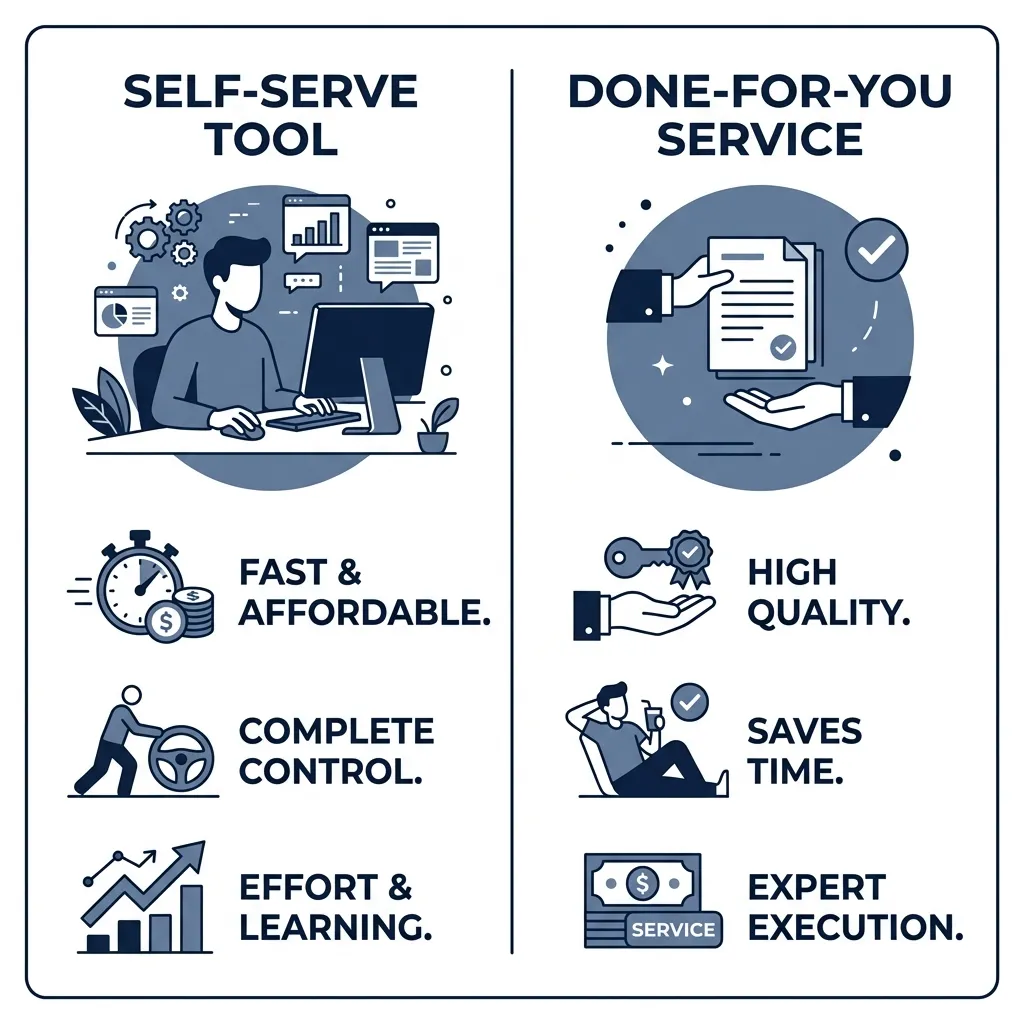
AI Writing Tools vs. AI Content Writing Services: The Distinction That Changes Everything
These two categories get conflated constantly, and the confusion costs buyers real money.
An AI writing tool is software you access directly — Jasper, Writesonic, Copy.ai, ChatGPT. You write the prompt, generate the draft, review it, edit it, fact-check it, and decide what to do with it. The tool does the generating. You do the work.
An AI content writing service is a managed or done-for-you arrangement. You submit a brief — topic, keywords, audience, tone. The service handles strategy, writing, and quality review, then delivers a finished or near-finished piece. You receive output. The service does the work.
The table below makes the operational difference hard to miss:
| AI Writing Tool | AI Content Writing Service | |
|---|---|---|
| What it is | Self-serve software you operate | Done-for-you content delivery |
| Who does the work | You | The service |
| Output ownership | Raw draft you edit | Publish-ready or near-ready content |
| Strategy included | Rarely | Usually |
| QA layer | None | Human review step |
| Cost model | Monthly subscription | Per piece, per word, or retainer |
| Best for | In-house teams with editing capacity | Businesses without a content department |
The wrong-purchase scenario plays out like this: a founder buys a Jasper subscription expecting finished blog posts. They discover they need to write detailed prompts, evaluate outputs, edit for accuracy, check facts, and adjust tone on every draft. Two months later, the subscription is unused. The tool was not the problem — the mismatch was.
A tool is the right answer when you have an in-house team with real editing capacity, low content volume, and a tight budget. A managed service makes sense when you need consistent output, you do not have an internal content function, or the quality threshold is high enough that a raw AI draft is not the starting point you want.
The distinction is not a minor semantic issue. It determines whether what you buy actually solves your problem.
How Managed AI Content Writing Services Actually Work
Buyers who have not used a managed AI content service often picture it as a black box: you pay, content appears. The reality involves a specific sequence of steps, and understanding that sequence tells you what you are actually purchasing.
A typical full-service workflow looks like this:
- Brief intake. You provide the topic, target keywords, audience, tone reference, and any factual constraints. The service may supplement this with keyword research and competitor analysis — or that may be a separate input you provide.
- Strategy and structure. The service determines the angle, outline, and semantic structure before writing begins. This is the step that separates a strategy-backed piece from a raw AI dump.
- AI draft generation. The draft is generated against the strategy brief — not as a freeform prompt, but against a structured content plan.
- Human QA and editing. A human reviewer checks the draft for brand voice alignment, factual consistency, structural quality, keyword integration, and readability. This step is not proofreading — it is substantive review.
- Delivery. The reviewed piece is delivered in your preferred format — ready to publish with light review, not requiring a rewrite.
What the human editing layer should actually check: off-brand language or tone drift, unsupported factual claims, keyword stuffing artifacts, structural gaps, and sections that are technically correct but add no useful information.
For a concrete example of what a documented QA process looks like in practice, Veldora’s multi-step content QA covers the specific checks the pipeline runs on every piece — brand voice, structure, and factual consistency — before delivery.
What you must provide to get usable output: a clear brief. The quality of a managed service’s output depends heavily on the inputs. Topic, target audience, keywords, tone reference, and any accuracy-critical facts the AI cannot be expected to know. Garbage in, garbage out applies even with a full-service wrapper.
Services also vary by tier:
- AI-only output — fastest, lowest cost, most editing required on your end. Useful if you have strong internal editors.
- AI-plus-human hybrid — the dominant managed model. AI generates, human reviews and refines. Near-publish-ready output.
- Human-only writing — slowest, most expensive, highest ceiling for specialized accuracy. Relevant for high-stakes content where no AI involvement is acceptable.
Understanding which tier a service operates in is the first question worth asking — not as a judgment, but because each tier implies a different editing burden on your side.
AI Content Quality Risks: What Can Go Wrong and What Services Do About It
AI-generated content has specific failure modes. Any service that does not acknowledge them is either not paying attention or hoping you will not ask.
The four you should know about:
1. Hallucinations and factual errors. AI models generate plausible-sounding text — including statistics, citations, and source references that do not exist. This is not a rare edge case; it is a documented characteristic of large language models. A draft that cites a study with a plausible-sounding journal name may be citing something that was never published. Fact-checking is not optional in any QA process that takes accuracy seriously.
2. Repetitive or generic phrasing. AI drafts tend toward the median — sentences that are technically correct but say nothing specific. “Content marketing is important for businesses today” is the kind of sentence no human editor would leave standing, but AI produces it constantly. A good editing layer removes this, but only if the reviewer is actually reading for substance, not just grammar.
3. Brand voice drift. An AI draft written in a neutral, corporate register for a brand whose voice is casual and direct produces content that sounds like someone else wrote it — because, in a meaningful sense, no one did. Brand voice alignment is a specific QA step, not a byproduct of generating text.
4. Predictable surface structure. AI tends to produce content with the same scaffolding: three-point intro, transition sentences that begin with “Furthermore,” conclusions that summarize what was just said. It is structurally complete and editorially thin. A service that does not catch this pattern delivers content that reads like AI regardless of whether it technically passes detection.
What Google Actually Says About AI Content
Google’s helpful content guidelines do not prohibit AI-generated content. The guidance targets content made to satisfy a search engine rather than a human reader — thin articles that exist to capture a keyword rather than answer a question, mass-produced content with no original perspective, and pages that demonstrate no real expertise on the topic they cover.
AI content is not inherently in violation of those guidelines. AI content that is accurate, specific, and genuinely useful for the reader it is written for is not the target. What is penalized is the pattern: bulk-generated, lightly edited, interchangeable articles that treat topics as keyword slots rather than questions worth answering.
For buyers, this means the risk is not “AI content will hurt my rankings.” The risk is “low-quality content with no editorial care will hurt my rankings” — and that risk exists whether the content was written by an AI, a low-cost freelancer, or an agency billing by volume. The production method is secondary to whether the content is actually useful. For more on how well-built content accumulates search value over time versus thin content that does not, this piece on content that compounds in search is worth reading alongside the quality risk framing here.
How to Choose: Tool, Hybrid Service, or Fully Managed AI Content Service
There is no universally right answer here, but the right answer for your situation is usually not hard to identify once you map the decision to four variables: volume, internal capacity, content type, and budget.
Volume and internal capacity. If you produce five or fewer pieces of content per month and have a competent in-house editor, a self-serve AI tool is a reasonable option. The editing burden is manageable, and the cost savings over a managed service are real. If you need consistent output — weekly or higher cadence — and do not have a dedicated editor, a managed service removes the bottleneck you would otherwise create.
Content type and quality threshold. Commodity content tolerates more AI involvement with lighter human review: basic informational blog posts, product descriptions for standard categories, FAQ pages. High-trust or specialized content — medical, legal, financial, or technical B2B — requires substantially more human involvement, both in reviewing factual claims and in applying domain expertise the AI cannot reliably supply. If your content falls into a high-stakes category, be explicit with any service about what accuracy standards apply and ask how they handle it.
Budget and cost model. AI-only services cost less; hybrid and full-service models cost more because human review time is built into the price. The honest framing: a lower per-piece cost that requires you to do significant editing is not actually cheaper — your time has a cost. The question is whether your time and editorial capacity are worth more than the delta between a cheap tool and a managed service.
The hybrid middle ground. Buyers with some editing capacity but uneven bandwidth are often best served by a hybrid service — one that delivers near-finished content requiring light review rather than a rough draft requiring substantive rewriting. This is the model most buyers asking this question actually need, though few services describe it that clearly.
| Your Situation | Best Fit |
|---|---|
| High content volume, no internal editors | Managed AI content service |
| Low volume, strong in-house editing capacity | Self-serve AI writing tool |
| Mid-volume, some editing capacity | Hybrid AI service with light human review |
| High-trust or technical content (medical, legal, finance) | Human writer or heavily edited hybrid service |
| Budget is primary constraint, speed matters | AI writing tool (with realistic quality expectations) |
| Want strategy included, not just drafts | Managed AI content service |
What to Look for When Evaluating an AI Content Writing Service
Once you have decided that a managed service fits your situation, the next question is how to tell a real one from a rebranded AI tool with a support ticket system.
Quality control process. Ask what the human editing layer specifically checks — not whether one exists. “We have expert editors” is not an answer. “Our editors check for brand voice alignment, factual consistency, keyword integration, and structural quality before delivery” is an answer. Veldora’s strategy-backed writing process is an example of what a documented, step-by-step production pipeline looks like — keyword research and competitor analysis inform the strategy, and QA reviews against that strategy before anything is delivered.
Pricing transparency. You should not need a sales call to understand the cost model. Look for services that publish pricing tiers, explain what each tier includes, and make per-piece or subscription costs findable without a demo request. Opacity in pricing is often opacity in process.
SEO integration. There is a meaningful difference between a service that delivers raw text and one that handles keyword research, structural optimization, heading hierarchy, and internal linking guidance. The value equation changes significantly depending on which one you are buying. Ask explicitly.
Sample content availability. Any credible service should be able to show you real output before you commit — a portfolio, a sample request, or a zero-commitment demo that produces actual content for your review. A service that requires a contract before showing you what it produces is asking you to buy blind.
Content type and vertical coverage. Not every service handles every format or topic area equally well. Ask whether they support the specific formats you need — long-form editorial, product pages, landing pages — and be direct about any specialized or technical subject matter.
Here is the evaluation checklist in portable form:
- What does your QA process check for — brand voice, factual accuracy, structure, or all three?
- Do you provide sample content before I commit?
- Is turnaround time guaranteed, and what is the SLA per content type?
- Are pricing and inclusions transparent upfront, or do I need to contact sales?
- Do you handle keyword integration and SEO structure, or just raw text?
- How do you handle specialized or technical topics where accuracy matters?
A service that cannot answer these clearly is not ready to be trusted with a content program.
If you want to see what proof-before-payment looks like in practice: Veldora’s free demo generates a real, strategy-backed content piece based on your topic — no credit card, no contract. You read the actual output and decide whether the quality meets your bar before spending anything. That is what evaluating a content service should feel like.
Generate a real, strategy-backed post on the free demo and read it yourself — before you spend a dollar. No credit card. No contracts. Just proof.
Frequently Asked Questions About AI Content Writing Services
Is AI-generated content against Google’s guidelines?
No. Google’s helpful content guidelines do not prohibit AI-generated content. What they target is content made primarily for search engines rather than people — thin, generic, or mass-produced articles that exist to capture keywords rather than answer questions. AI content that is accurate, specific, and written with a real reader in mind is not what those guidelines penalize. The production method is less important than whether the content is genuinely useful. Buyers should be skeptical of any service that claims its content is automatically “Google-safe” — that framing misrepresents what the guidelines say.
What is the difference between an AI writing tool and an AI content writing service?
An AI writing tool is self-serve software you operate — you prompt it, review the draft, edit it, and publish. An AI content writing service is a managed arrangement where the service handles strategy, writing, and quality review, then delivers finished or near-finished content to you. The operational difference is who does the work. With a tool, you do. With a service, they do.
How much do AI content writing services cost?
Costs vary significantly by service tier. AI-only services with minimal human involvement tend to be the lowest-cost option, though they typically require more editing on the buyer’s end. Hybrid AI-plus-human services cost more because human review time is built in. Full-service models with strategy, writing, QA, and SEO integration sit at the higher end. The honest framing is that per-piece cost alone does not capture the real cost — a cheap service that requires significant editing is not cheaper than a more expensive service that delivers near-publish-ready content. What matters is total time-plus-dollar cost to get a usable piece.
Will I still need to edit content from an AI writing service?
A good managed service delivers near-publish-ready content that requires light review, not heavy rewriting. But zero review is not realistic, and any service that implies otherwise is either not thinking clearly about accuracy or not being straight with you. You should read what you publish — both to catch anything the QA layer missed and because you are ultimately responsible for what appears under your name. The goal is to eliminate the burden of heavy editing, not the expectation of any review at all.
Can AI content services handle technical or specialized topics?
General business, marketing, and informational content is well within reach for most managed AI content services. Highly specialized or high-stakes content — medical, legal, financial, or technical B2B topics where accuracy is non-negotiable — requires more human involvement, and the AI’s limitations in these areas are real. If your content falls into a specialized category, ask the service directly how they handle it, what their fact-checking process looks like, and whether they have subject-matter familiarity in your vertical. A vague answer is a meaningful signal.
Is a managed AI content service worth the cost compared to using ChatGPT myself?
ChatGPT is free and capable. The honest comparison: using it yourself means you are providing the strategy, writing the prompts, evaluating the drafts, editing for accuracy and brand voice, and doing your own QA on every piece. A managed service removes those steps. Whether that is worth the cost depends on whether your time and editorial capacity are worth more than the service fee. For businesses that have a genuine content program — consistent cadence, SEO intent, quality threshold — the math usually favors managed delivery. For someone producing one blog post a month with strong writing instincts, ChatGPT plus careful editing is a reasonable approach.
The Decision Is Simpler Than It Looks
The tool-versus-service distinction is where most buyers go wrong. They search for help with content, land on a tool comparison, buy a subscription, and discover they have added work to their plate rather than removed it.
If you have a content program to run and do not have an internal team to run it, you need a service — not more software. The evaluation criteria above apply to any service you consider. What separates a real managed service from a rebranded AI tool is process specificity: what the workflow does at each step, what the QA layer checks, and what you can verify before you spend anything.
Veldora runs the full pipeline — strategy, keyword research, AI draft, multi-step QA, and delivery — without putting you in the editor’s chair for every piece. Built from 12 years inside SEO agencies, the process is designed around the failure modes that make most AI content programs fall apart: no strategy, no QA, no accountability for what gets published.
The best way to evaluate it is to see it.
Generate a real, strategy-backed post on the free demo and read it yourself — before you spend a dollar. No credit card. No contracts. Just proof.
← Back to all posts